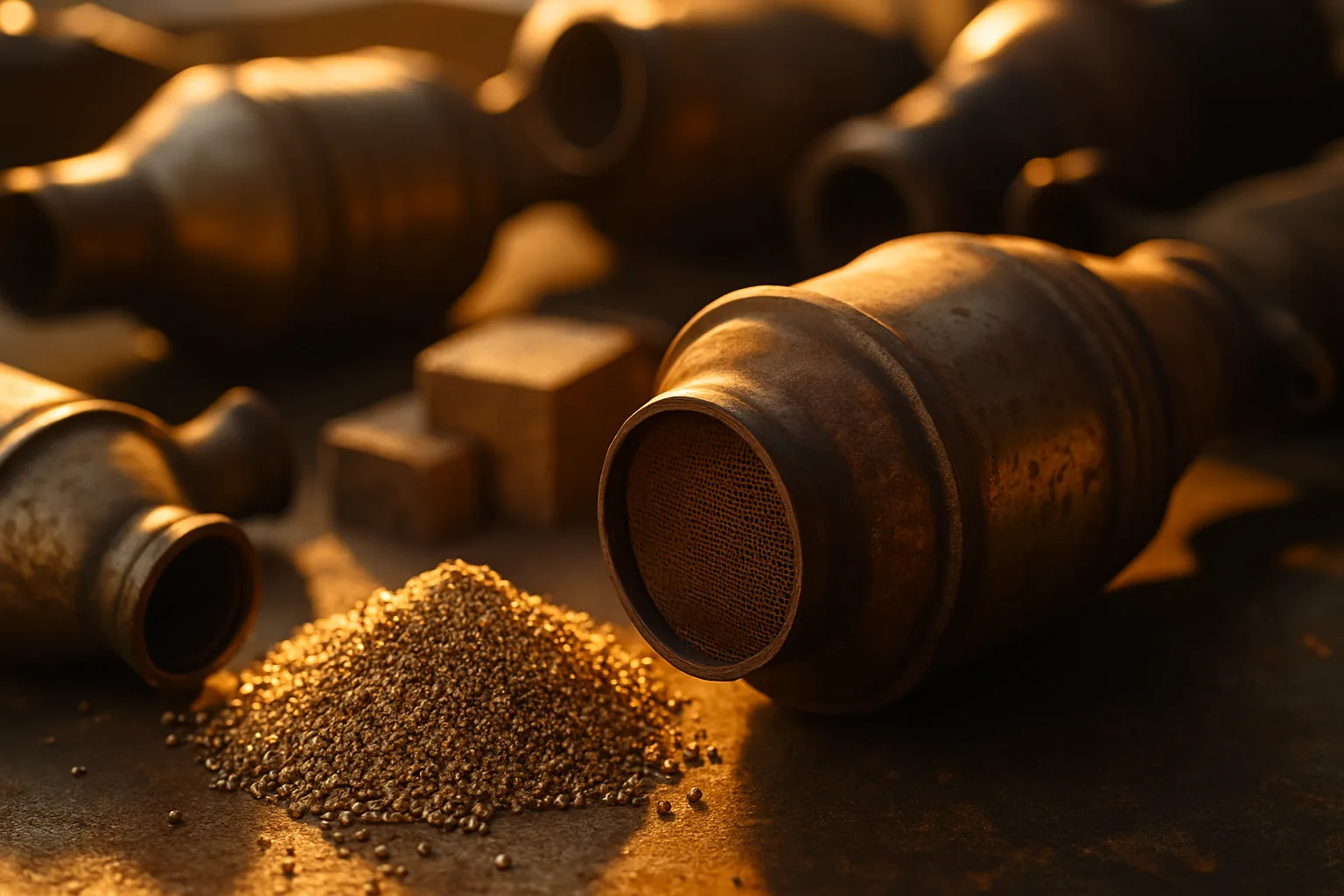
What's Actually Inside a Catalytic Converter — and Why Buyers Care So Much
Most people know catalytic converters are worth money. Few know why. If you're sitting on a used cat and trying to figure out what it's worth, the answer starts with three metals you can't see — and a market that moves every single week. Knowing what's inside changes how you negotiate, who you sell to, and how much you walk away with.
This week's market recap digs into the precious metals that drive catalytic converter scrap value, what's been happening in the PGM markets through mid-July 2026, and why sellers in Tacoma and across Washington state are leaving real money on the table by calling just one buyer.
The Three Precious Metals Inside Every Catalytic Converter
Catalytic converters contain a ceramic or metallic substrate coated with a wash of platinum group metals — PGMs. These are the metals that make the converter function, and they're the same metals that make it valuable at end of life. There are three you need to know.
Platinum (Pt) is the workhorse. It handles oxidation reactions, converting carbon monoxide and unburned hydrocarbons into CO₂ and water. Platinum has historically been the dominant PGM in diesel converters. Its price is sensitive to European auto production volumes and industrial demand from fuel cell research.
Palladium (Pd) became the star metal through the late 2010s and early 2020s. Gasoline engines favor palladium. At its peak it outpaced platinum significantly in price per troy ounce, and while the gap has narrowed as of mid-2026, palladium still commands strong value in high-volume gasoline converter cores.
Rhodium (Rh) is the wild card. Rhodium handles nitrogen oxide reduction — it's critical for emissions compliance. It also trades in the thinnest market of the three, which means its price swings hard. When rhodium is high, some converter grades see dramatic value spikes. When it corrects, those same grades drop fast. It's the metal that keeps scrap buyers and sellers both nervous.
The combination of all three — loaded in different ratios depending on converter type, vehicle make, and emissions standard — is what determines your catalytic converter price. No two converter grades are identical, and that's exactly why a VIN lookup or serial number check matters before you accept any offer.
How PGM Markets Moved This Week
As of the week of July 12, 2026, PGM markets have been showing mixed signals. Platinum has held relatively steady, supported by continued hydrogen fuel cell development demand and tightening South African mining output. Palladium has seen modest pressure as EV adoption in North America continues to grow — fewer gasoline engines in the pipeline means long-term demand questions linger, though near-term recycling supply remains tight. Rhodium remains the most volatile of the three, as it almost always does.
What this means practically: scrap metal prices today for converters are still strong enough to reward sellers who shop their loads properly. A batch of high-grade domestic cats from a late-model gasoline fleet will hit differently than a pile of aged foreign units or stripped shells. The spread between a low offer and a competitive offer on the same load can be significant — and that spread is where uninformed sellers lose money every week.
If you want to check current scrap converter prices before you commit to any buyer, that's always the right first move. Price discovery isn't just for big yards. It matters at every volume level.
Why Converter Grade Identification Is the Skill Most Sellers Skip
Here's where most sellers in Tacoma, and across Washington generally, give up margin without realizing it. A buyer quotes a number. It sounds reasonable. The seller says yes. Deal done — and often the seller had no idea whether that number was fair, low, or embarrassingly low.
Converter grade is determined by several factors:
- Vehicle type: Domestic vs. foreign, gas vs. diesel
- Engine size: Larger engines often carry more PGM loading
- Model year: Tighter emissions standards in recent model years often mean higher PGM content
- Converter position: Pre-cat (direct-fit, close-coupled) vs. rear cat — pre-cats typically carry more precious metal
- Condition: Intact substrate vs. cracked, burned, or rattling units grade out differently
- Serial number: Many high-value converters have identifiable part numbers that map to known PGM assay data
Serial number and VIN lookup tools exist for exactly this reason. Platforms like SMASH use built-in serial tracking and photo documentation so every unit in a load is identified before it goes to auction — not after. That documentation gives buyers more confidence to bid aggressively, and more buyer confidence means better scrap converter prices for the seller. If you want to understand the mechanics behind this, read scrap converter pricing guides that break down how grading affects value.
Why Tacoma Sellers Benefit from Competitive Auctions — Not Single Buyer Calls
If you're a catalytic converter buyer Tacoma area seller — meaning you're a yard, auto recycler, or fleet operator looking to move converter inventory — the single-call method is the most expensive habit in the business. One buyer, one offer, no competition. That buyer knows you have no benchmark. The offer reflects that.
The alternative is straightforward: get your load in front of multiple vetted buyers simultaneously. When buyers compete, the price discovery process actually works. You find out what the market will actually pay — not what one buyer decides to tell you the market pays.
This is the core of what find the best price for your scrap on SMASH is built around. SMASH runs a vetted buyer network through a competitive auction format. No subscription fees. Inventory documentation built in. Auto-invoicing once a load clears. The platform only wins when the seller wins — that alignment matters.
Yards in Washington running catalytic converter recycling Tacoma operations can access buyers across North America, not just whoever happens to be in the area code. That reach changes your price floor. Local buyers are fine — but local buyers competing against regional and national buyers is better.
How to Estimate What Your Converter Load Is Worth
If you've ever searched how much is my catalytic converter worth calculator, you know these tools exist — and they vary widely in accuracy. Here's the honest framework for thinking about converter value:
- Identify your units. Sort by type: domestic, foreign, pre-cat, diesel. Each category prices differently.
- Look up serial numbers where possible. High-value units like large pre-cats, certain Toyota, Honda, and GM converters, have known assay data attached to identifiable part numbers.
- Check live PGM spot prices. Platinum, palladium, and rhodium move daily. An offer that was fair last week may be low this week if rhodium has jumped.
- Factor in the refinery process fee. Buyers who process through a refinery quote net of processing and assay costs. Understanding that structure helps you compare offers apples-to-apples.
- Get more than one offer. This isn't optional if you want to know what your load is actually worth. One offer is a guess. Multiple offers is a market.
For Tacoma-area sellers specifically, Tacoma scrap metal services can walk you through the local process and connect you with buyers active in your region. And when you're ready to benchmark any offer you receive, find the best scrap converter prices today before you commit to anything.
Disclaimer: Catalytic converter prices fluctuate daily based on platinum, palladium, and rhodium spot markets. All pricing information in this article reflects general market context as of July 2026. Always check current rates before selling.
The Bottom Line for This Week's Market
PGMs are still worth chasing. The value inside your used catalytic converters — platinum, palladium, rhodium — hasn't disappeared. What kills seller returns isn't a bad market. It's bad information and no competition. Sellers who document their loads, identify their grades, and put inventory in front of multiple buyers consistently outperform those who don't.
If you're in Tacoma, across Washington, or anywhere in North America moving converter inventory, the process is the same: know what you have, know what the metals are worth today, and create competition among buyers. Platforms like SMASH exist to make that last step simple — no cold calls, no guessing, no single-buyer dependency.
If you're ready to stop guessing at your converter value and start finding out what buyers will actually pay, get a free quote at best-scrap-converter-prices.com. It's a straightforward first step toward selling smarter — and it costs you nothing to find out where you stand.
Frequently Asked Questions
Q: How do I find a reliable catalytic converter buyer in Tacoma?
Look for buyers who will identify your units by serial number or VIN before quoting — not after. Reliable buyers document what they're buying. Better yet, use a platform that puts your load in front of multiple vetted buyers simultaneously so you have real price discovery rather than a single take-it-or-leave-it offer.
Q: What precious metals are inside a catalytic converter?
All catalytic converters contain some combination of platinum, palladium, and rhodium — collectively called platinum group metals or PGMs. The exact ratio varies by vehicle type, engine size, model year, and emissions standard. These three metals are what give your converter its scrap value, and their daily spot prices directly affect what buyers will pay.
Q: How much is a catalytic converter worth in Tacoma right now?
That depends on the grade, condition, and current PGM spot prices — all of which change regularly. A high-grade domestic pre-cat from a late-model gasoline truck is worth far more than a stripped or cracked foreign unit. The only way to know for certain is to identify your specific converters and get competitive offers. Check current rates at best-scrap-converter-prices.com before accepting any quote.
Q: Does condition affect catalytic converter scrap value?
Yes, significantly. Intact substrate with no rattling, cracking, or burn damage grades out higher than damaged units. Buyers assay the ceramic substrate — if it's broken up or contaminated, the recoverable PGM content drops. Photo documentation and honest grading upfront prevents disputes and helps buyers bid with confidence.
Q: Are catalytic converter buyers near me offering fair prices?
The only way to know is to compare. A local buyer may be offering a fair price — or they may be offering what they know you'll accept with no benchmark. Getting your load in front of catalytic converter buyers near me through a competitive process, rather than calling one yard, is the fastest way to find out where fair actually sits for your specific inventory.
Stay current on PGM markets and scrap pricing — follow SMASH on LinkedIn at linkedin.com/company/scrap-metal-auction-sales-hub for weekly industry updates and converter market insights.
```