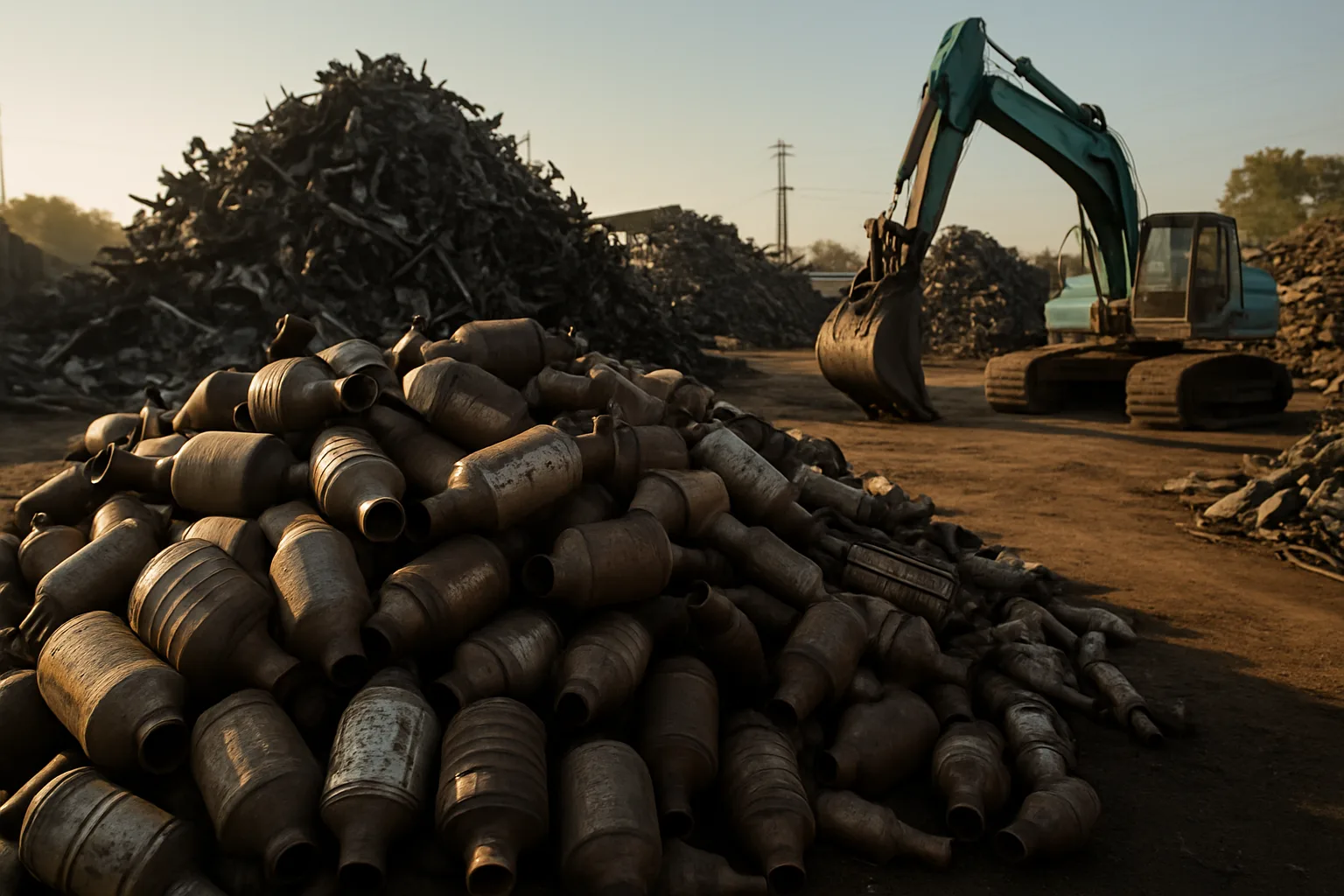
From Exhaust Pipe to Precious Metal: What Actually Happens to Your Catalytic Converter
Most people know their catalytic converter has value. Few know why — or what happens to it after it leaves the vehicle. That gap in knowledge costs sellers real money. If you're sitting on a used cat in Los Angeles and you don't understand what drives catalytic converter prices today, you're negotiating blind.
This week's market recap breaks down the full lifecycle of a catalytic converter — from the moment it bolts onto an exhaust system to the point where its platinum, palladium, and rhodium get recovered and re-enter the global supply chain. Understanding that journey changes how you think about scrap converter value, who you sell to, and how to get paid fairly.
What's Actually Inside a Catalytic Converter (And Why It Matters for Pricing)
A catalytic converter does one job: it turns harmful exhaust gases into less harmful ones. It does that using a ceramic or metallic honeycomb substrate coated with platinum group metals — specifically platinum, palladium, and rhodium. These aren't trace amounts. Depending on the vehicle, a single converter can contain anywhere from a few grams to well over ten grams of PGMs combined.
Rhodium is the wildcard. It's rarer than gold, produced almost entirely as a byproduct of platinum and palladium mining, and its price can swing dramatically based on global supply shifts. Palladium has historically driven value in gasoline-engine converters. Platinum tends to dominate diesel applications. The exact mix — and the ratios — varies by manufacturer, engine size, emissions standard, and model year.
This is why scrap converter value isn't one flat number. A converter off a late-model Toyota Prius doesn't price the same as one off a Ford F-250 diesel. Buyers who can identify the serial number, cross-reference it against assay data, and verify the unit is intact will pay more — because they know exactly what they're buying. That's also why tools that let you look up how much is my catalytic converter worth by serial number free have become so widely used. The serial number is the starting point for honest pricing.
Step One — Removal and Initial Sorting
The lifecycle starts when the converter comes off the vehicle. This happens in a few ways: routine replacement at a shop, end-of-life vehicle processing at a dismantler, or recovery from a totaled or crushed unit at a salvage yard. In high-volume markets like Los Angeles, where vehicle turnover is constant and the fleet is enormous, yards see a steady flow of used converters every week.
Not all removal is equal. A clean cut with the unit intact preserves value. Damaged substrates — cracked, hollow, or contaminated honeycomb — reduce the recoverable PGM content and therefore the scrap converter price. This is why experienced buyers ask for photos before quoting. Condition matters, and documentation protects both sides of the transaction.
Once removed, converters get sorted. OEM units from original equipment manufacturers typically carry more PGM loading than aftermarket replacements. DPF units (diesel particulate filters) are processed separately. Large foreign units from heavy equipment or trucks often yield more recoverable material than their smaller counterparts. Before any converter moves to a processor, this sorting step defines what the load is actually worth.
The Middle Stage — Grading, Quoting, and the Auction Advantage
Here's where most sellers lose money. The traditional model goes like this: you call one buyer, they give you a number, you take it or leave it. You have no idea if that number is fair. You have no leverage. You have no competing offer to push back with.
That's the old way. It's still how a lot of scrap moves in this industry — and it's the reason platforms built around competition exist.
When you run a load through a catalytic converter auction format, multiple vetted buyers see the same inventory at the same time. They're not guessing. You're not guessing. The serial numbers are logged. Photos are attached. The substrate condition is documented. Buyers bid on what they can actually see. More buyers competing for the same load means better price discovery — not a guaranteed higher price, but a market price determined by real competition rather than a single phone call.
Platforms like the SMASH scrap metal auction marketplace are built around exactly this model. Sellers list their converters with documentation — serial numbers, photos, unit counts — and vetted buyers compete. The auto-invoicing handles the back end. No subscription fee. SMASH only wins when the seller does. If you're in Los Angeles and selling volume, that structure changes your business. To find the best scrap converter prices today, competition is the mechanism — not luck or relationships.
The scrap catalytic converter price by model isn't fixed. It moves with PGM spot prices and with what buyers in the market are willing to pay at a given moment. A competitive auction format captures that real-time value. A single buyer quote freezes it at whatever that buyer chooses to offer.
Step Two — Decanning and Substrate Processing
After a converter sells, it moves to a processor. The first step is decanning — physically removing the ceramic or metallic substrate from the outer shell. The shell (the "can") is steel and goes to ferrous scrap. The substrate is where the PGMs live.
Substrates get processed one of two ways: sampling and smelting. In sampling, a representative portion of the batch is assayed to determine PGM content, and the return is calculated based on that sample across the full lot. In smelting, the entire batch is processed and the actual recovered metal is measured. Each method has its own trade-offs around accuracy, timing, and settlement terms.
Large processors handle these runs at scale — sometimes thousands of units per batch. The economics of PGM recovery favor volume. This is why buyers who aggregate inventory from multiple sellers can often offer better terms: they're bringing more material to the processor and negotiating from a stronger position. It's also why individual sellers benefit from platforms that pool their access to serious, high-volume buyers — rather than selling one unit at a time to whoever picks up the phone.
For California-based sellers, proximity to processing infrastructure in the western US can affect logistics costs and settlement timelines. It's worth asking any buyer how they process material and what their settlement window looks like. Those details affect your real return, not just the quoted price per unit.
Precious Metal Recovery and Market Pricing
After processing, the recovered platinum, palladium, and rhodium re-enter the market. They go back into new catalytic converter production, electronics manufacturing, jewelry, and industrial applications. The supply loop closes. What started as an exhaust component ends as raw material for the next generation of products.
PGM spot prices — particularly palladium and rhodium — are set on global commodity markets and tracked daily. Catalytic converter prices today are directly tied to those spot prices. When palladium spikes, converter values climb. When rhodium pulls back, the high-value units that were commanding premium prices adjust accordingly. This is a commodity market, and it moves.
This is also why checking current rates matters. A price you were quoted six months ago — or even last week — may not reflect today's market. To check current scrap converter prices, you need access to buyers who are pricing against live PGM data, not working off a stale price sheet.
For sellers managing ongoing volume — yards processing multiple vehicles per week in Los Angeles or anywhere across California — tracking that market movement is part of the job. Timing a sale when PGM prices are favorable adds up. Having buyers who price transparently against spot data gives you the visibility to make that call. SMASH connects sellers to buyers who work that way.
What This Means for Los Angeles Sellers Right Now
Los Angeles runs a lot of vehicles. The vehicle density here, combined with the age of a significant portion of the fleet, means converters come off cars constantly — through repairs, accidents, end-of-life processing, and theft recovery. Los Angeles scrap metal services handle substantial converter volume, and that volume creates both opportunity and noise in the local market.
Opportunity: there are serious, active catalytic converter buyers California has to offer, and competition among them is real. If you're reaching the right buyers, you're in a market that can deliver fair prices based on actual PGM content.
Noise: not every buyer in a high-volume market is pricing transparently. Some quote flat rates that don't move with the market. Some won't disclose how they're calculating value by serial number. If you don't know what your unit is worth going in, you can't push back.
The answer is documentation and competition. Know your serial numbers. Photograph your units. Bring your inventory to a platform where multiple buyers compete openly. If you're ready to start, read scrap converter pricing guides to build your baseline knowledge before you list a single unit. And if you're ready to sell with competition working in your favor, SMASH is where that happens.
Prices fluctuate daily based on PGM spot markets. Always verify current rates before finalizing any sale.
Frequently Asked Questions
Q: What determines catalytic converter prices today?
Catalytic converter prices are driven by the current spot prices of platinum, palladium, and rhodium — the precious metals embedded in the converter's substrate. The make, model, and condition of the unit also affect value. A converter from a late-model hybrid will price very differently than a generic aftermarket unit off a compact car.
Q: How do I find out how much my catalytic converter is worth by serial number for free?
Most serious buyers and platforms can cross-reference a serial number against assay databases to estimate PGM content. The serial number is stamped or etched on the converter body. Submit it along with clear photos to a buyer or platform like SMASH to get a quote based on actual data rather than a flat-rate guess.
Q: What is the best catalytic converter price I can get in Los Angeles?
The best price in Los Angeles — or anywhere — comes from competition. Getting quotes from multiple vetted buyers simultaneously gives you real price discovery rather than accepting whatever a single buyer offers. Documented inventory with serial numbers and photos consistently attracts stronger offers because buyers can price with confidence.
Q: How does a catalytic converter auction work for sellers?
In a converter auction, you list your inventory with documentation — serial numbers, photos, unit condition — and multiple vetted buyers submit competing bids. The seller sees all offers and can accept the strongest one. Platforms like SMASH handle the process including auto-invoicing, with no subscription fee to the seller.
Q: Are scrap catalytic converter prices the same across California?
The underlying PGM-based value is the same statewide — it's tied to global commodity markets, not geography. However, local logistics, buyer relationships, and competition levels can affect what you're actually offered in practice. In high-volume markets like Los Angeles, active competition among buyers can lead to sharper, more accurate pricing for sellers who know how to reach those buyers.
If you've made it this far, you understand what your converter is actually worth — and why the process you use to sell it matters as much as the unit itself. Start with the right information, document your inventory, and bring it to a market where buyers compete. That's how you capture real value. Find the best scrap converter prices today and get a free quote at best-scrap-converter-prices.com.
Follow SMASH on LinkedIn for weekly market insights, PGM price updates, and scrap industry news: follow SMASH on LinkedIn.
```