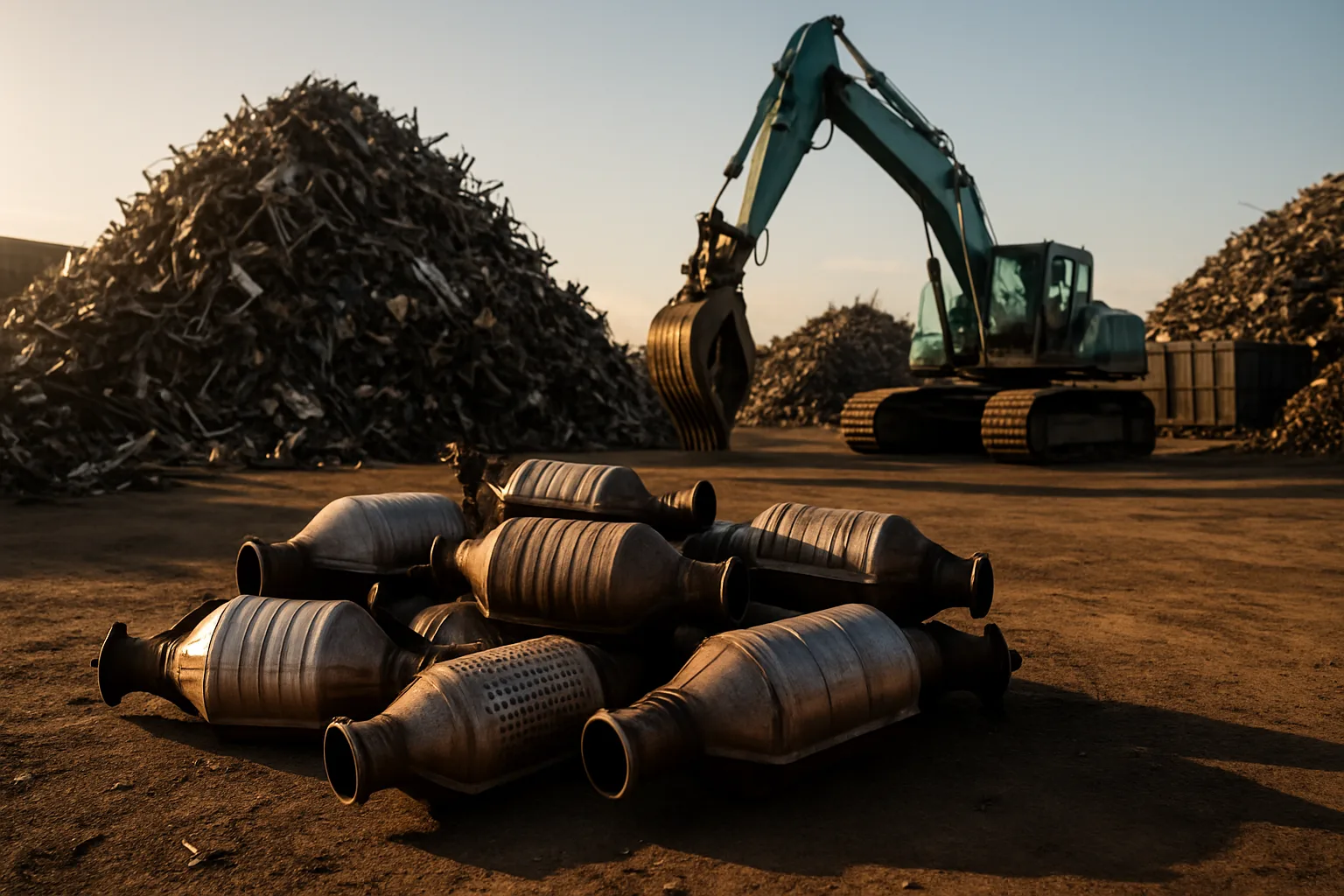
Platinum, Palladium, and Rhodium: The Metals That Determine Your Converter's Value
Most people selling a catalytic converter have no idea what's actually inside it. They hand it over to a buyer, get a number, and hope it's fair. But if you understand what drives catalytic converter recycling El Paso pricing — specifically the three precious metals buried in that ceramic substrate — you stop guessing and start negotiating from a position of knowledge.
The converter sitting on your shelf right now could be worth $30. It could be worth $300. The difference comes down to platinum, palladium, and rhodium — and how much of each your specific unit contains. Let's break down exactly how those numbers get calculated, and what you can do to make sure you're not leaving money on the table.
What Makes a Catalytic Converter Valuable: The Three Precious Metals
Inside every catalytic converter is a honeycomb-shaped substrate coated with a wash of precious metals. These metals act as catalysts — they trigger chemical reactions that convert toxic exhaust gases into less harmful compounds. When the converter reaches end of life, those metals don't disappear. They can be recovered, refined, and sold back into industrial markets. That recovery value is what determines your scrap catalytic converter price by model.
Here's a quick breakdown of each metal and its role in pricing:
- Platinum (Pt): Used heavily in diesel converters and older gasoline units. Platinum markets tend to be more stable than the other two, but prices still fluctuate based on mining output, industrial demand, and currency shifts. As of mid-2026, platinum remains a significant contributor to converter value in diesel-heavy fleets common across El Paso scrap metal services markets.
- Palladium (Pd): Dominant in modern gasoline-engine converters. Palladium has seen some of the most dramatic price swings in the precious metals world over the past decade. Its concentration in newer vehicles tends to be higher, which is why late-model gasoline converters often command strong prices at the scrap yard.
- Rhodium (Rh): The wildcard. Rhodium is the rarest of the three, with limited mining supply concentrated in a small number of global producers. Even small amounts of rhodium in a converter can account for a large portion of its total value. When rhodium prices spike, converter values spike with them.
The ratio and total load of these three metals — often called the PGM (platinum group metals) content — is the core variable every buyer uses to determine what your converter is worth at the scrap yard.
How the Assay Process Works: From Converter to Cash
Buyers don't just eyeball a converter and guess its PGM content. There's a real process behind the valuation. Understanding it helps you recognize whether the offer you're getting reflects actual market value or just a lowball number.
Here's the typical flow:
- Identification: The buyer identifies the converter by serial number, make, model, or visual characteristics. Databases compiled from thousands of historical assays let buyers estimate PGM content before processing. This is why platforms that support scrap catalytic converter price by model lookups give sellers a huge transparency advantage.
- Decanning: The metal shell is cut open and the ceramic substrate (the "brick") is removed. The brick contains the precious metal coating.
- Processing and sampling: The brick is crushed, milled, and homogenized into a powder. A representative sample is pulled for laboratory assay.
- Assay: The sample goes through ICP (Inductively Coupled Plasma) analysis, which measures the exact concentration of platinum, palladium, and rhodium in parts per million (ppm).
- Settlement: The buyer multiplies ppm by weight, applies current spot prices for each metal, applies a recovery percentage, and calculates a payable value. Your offer is derived from that number.
The gap between what the assay reveals and what a single buyer quotes you is exactly where sellers lose money. More buyers competing for your load closes that gap. Platforms like SMASH are built on that principle — documented inventory, competitive bidding, and transparent price discovery rather than a take-it-or-leave-it phone offer.
Why Converter Prices Change Daily — And What Drives the Market in 2026
If you checked what a specific converter was worth six months ago and assume it's the same today, you may be surprised. Converter scrap value moves with live precious metal markets, and those markets respond to factors far outside the scrap yard's control.
Key drivers in mid-2026 include:
- Global EV transition pace: As electric vehicles continue to take market share, the long-term demand for catalytic converters in new production is under pressure. This affects palladium in particular, since EVs don't require converters. That market dynamic influences where investors position themselves in PGM futures.
- South African and Russian mining output: A significant portion of global platinum and palladium supply comes from South Africa. Rhodium is similarly concentrated. Any disruption — labor, regulatory, or geopolitical — sends prices sharply in either direction.
- Industrial demand beyond auto: Platinum is used in hydrogen fuel cell production, an industry gaining traction in 2026. That competing demand source adds upward price pressure independent of the automotive recycling market.
- USD strength: PGMs are priced globally in U.S. dollars. When the dollar strengthens, commodity prices in USD often soften. This is particularly relevant for sellers in Texas and across the southern U.S. who are watching their best converter price move week to week.
The takeaway: the converter sitting in your yard has a price that changes every trading day. Waiting for the right moment matters. So does knowing what you actually have before you sell.
Disclaimer: Precious metal spot prices fluctuate continuously. The factors discussed here reflect general market dynamics as of July 2026. Always check current scrap converter prices before making any selling decision.
What Affects Your Specific Converter's Price at the Scrap Yard
Beyond raw metal markets, several converter-specific variables determine what you'll actually receive. Knowing these helps you present your inventory accurately — and makes your load more attractive to buyers when you sell catalytic converters online.
- Make, model, and year of the vehicle: A heavy-duty diesel truck converter holds a very different PGM load than a compact sedan's. Luxury and performance vehicles often run richer substrates. If you're recycling in El Paso — where pickup trucks, fleet vehicles, and cross-border commercial traffic are common — you're likely seeing a diverse mix of converter types.
- Substrate condition: A converter that has been in a fire, submerged in water, or is cracked and contaminated will return less on assay. The ceramic can fracture and lose material. Buyers discount accordingly.
- Foiled vs. ceramic substrate: Some newer converters use metallic foil substrates rather than ceramic. These process differently and carry different PGM profiles.
- Aftermarket vs. OEM: Aftermarket converters installed as replacements typically carry lower PGM loads than the original equipment units. Buyers know this. Don't expect an aftermarket cat to price like an OEM unit from the same vehicle.
- Quantity and lot consistency: Volume matters. A lot of 50 converters, accurately sorted and documented, will attract more competitive bids than a single unit or an unsorted pile. This is where proper documentation — photos, serial numbers, model identification — directly translates to better price discovery.
SMASH gives sellers the tools to document exactly this kind of detail before a load goes to market. That documentation builds buyer confidence, and buyer confidence drives competition. You can find the best scrap converter prices today when buyers have the information they need to bid aggressively.
How to Get a Better Price When You Sell Catalytic Converters in Texas
Understanding the metals is step one. Getting maximum value when you sell catalytic converters Texas buyers are competing for requires a deliberate approach. El Paso sellers, in particular, operate in a market with unique characteristics — proximity to the border, heavy commercial traffic, and a strong base of fleet and industrial operations all shape the local converter supply.
Here's what separates sellers who consistently get strong prices from those who consistently leave money on the table:
- Identify before you sell. Use available databases and tools to understand what models you have before engaging any buyer. A read scrap converter pricing guides approach gives you a baseline before anyone quotes you a number.
- Document everything. Photos of the serial number, substrate face, and overall condition. This isn't just paperwork — it's leverage. Buyers who can see exactly what they're bidding on are more likely to bid aggressively.
- Get more than one offer. This is the core problem with the old phone-and-handshake model. One buyer, one offer, no context. When you get competitive bids for your scrap metal, market forces do the work for you.
- Time the market when possible. If you're holding a significant volume and precious metal prices are in a downtrend, patience has real dollar value. Not every seller has that flexibility, but understanding the market gives you the option.
- Use platforms built for transparency. SMASH connects sellers with vetted buyers and runs a competitive auction format so you know the market responded to your load — not just one buyer's margin target.
Texas is a large and active converter recycling market. From El Paso in the far west to the major metros in the east, there's no shortage of supply — or buyers. The question is whether the structure you're selling into works for you or against you.
Frequently Asked Questions
Q: How do I know if my catalytic converter is worth selling in El Paso?
Most OEM catalytic converters carry recoverable amounts of platinum, palladium, or rhodium and are worth selling. Even lower-value units often return more than scrap steel pricing. The best way to know is to identify your converter by serial number or vehicle model and check current market rates before handing it over to any buyer.
Q: Does catalytic converter recycling in El Paso require any special paperwork?
Yes. Texas has regulations around the sale of used catalytic converters to discourage theft-driven recycling. Sellers are typically required to provide a valid ID, proof of ownership or documentation of lawful possession, and in some cases a bill of sale. Requirements can vary by jurisdiction and buyer, so confirm with your specific buyer before completing a transaction.
Q: Why does the same converter model get quoted at different prices by different buyers?
Each buyer applies their own recovery rate, processing cost assumptions, and margin targets to the same underlying PGM value. That's why getting multiple offers — rather than accepting the first number — consistently produces better outcomes for sellers. Competition between buyers is what drives scrap converter prices toward actual market value.
Q: What's the difference between a scrap yard quote and an online converter auction platform?
A scrap yard quote reflects one buyer's assessment and margin. An online auction platform exposes your inventory to multiple vetted buyers who compete against each other. That competition can reveal the actual market value of your load rather than a single buyer's preferred purchase price. Platforms like SMASH operate on this model, with no subscription fees — they only succeed when sellers do.
Q: Do aftermarket catalytic converters have the same scrap value as OEM units?
Generally, no. Aftermarket converters are manufactured to meet emissions standards at lower cost, which typically means a reduced PGM load compared to original equipment units from the same vehicle. When selling, it's worth identifying whether your converters are OEM or aftermarket replacements, as the price difference can be significant.
You've now got a real understanding of what drives converter value — the metals, the assay process, the market variables, and the selling strategies that actually work. If you're ready to move inventory and want to know what the market will actually pay, the next step is straightforward. Find the best scrap converter prices and get a free quote at best-scrap-converter-prices.com — because guessing stopped being a strategy the moment you started reading this.
Stay sharp on scrap metal market moves. Follow SMASH on LinkedIn for industry updates, pricing insights, and practical guidance for recyclers across North America.