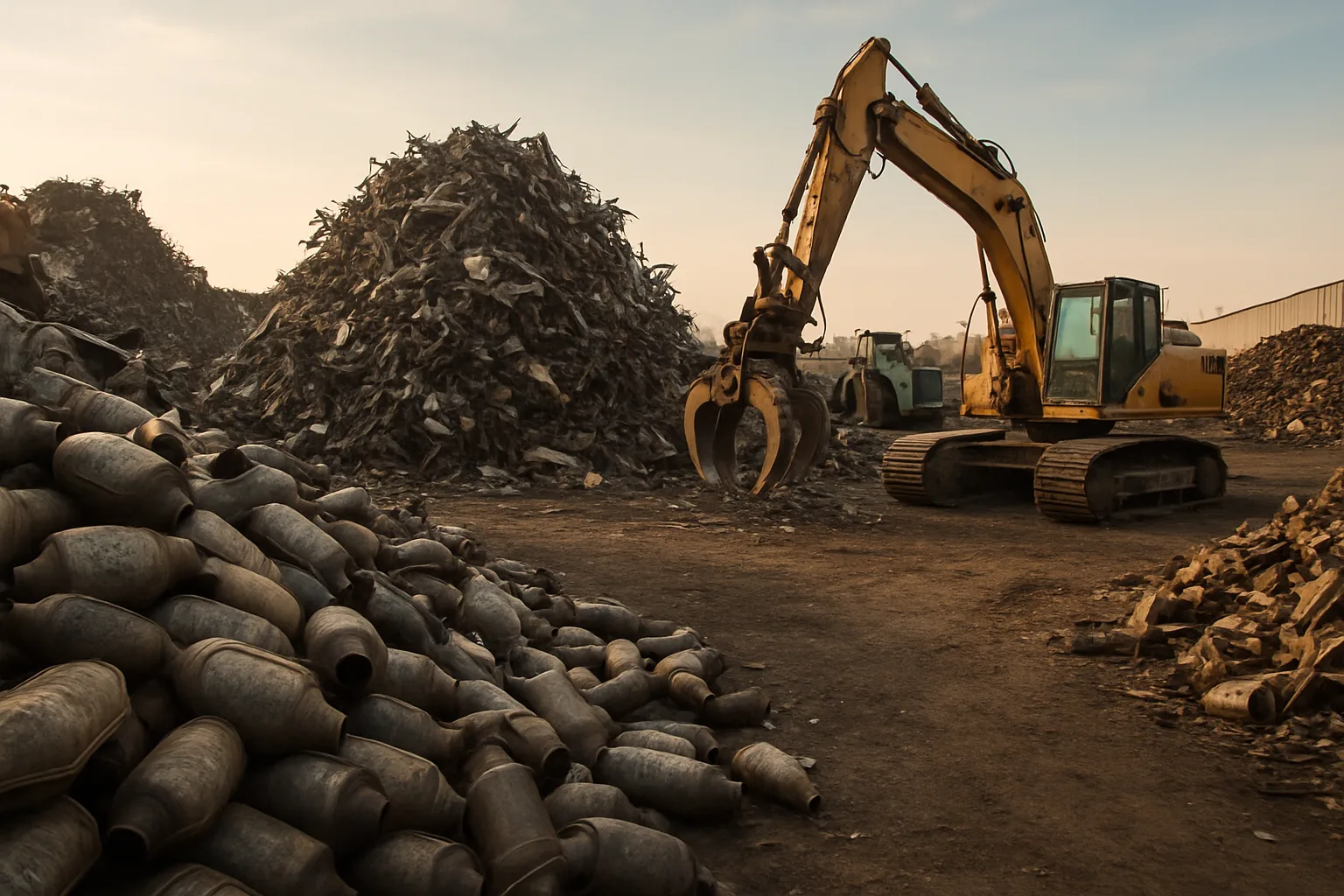
Hybrid vehicles contain catalytic converters worth two to three times more than what you'd pull from a standard gas-powered car. That's not a typo. If you're sitting on a stack of hybrid cats and treating them like regular scrap, you're leaving serious money on the table. For sellers chasing the best catalytic converter price Boston has to offer, knowing what's inside a hybrid converter changes everything.
Here's why hybrid cats command a premium — and how to make sure you get paid accordingly.
Why Hybrid Catalytic Converters Carry More Precious Metals
A standard gasoline engine runs hot and burns fuel continuously. Its catalytic converter works hard, but it works in a predictable cycle. A hybrid engine is different. It starts and stops constantly, switching between electric and gas power dozens of times on a single commute. Every cold start produces a burst of unburned hydrocarbons. The converter has to neutralize those emissions fast — even before it reaches full operating temperature.
To handle that demand, engineers load hybrid converters with a higher concentration of platinum group metals (PGMs): platinum, palladium, and rhodium. These three metals do the actual chemical work of converting toxic exhaust gases into less harmful compounds. More stops and starts means more demand on the substrate. More demand means more precious metal loading to compensate. It's basic chemistry with a significant dollar value attached.
- Platinum — primary oxidation catalyst, handles CO and hydrocarbons
- Palladium — works alongside platinum, particularly effective at cold-start emissions
- Rhodium — handles nitrogen oxide reduction; the rarest and often most valuable of the three
The rhodium price today remains one of the most volatile figures in the precious metals market. Rhodium has historically spiked to extreme highs during periods of tightening emissions standards globally — and hybrid cats carry meaningful rhodium content precisely because of those stricter requirements. When rhodium moves, hybrid converter values move with it.
Hybrid Converter vs. Standard Converter: What the Difference Looks Like in Scrap Value
Not every converter is created equal. Scrap buyers sort converters by make, model, year, and sometimes VIN — because the loading varies dramatically between manufacturers and model years. A hybrid cat from a Toyota Prius, a Ford Fusion Hybrid, or a Honda Accord Hybrid will typically grade out significantly higher than a comparable unit from a non-hybrid version of the same vehicle.
When you check current scrap converter prices, you'll notice hybrid-specific listings often sit in their own tier. Here's a rough breakdown of what separates them:
- PGM loading — hybrid cats can contain measurably higher platinum and palladium content per unit
- Substrate density — finer honeycomb structures increase surface area and catalyst contact
- Dual converter setups — many hybrids run two converters: a smaller "light-off" unit near the engine and a larger main unit downstream
- Cold-start additives — some hybrid systems include additional catalyst coatings specifically for low-temperature performance
That dual-converter setup is important. If you're pulling a hybrid drivetrain, you may be holding two separate units — both with elevated PGM content. Miss the secondary unit and you miss half the value.
How Scrap Converter Buyers in Boston Price Hybrid Units
Boston and the wider Massachusetts market has a solid base of scrap metal buyers, but pricing for hybrid converters varies more than most sellers expect. Some local yards will quote you a flat rate based on visual inspection. Others use assay data and live precious metal spot prices. The gap between those two approaches can mean hundreds of dollars per unit on a high-grade hybrid cat.
Boston is home to a significant concentration of hybrid vehicles — Massachusetts has consistently been one of the top states for hybrid and EV adoption. That means the local supply of end-of-life hybrid converters is real and growing. A yard that pays flat rates isn't necessarily doing you a favor. You need a buyer who actually knows the difference between a Prius gen-two cat and a Prius gen-three — because the market does.
For sellers who want full transparency, Boston scrap metal services that connect you to a competitive buyer network make far more sense than a single-quote approach. One phone call to one buyer is the old way. It was never in your favor.
Platforms like SMASH give you a better path. Instead of calling one buyer and hoping the number is fair, you put your load in front of multiple vetted buyers. Competition does what it's supposed to do — it surfaces the real market price. No subscription fees. You only pay when a deal closes. That structure matters when you're selling hybrid cats worth real money.
SMASH Scrap Metal Auction: How It Changes the Equation for High-Value Converters
The SMASH scrap metal auction model was built for exactly this situation. A single hybrid converter load, properly documented — photos, VINs, serial numbers, part condition — is a fundamentally different listing than "a box of cats, make offer." Documentation gives buyers confidence. Confidence drives competitive bids. Competitive bids mean better price discovery for the seller.
SMASH's inventory tool and VIN lookup feature let you build a credible listing before you ever talk to a buyer. Photo documentation isn't optional — it's how you prove your load is what you say it is. For hybrid converters specifically, that matters. A Prius cat with visible heat shielding and clear part markings will attract better offers than an unidentified unit in a mixed pile. Buyers know what they're bidding on. That's how you find the best scrap converter prices today.
Auto-invoicing and transparent transaction records also eliminate the back-and-forth that slows down payments. You sold the load. The paperwork handles itself. That's how scrap should work in 2026.
Rhodium Price Volatility and Why It Matters for Hybrid Sellers Right Now
Of the three platinum group metals, rhodium is the one that makes hybrid converter values swing the hardest. It's rarer than platinum and palladium, mined in far smaller quantities, and almost entirely dependent on automotive demand. When automakers ramp up production of hybrid and clean-diesel vehicles — both of which require elevated rhodium loading — prices respond.
Watching the rhodium price today isn't just for precious metal traders. If you're accumulating hybrid cats, timing your sale relative to rhodium spot prices is legitimate strategy. A load that sits in your yard for three weeks during a rhodium rally can be worth measurably more than the same load sold on Monday at a flat rate. This is exactly the kind of market data that a transparent auction platform surfaces — buyers are bidding on live market conditions, not on what they think they can get away with offering.
For more context on how precious metal markets affect converter scrap values, read scrap converter pricing guides that break down PGM market dynamics in plain language.
What to Do Before You Sell Your Hybrid Converters
Preparation is the difference between a fair price and a great one. Before you put a hybrid converter load in front of any buyer, run through this checklist:
- Identify the unit — Use the part number stamped on the converter shell, the vehicle VIN, or both. Hybrid cats from Toyota, Ford, Honda, and Hyundai all have documented PGM loading data that buyers reference.
- Document everything — Take clear photos of the converter body, the part number, and the overall condition. No major damage to the substrate. Show what you've got.
- Check for dual units — On Prius and similar platforms, confirm whether you have both the small upstream unit and the main downstream converter. They're often separated in disassembly and accidentally sold as a single unit.
- Don't sell blind — Get multiple quotes or use an auction format. A single-buyer quote with no competition is a starting point, not a final number.
- Time the market if you can — If rhodium is trending up and your load is documented and ready, holding a few days isn't always a bad call. Don't speculate indefinitely, but don't panic-sell either.
smashscrap.com gives you the auction infrastructure to execute this properly — vetted buyers, documented listings, and competitive bidding instead of a single take-it-or-leave-it offer.
Massachusetts sellers near Boston have access to both local yard options and national buyer networks through platforms like SMASH. Use both to your advantage. Local yards can give you a quick baseline. A national auction can push that number higher when the load is worth it — and hybrid cats almost always are.
If you're ready to stop guessing what your hybrid converters are worth, the next step is straightforward. Build your listing, document your load, and let buyers compete. The market will tell you the real price. Find the best scrap converter prices and get a free quote at best-scrap-converter-prices.com — it's the fastest way to know where you actually stand before you commit to a sale.
Follow SMASH on LinkedIn for ongoing scrap metal market updates, PGM pricing insights, and converter scrap news worth reading.
Frequently Asked Questions
Q: Why are hybrid catalytic converters worth more than regular converters?
Hybrid engines cycle on and off constantly, which puts greater demand on the catalytic converter — especially during cold starts. To meet emissions requirements under those conditions, manufacturers load hybrid cats with higher concentrations of platinum, palladium, and rhodium. More precious metal content means higher scrap value per unit.
Q: How do I find the best catalytic converter price in Boston?
Don't rely on a single yard quote. Get your converter properly identified — by part number or VIN — then put it in front of multiple buyers. Boston has a growing hybrid vehicle base, which means local demand for hybrid cats is real. Using an auction platform like SMASH lets vetted buyers compete, which surfaces the actual market price instead of one buyer's margin.
Q: Does the rhodium price affect what I get paid for a hybrid cat?
Yes, directly. Rhodium is one of the three PGMs inside your catalytic converter, and it's often the most valuable. When rhodium spot prices rise, the assay value of rhodium-bearing converters rises with them. High-value hybrid cats are particularly sensitive to rhodium price movements because of their elevated loading.
Q: Do hybrid vehicles have more than one catalytic converter?
Many do. Hybrid platforms like the Toyota Prius often run a small "light-off" converter positioned close to the engine — designed to reach operating temperature quickly — plus a larger main converter downstream. Both contain PGMs. Selling only one unit when two exist is a common and costly mistake.
Q: What information should I have ready before selling a hybrid catalytic converter in Massachusetts?
Have the part number from the converter shell, the vehicle VIN if available, and clear photos of the unit. Knowing the make, model, and year of the source vehicle helps buyers confirm the PGM loading and bid accurately. A well-documented converter load consistently attracts stronger offers than unidentified units in a mixed pile.
```