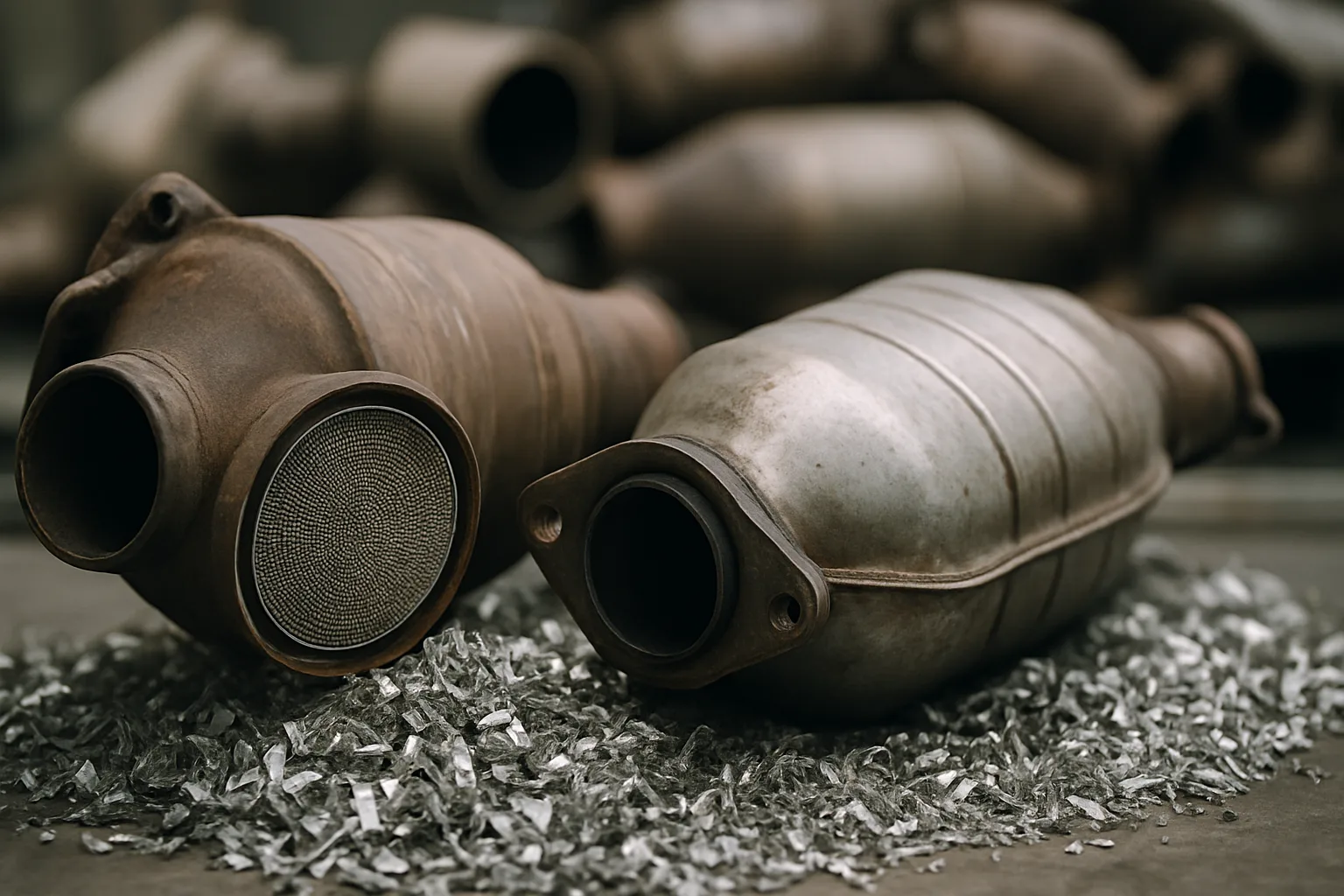
OEM vs Aftermarket Catalytic Converters: Why the Scrap Value Gap Is Bigger Than You Think
Pull two catalytic converters off the same vehicle — one OEM, one aftermarket — and you might get wildly different quotes from buyers. That gap isn't random. It comes down to precious metal content, and specifically where the palladium price today sits relative to platinum and rhodium. If you're selling converters in Kansas City or anywhere across Missouri, understanding this difference can mean serious money left on the table — or kept in your pocket.
This isn't about brand loyalty. It's about chemistry, market data, and knowing what your material is actually worth before you hand it over to a buyer.
What Makes OEM Converters Worth More as Scrap
Original equipment manufacturer converters are built to meet strict emissions standards set by the EPA and California Air Resources Board. To hit those targets reliably over a vehicle's full service life, OEM converters are loaded with higher concentrations of platinum group metals — primarily platinum, palladium, and rhodium. These aren't trace amounts. They're engineered in precise ratios to catalyze combustion byproducts effectively across a wide range of operating temperatures.
Aftermarket converters take a different approach. They're built to pass inspection, not necessarily to match the PGM loading of the factory part. That means lower precious metal content — sometimes dramatically lower. When you're recycling converters and a buyer is calculating scrap converter value based on assay data, that difference shows up immediately in the quote.
- OEM converters typically carry higher palladium and rhodium content per unit
- Aftermarket converters may use cheaper substrate materials and reduced PGM loading
- The substrate itself (ceramic vs metallic) affects how efficiently PGMs are recovered during smelting
- Some aftermarket units contain little to no rhodium — the most valuable PGM by weight
The bottom line: two converters that look nearly identical from the outside can have completely different scrap payouts. OEM units from high-displacement vehicles — trucks, SUVs, luxury cars — tend to command the strongest catalytic converter prices in the secondary market.
How the Palladium Price Today Drives the OEM Premium
Palladium has been the dominant PGM story in converter recycling for years. It's the primary catalyst in gasoline-powered vehicles, and OEM manufacturers load it heavily to meet emissions targets over 100,000+ mile service lives. When you check the palladium price today, you're looking at a number that directly multiplies the value difference between OEM and aftermarket units.
Here's why that matters in practical terms. An OEM converter from a popular full-size truck might contain several grams of palladium. An aftermarket replacement for the same vehicle might contain a fraction of that. With palladium trading in a range that fluctuates significantly based on automotive demand, supply chain shifts, and currency movements, even a small difference in palladium loading creates a large difference in scrap payout.
Rhodium compounds this effect. It's the rarest of the three primary PGMs and typically carries the highest price per troy ounce. OEM converters — especially those from European manufacturers and late-model domestic trucks — often contain measurable rhodium content. Most budget aftermarket converters do not. That alone can swing the value of a single unit by a significant margin when precious metal markets are active.
Disclaimer: Precious metal prices fluctuate daily based on global market conditions. Always check current scrap converter prices before making selling decisions.
Identifying OEM vs Aftermarket in the Yard — What to Look For
For yard operators and converter buyers in Kansas City, accurate identification is the first step toward accurate pricing. You can't quote a fair price — or get one — if you're treating all converters as equivalent. Experienced buyers spot the difference fast. Sellers who learn to do the same stop leaving money on the table.
Several physical indicators help separate OEM from aftermarket units:
- Markings and stamps: OEM converters often carry manufacturer codes, part numbers, or casting marks from the original vehicle maker. Aftermarket units typically have generic supplier codes.
- Substrate density: OEM ceramic substrates are generally higher cell-count and more uniform. Some aftermarket units use thinner, lower-density substrates.
- Weight: OEM converters are often heavier for their size due to denser substrate material and higher PGM wash coat loading.
- Shell construction: Aftermarket units frequently use thinner-gauge stainless steel shells. OEM units tend to be more robust.
- VIN correlation: Platforms that support VIN lookup — like SMASH — can help cross-reference a vehicle's original converter specs against what you're holding.
Kansas City yards pulling converters from a mix of domestic trucks, import vehicles, and fleet equipment will see this variance constantly. Missouri's strong commercial vehicle market means OEM heavy-duty truck converters show up regularly — and those are often among the highest-value units in any load.
Scrap Catalytic Converter Prices in Kansas City — What the Market Looks Like Right Now
Missouri scrap yards face the same pricing dynamics as the broader North American market, but local competition and buyer access shape what sellers actually receive. The problem most converter sellers encounter isn't the market itself — it's having access to only one or two buyers. That limits price discovery. A single buyer quote isn't a market price. It's one opinion.
If you're trying to sell a catalytic converter near me for cash and you've only called one yard, you may be accepting a price 10%, 20%, or more below what a competitive quote process would surface. This is where the structure of how you sell matters as much as what you're selling. Find the best scrap converter prices today by putting your load in front of multiple vetted buyers — not just the nearest one.
For local context: Kansas City scrap metal services through platforms that use auction-style bidding give Missouri sellers access to verified buyers competing for their material — rather than a single take-it-or-leave-it number. That competition is what moves prices toward actual market value. More buyers means better price discovery. That's not a sales pitch — it's how markets work.
SMASH operates as a B2B scrap metal marketplace that connects converter sellers with vetted buyers across North America. No subscription fees. No guessing. When multiple buyers see your documented inventory and bid on it, the price reflects what the material is actually worth — not what one buyer feels like paying that afternoon.
Why Documentation Changes Your Converter Scrap Value
Whether you're running a small yard or managing converter inventory at scale, documentation is no longer optional if you want top-tier bids. Buyers who can see photos, serial numbers, vehicle source data, and weight information bid with more confidence. Confident buyers bid higher. That's the direct connection between documentation and best converter price outcomes.
This matters even more for OEM vs aftermarket differentiation. If a buyer can verify — through photos and VIN-correlated data — that your load contains OEM units from late-model domestic trucks, they're not guessing at PGM content. They're pricing against known specs. That certainty reduces their risk, and reduced buyer risk translates to stronger bids for the seller.
Platforms built for platinum group metals recycling and converter trading now support photo documentation, serial tracking, and inventory tools that make this process systematic rather than ad hoc. SMASH Scrap — where verified buyers bid on your metal — is built around exactly this principle: documented loads attract serious buyers who compete on price rather than exploit information gaps.
If you want to read scrap converter pricing guides that break down PGM recovery by converter type, the data consistently shows the same pattern — sellers with documented, categorized inventory outperform sellers who ship mixed, undocumented loads. OEM units separated from aftermarket units, properly photographed and logged, generate materially better outcomes.
How to Get the Best Price for Mixed OEM and Aftermarket Converter Loads
Most yards don't have the luxury of selling pure OEM loads. Reality is a mix — some OEM units, some aftermarket, varying vehicle classes and model years. The goal is to maximize value across the full load, not just the premium units.
Here's a practical approach that experienced converter sellers use:
- Sort before you sell. Separate OEM from aftermarket where you can identify them. Even rough sorting helps buyers price more accurately.
- Document the high-value units. OEM converters from full-size trucks, SUVs, and luxury vehicles warrant individual photos and serial numbers. Don't lump them in with budget aftermarket units.
- Use VIN lookup where available. Knowing the source vehicle confirms OEM status and helps buyers price against spec sheets rather than visual guesses.
- Get multiple bids. This is the single most important step. One quote is not a price — it's a starting point. A competitive auction format forces buyers to show their actual number.
- Check the palladium price today before you sell. If PGM markets are moving, timing matters. A load quoted on a day when palladium is down may fetch significantly more a week later.
Kansas City sellers working with SMASH get access to all of this in one platform — inventory tools, buyer competition, and transparent pricing tied to real market conditions. No subscription fees means you're not paying to play before you even know what your load is worth.
Frequently Asked Questions
Q: Why does the palladium price today affect my converter scrap value so directly?
Palladium is the primary catalyst in gasoline engine converters, and OEM units contain measurable quantities of it per unit. When the palladium price today is high, every gram in your converter is worth more. Scrap buyers calculate payout based on recovered PGM content multiplied by current spot prices — so market movement directly affects what you receive.
Q: How do I know if my catalytic converter is OEM or aftermarket?
Look for manufacturer stamps, OEM part numbers, and vehicle-specific markings on the converter shell. OEM units are often heavier, have higher-density substrates, and carry factory codes. Aftermarket units typically have generic supplier codes and lighter construction. VIN lookup tools on platforms like SMASH can help cross-reference original equipment specs against what you're holding.
Q: Where can I get the best scrap catalytic converter prices in Kansas City?
The best scrap catalytic converter prices in Kansas City come from competitive bidding — not a single buyer quote. Using a B2B platform that puts your documented inventory in front of multiple vetted buyers gives you real price discovery. Local yards are a starting point, but a competitive auction process typically surfaces stronger offers, especially for OEM units with verified content.
Q: Does separating OEM from aftermarket converters actually make a difference in payout?
Yes — significantly. Buyers price mixed loads conservatively because they can't verify content on every unit. Sorted, documented loads — especially those where OEM units are identified and photographed separately — attract more confident bids. That confidence translates directly into better pricing for the seller.
Q: What is platinum group metals recycling and why does it matter for converter pricing?
Platinum group metals recycling refers to the process of recovering platinum, palladium, and rhodium from spent converters through smelting and chemical extraction. The recoverable PGM content in a converter — determined by its OEM or aftermarket status, vehicle class, and condition — is the primary driver of its scrap value. Understanding this helps sellers categorize and price their material more accurately before going to market.
Ready to stop guessing what your converters are worth? Find the best scrap converter prices today — get a free quote at best-scrap-converter-prices.com and put real market competition to work for your material.
Follow SMASH on LinkedIn for industry updates, PGM market insights, and scrap metal pricing news that keeps you ahead of the market.
```