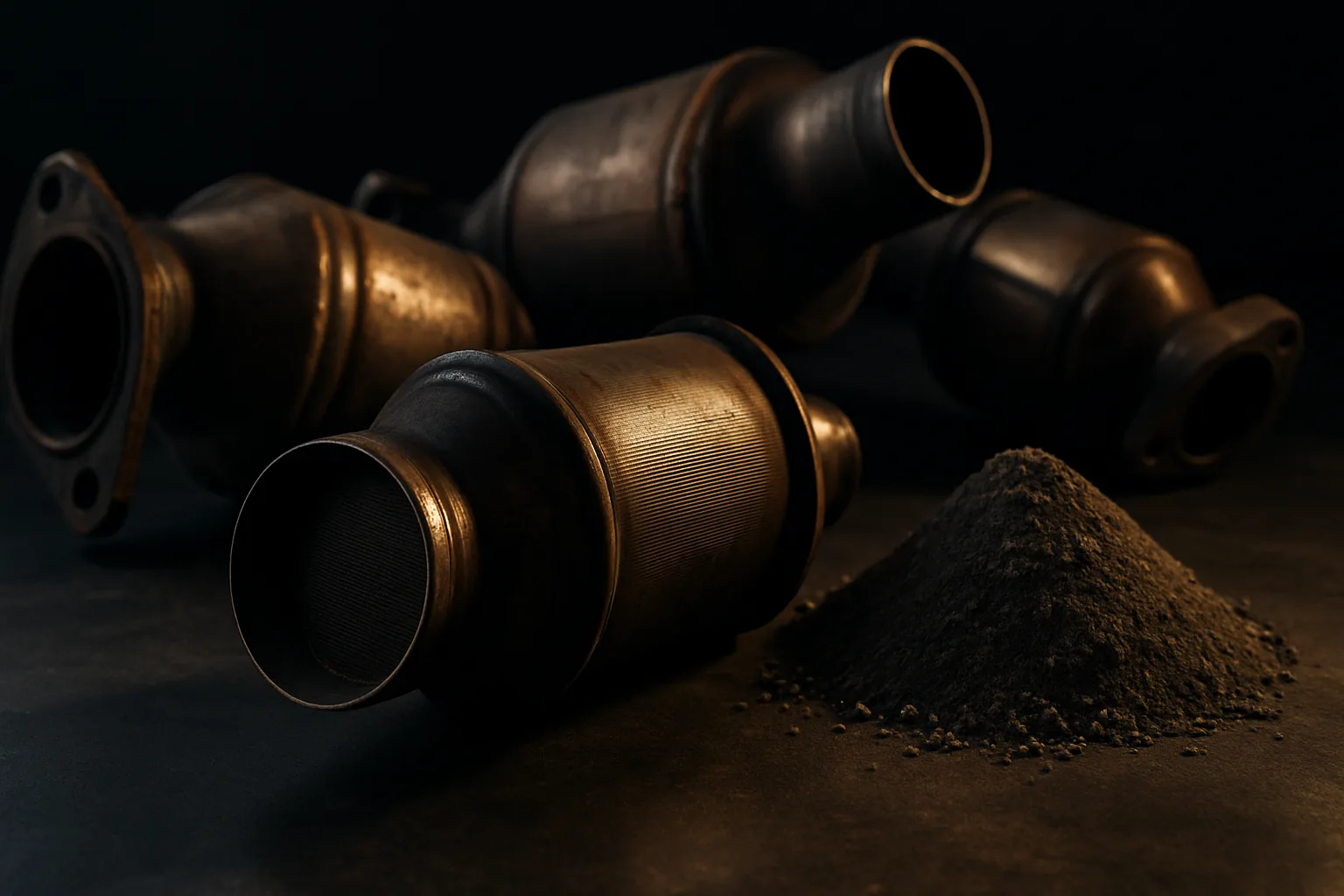
Most converter sellers in Austin hand over their cats and never think twice about what happens next. That's leaving money on the table. Understanding how catalytic converter recycling actually works — from assay to smelter — tells you exactly why prices vary so wildly between buyers, and how to make sure you're getting paid on real data instead of someone's best guess.
The catalytic converter recycling Austin market is active. Shops, yards, and independent collectors move serious volume through Texas every week. But the path from your converter to a final payment involves chemistry, metallurgy, and a pricing chain that most sellers never see. Let's break it down.
---Why the Assay Process Determines Your Converter Scrap Value
A catalytic converter isn't worth money because it's made of steel. It's worth money because of what's inside the ceramic or metallic substrate — platinum, palladium, and rhodium (PGMs, or platinum group metals). These three metals drive almost all of your converter scrap value. The steel shell is almost an afterthought in pricing.
The assay is the process that measures exactly how much of each PGM is present in a given lot of converters. There are two main methods used at scale:
- Fire assay (FA): The substrate material is melted down with a collector metal (usually lead or nickel sulfide), the PGMs concentrate into a button, and that button is chemically analyzed. Highly accurate. Industry standard for final settlement.
- X-ray fluorescence (XRF): A handheld or bench-top device shoots X-rays at the substrate and reads the energy signature of the metals present. Fast. Used for sorting and early pricing estimates. Less precise than fire assay on its own.
Here's why this matters for you: a buyer quoting you a price without an assay is guessing — or using a database of historical values for that converter's serial number. That database is only as good as the last time that converter type was tested. XRF on-site at a yard gives a directional read. The real settlement happens weeks later after fire assay at a licensed smelter. If your contract is based on post-smelt assay, your final payment may look different from the original quote.
Know what your quote is based on before you commit. That's not paranoia — it's how professional buyers think about every load.
---From the Yard to the Smelter: How Catalytic Converter Recycling Actually Moves
Once converters are collected — whether from a single seller in Austin or aggregated from dozens of yards across Texas — they move through a processing chain before PGMs are ever recovered. Understanding each step helps you ask better questions when you sell catalytic converters online or at a physical buyer.
Here's the typical flow:
- Collection and sorting: Converters are sorted by type — OEM vs. aftermarket, foreign vs. domestic, foil (metallic substrate) vs. ceramic. Each category carries different PGM concentrations. Aftermarket cats typically have lower PGM content than OEM units.
- Decanning: The steel shell is mechanically cut away from the substrate. The shell goes into ferrous scrap. The substrate (the "bread" of the converter) moves forward for processing.
- Milling and homogenization: The substrate is crushed and milled into a fine, uniform powder. This is critical — without homogenization, the assay won't accurately represent the entire lot. A poorly milled sample gives you a bad number, and a bad number means a bad settlement.
- Sampling: A statistical sample is pulled from the milled material. Multiple samples go to multiple labs in some cases. This is where the fire assay or wet chemistry analysis happens.
- Smelting and refining: The bulk material goes to a smelter. PGMs are extracted, refined to spec, and sold into the industrial market — mostly automotive manufacturing, electronics, and chemical processing.
The entire process from receiving a load to final assay settlement can take anywhere from a few weeks to a couple of months, depending on the smelter's schedule and lot size. Larger lots tend to move faster because smelters prioritize volume. If you're moving a handful of converters, you're likely going through a middleman aggregator — which adds a margin layer.
---How Precious Metal Spot Prices Connect to Your Catalytic Converter Price
Every catalytic converter price quote you receive is anchored, at some level, to the real-time spot prices of platinum, palladium, and rhodium on the open market. These metals trade globally. They are priced in USD per troy ounce. They move daily — sometimes sharply.
When you sell catalytic converters Texas, whether in Austin or anywhere else in the state, the buyer is essentially doing a quick calculation in their head (or more likely, in a pricing database):
- Estimated PGM content by weight (grams of Pt, Pd, Rh per unit)
- Current spot prices for each metal
- A recovery factor (what percentage of theoretical PGM content the smelter actually recovers — never 100%)
- Processing costs, margin, and risk buffer
The difference between a competitive buyer and a lowball buyer often comes down to the recovery factor and the margin they build in. A buyer offering 80% of assay return is meaningfully different from one offering 70%. On a high-value converter with significant PGM content, that gap can be substantial.
This is exactly why competition matters. When you sell your scrap metal on the SMASH marketplace, multiple vetted buyers are bidding on your material. That bid competition compresses the margin spread and gives you better price discovery. One phone call to one buyer gives you one data point. An auction gives you the market.
Disclaimer: Precious metal spot prices fluctuate daily. Always check current scrap converter prices before committing to a sale. Historical prices are not a reliable indicator of current value.
---What the Best Converter Price Actually Looks Like — and How to Find It
Sellers searching for the best converter price often make the mistake of treating the first quote as the market. It isn't. The first quote is what one buyer is willing to pay. The market is what multiple competing buyers will pay when they know someone else is bidding.
A few things that separate a strong converter offer from a weak one:
- Transparency on assay method: Is the price based on XRF, database lookup, or post-smelt fire assay? Each carries different accuracy and different risk allocation between buyer and seller.
- Clear return percentage: What percentage of assay return is the buyer offering? Get this in writing.
- Settlement timeline: When do you get final payment? Net-30 after assay is common. Know what you're agreeing to.
- Vetted buyer credentials: In Texas, regulations around converter purchasing have tightened significantly in response to theft-related enforcement. Buyers operating legally carry proper documentation and comply with state purchase requirements. If a buyer isn't asking for your ID or documentation, that's a flag, not a perk.
Platforms like SMASH are built around exactly these standards. Buyers on the platform are vetted. Sellers document their inventory — serial numbers, photos, condition — which gives buyers more confidence and, in turn, produces more competitive bids. Documented inventory isn't just good practice. It's what separates a price-discovery auction from a guessing game.
If you're in Austin and moving volume regularly, connecting with Austin scrap metal services that understand the local market is worth your time. Local buyers know Texas regulations, local pricing conditions, and the specific converter types that move through Central Texas shops and yards.
---Using a Scrap Converter Price Lookup Tool Before You Sell
One of the most practical tools available to converter sellers in 2026 is the scrap converter price lookup. These tools — available through platforms and buyer networks — let you enter a serial number or VIN-linked converter type and get an estimated value based on current PGM spot prices and historical assay data for that specific unit.
They're not perfect. Database values are averages and may not reflect the exact PGM content of your specific converter (especially if it's an aftermarket replacement or has been tampered with). But a lookup gives you a baseline — something to sanity-check a buyer's offer against.
If a buyer quotes you 40% below what a reputable lookup tool shows for that converter, ask why. Maybe they're pricing in high processing risk. Maybe they're discounting for condition. Or maybe they're counting on you not knowing. A lookup tool shifts that information imbalance in your favor.
To find the best scrap converter prices today, you need both a lookup baseline and competitive bids. Neither alone is enough. Together, they give you a clear picture of what your material is actually worth in the current market.
Want to go deeper on how pricing tools and auction platforms work? Read scrap converter pricing guides that break down the mechanics of PGM valuation and what to watch for when you receive an offer.
---Weekly Market Note: Converter Recycling in Austin This Week
As of this week, the Texas converter market is seeing steady volume from auto recyclers, collision shops, and independent sellers across the Austin metro. PGM spot prices have been active — palladium in particular has shown movement tied to broader industrial demand shifts. Rhodium, as always, remains the wildcard.
If you're holding converters and waiting for a better price, know that holding carries risk in both directions. Spot prices can move against you as easily as they can move in your favor. The smarter play is usually to get competitive bids now, understand what the market is paying, and make an informed decision — not to sit on material waiting for a price you read about six months ago.
The Austin scrap market rewards sellers who show up with documentation, clean material, and knowledge of what they have. That's true whether you're selling one converter from a shop pull or a pallet of mixed cats from a full-service yard.
---Frequently Asked Questions
Q: How long does it take to get paid after selling catalytic converters in Austin?
It depends on the buyer and the pricing method. If the buyer pays on a database or XRF estimate, you may receive payment same-day or within a few days. If your contract is based on post-smelt fire assay, settlement typically takes 3–6 weeks after the lot reaches the smelter. Ask your buyer upfront which method applies and when to expect final payment.
Q: What's the difference between an OEM and aftermarket catalytic converter for scrap value?
OEM (original equipment manufacturer) converters generally contain higher PGM concentrations than aftermarket replacements. Aftermarket units are built to meet emissions standards at lower cost, which usually means less platinum, palladium, and rhodium per unit. This translates directly to lower scrap value. If you're sorting a mixed lot, separating OEM from aftermarket before getting a quote can help you understand the value split.
Q: Is catalytic converter recycling regulated in Texas?
Yes. Texas has enacted regulations around the purchase of used catalytic converters to combat theft. Licensed buyers are required to collect seller identification, documentation of ownership, and in some cases maintain transaction records for law enforcement access. Complying with these rules protects both buyer and seller. If a buyer in Austin is skipping documentation, that's a legal and reputational risk you don't want to be part of.
Q: Can I sell catalytic converters online from Austin, Texas?
Yes. Selling catalytic converters online has become increasingly straightforward for Texas sellers. Platforms that support remote bidding allow you to document your inventory with photos and serial numbers, receive competitive bids from vetted buyers, and arrange shipping or local pickup. SMASH is built specifically for this kind of transaction — bringing competition to a market that historically relied on a single phone call to a single buyer.
Q: What is a fire assay and why does it matter for my converter scrap value?
A fire assay is the most accurate method for determining the actual PGM content in a processed converter lot. The substrate material is melted with a collector metal, PGMs are isolated, and the resulting button is chemically analyzed. It's the industry standard for final settlement because it measures what's actually there — not what a database or XRF estimate predicts. Understanding whether your sale is settled on fire assay or an estimate tells you a lot about the accuracy and fairness of your final payment.
---If you're moving converters in Austin or anywhere across Texas and you're not sure whether your current buyer is giving you the market rate — you probably aren't getting it. The gap between a competitive offer and a lowball is real, and it's measured in dollars per unit, not pennies. Platforms like SMASH exist to close that gap by putting real buyer competition behind every load. When you're ready to see what your material is actually worth, find the best scrap converter prices — get a free quote at best-scrap-converter-prices.com.
Follow SMASH on LinkedIn for weekly scrap metal market insights, PGM price updates, and converter recycling industry news delivered straight to your feed.