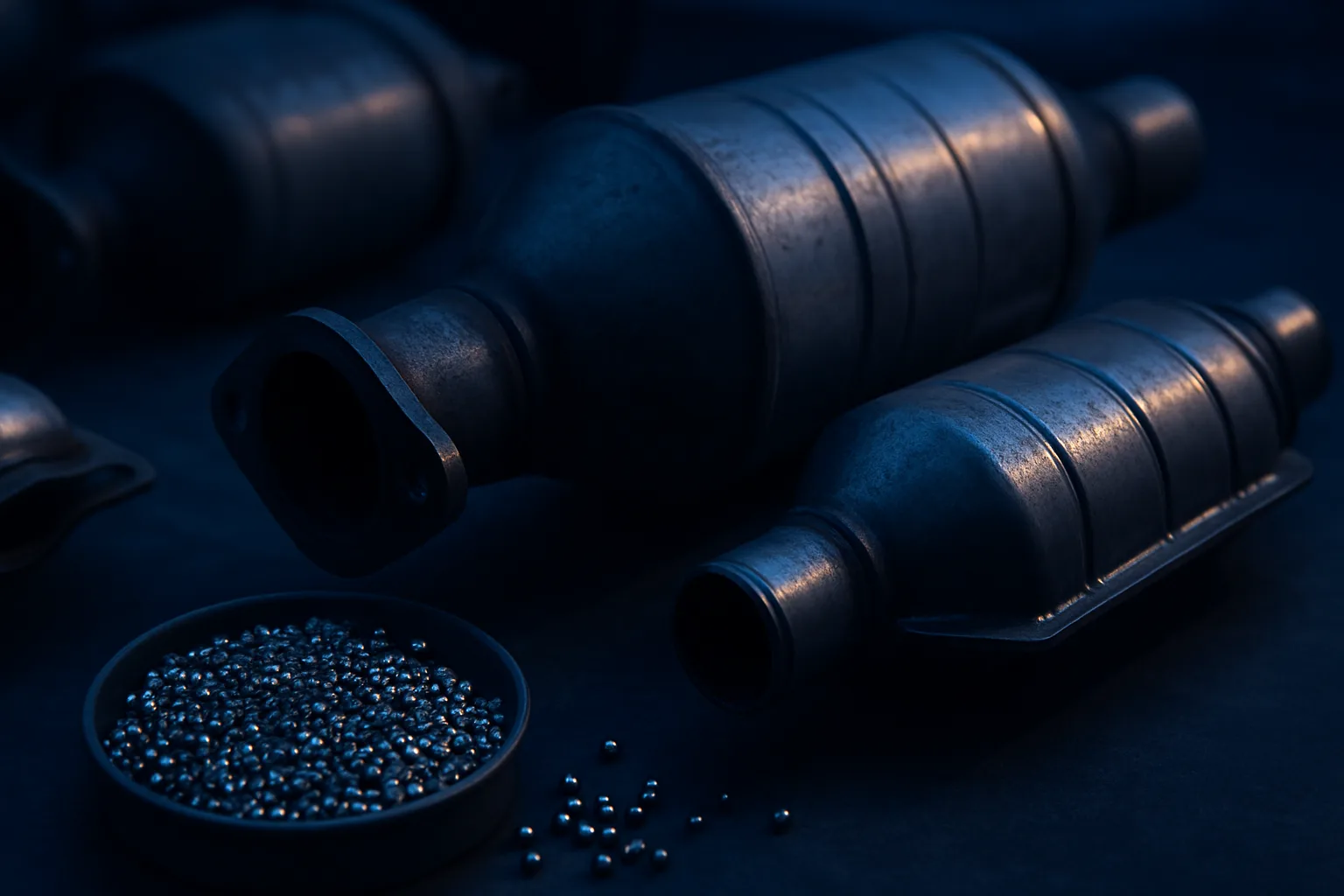
Palladium prices shifted again this week — and if you're sitting on a stack of pulled converters, that matters more than you think. The difference between selling today and selling next week could change your payout. Before you can take advantage of timing the market, though, you need to get those converters off the vehicle correctly. A damaged converter is worth less. A missing heat shield tells a buyer the substrate took a hit. Details like that eat into your scrap catalytic converter prices, whether you're in St. Louis or anywhere else in Missouri.
This guide covers the right way to pull a converter — tools, safety, documentation — so you show up to a buyer with clean inventory and full confidence in what you're selling. And once you've done the work, platforms like the SMASH scrap metal auction marketplace put that inventory in front of vetted buyers competing for your load, not one guy on the phone taking his best guess at your expense.
Why the Palladium Price Today Should Drive Your Timing
Catalytic converters hold value because of what's inside them: platinum, palladium, and rhodium. These are precious metals, and their spot prices move daily. Palladium is often the dominant driver for many converter types. When the palladium price today is elevated, your converter scrap value goes up. When it dips, buyers tighten their offers fast.
This isn't abstract market theory. It's the difference between a strong payout and leaving money behind. Before you pull a single bolt, check where palladium is trading. Then make a decision about whether you sell today or wait. That kind of data-driven thinking is how serious recyclers operate. You can check current scrap converter prices before you commit to anything.
- Palladium: Primary driver for most domestic converter types
- Platinum: Stronger factor in diesel converters
- Rhodium: High value per gram, varies sharply by vehicle make
Knowing which metals dominate your specific units — and where those metals are trading — is step one. Step two is making sure you don't damage the substrate when you remove the unit.
Tools and Safety Before You Touch the Converter
A catalytic converter runs hot. Extremely hot. Even several hours after a vehicle has been parked, the converter housing and surrounding exhaust components can hold heat that causes serious burns. Always confirm the vehicle has cooled completely before you start. This isn't a suggestion — it's a hard rule.
Here's what you need before you start:
- Safety glasses and heat-resistant gloves — even on a cool converter, rust fragments and exhaust soot are a hazard
- Penetrating oil (PB Blaster or equivalent) — exhaust bolts and clamps seize over time, especially in Missouri winters
- Reciprocating saw with a metal-cutting blade or angle grinder — for pipe cuts when bolts won't budge
- Ratchet set with deep sockets (typically 13mm–17mm) — for bolt-on flanges
- Floor jack and jack stands — never work under a vehicle on just a jack
- Torque wrench — if the vehicle is going back on the road after removal
- Ear protection — angle grinders are loud; protect yourself
Never use an open flame to loosen exhaust hardware if there's any chance of fuel line proximity. That sounds obvious until it isn't. Work in a ventilated area — exhaust residue and rust dust are not things you want to breathe.
Step-by-Step: How to Remove a Catalytic Converter Without Damaging the Substrate
The substrate is the ceramic or metallic honeycomb structure inside the converter shell. That's where the precious metals live. A cracked or shattered substrate cuts your catalytic converter price significantly — buyers discount rattlers hard, and for good reason. The goal is to get the unit off the vehicle intact.
- Soak the hardware first. Spray penetrating oil on all bolts, clamps, and flanges the night before if possible. If not, give it at least 20–30 minutes of soak time. This step alone prevents most stripped bolts.
- Raise the vehicle safely. Get it on level ground. Use jack stands rated for the vehicle weight. Two stands minimum — never one.
- Identify all mounting points. Converters connect via flanged bolts (two or more) at each end, or they're welded directly to the exhaust pipe with clamps. Know which you're dealing with before you start turning anything.
- Remove bolts or cut the pipe. For flanged connections, use your ratchet. For seized hardware, PB Blaster again — wait — then try. If it's not moving, cut the pipe with a reciprocating saw at least an inch outside the converter housing to protect the substrate. A clean pipe cut is better than a shattered ceramic core.
- Support the converter while cutting. The unit can be surprisingly heavy (5–20+ lbs depending on vehicle). Don't let it drop. A falling converter hits the ground with force that can crack the substrate.
- Check the oxygen sensors. Many converters have O2 sensors threaded into the housing. Remove them carefully. A broken O2 sensor boss on the converter shell doesn't affect recycling value much, but it tells a buyer you worked fast and sloppy — not a great first impression.
- Inspect before you store. Look at the substrate through the inlet or outlet. It should be intact, uniform, and not visibly crumbled. If it's damaged, it's still worth selling — but document it honestly. Buyers in St. Louis and across Missouri expect accurate representation.
Clean pulls with intact substrates consistently get better offers. That's not just common sense — it's built into how buyers evaluate scrap metal inventory management across large loads.
Documenting Your Inventory the Right Way
One converter is a conversation. Ten is a load. Fifty is a business. And once you're moving volume, documentation stops being optional. Buyers want to know exactly what they're bidding on before they commit to a number — especially when the palladium price today is moving and they're managing their own exposure.
Good documentation includes:
- Photos of each unit — top, bottom, and substrate view through the inlet
- VIN from the source vehicle (where available) — this ties converter type to known precious metal content
- Serial number or part number if stamped on the shell
- Condition notes — intact, hairline crack, rattler, empty shell
- Vehicle make, model, year — even approximate helps buyers confirm what they're getting
This is exactly where scrap metal inventory management tools earn their value. SMASH has built-in photo documentation, serial tracking, and VIN lookup — so when your load goes to auction, buyers are bidding on verified inventory, not a mystery pallet. That's how you get competitive offers instead of defensive lowballs. You can find the best scrap converter prices today when buyers actually know what they're buying.
If you're new to this, our scrap converter pricing guides walk through how to categorize and present your inventory before listing.
Selling in St. Louis: Know Your Local Market Before You Commit
St. Louis has a solid concentration of auto recyclers, dismantlers, and metal buyers. That's good — it means there's demand. It also means some buyers are counting on you not knowing what your units are worth before you walk in the door. The single-buyer, one-phone-call model still dominates a lot of the St. Louis market, and it doesn't serve sellers.
When you search for catalytic converter buyers near me within 20 mi, you're going to get a list of options. Some will quote you fair prices tied to real precious metal data. Others will give you a flat number that sounds reasonable until you compare it to what competitive bidding actually reveals. The gap can be significant, depending on which converter types you're selling and where palladium is trading that day.
Using St. Louis scrap metal services that connect you to multiple buyers — rather than one — is how you stop leaving money on the table. Competition is the mechanism that gets prices closer to where they should be. That's not a sales pitch; it's how markets work.
SMASH brings that competitive structure to the converter market. Vetted buyers bid against each other on your documented load. You see the offers. You decide. No subscription fees — SMASH only earns when you sell. That alignment matters.
After the Pull: What Happens Next
Once your converters are off, inspected, documented, and ready to move, you have a decision to make: sell locally, list on a platform, or hold and watch the palladium price today for a better window.
There's no universally right answer. If you need cash now, a competitive auction platform gets you offers fast without committing to one buyer's price. If you have storage and conviction that precious metals are trending up, holding a week or two might make sense — but that's a market call, not a guarantee.
What's not smart is walking into the first buyer you find and taking their number without knowing the market. That's the old way. It worked when information was scarce. Now you have real-time precious metal data, VIN lookup tools, photo documentation, and auction platforms that put your load in front of multiple serious buyers at once.
Ready to see what your converters are actually worth? When you're done with the pull and the paperwork, head to best-scrap-converter-prices.com — get a free quote and find out where your load stands in the current market. No obligation. No guesswork.
Frequently Asked Questions
Q: How does the palladium price today affect what I get paid for a scrap catalytic converter?
Palladium is one of the three precious metals — alongside platinum and rhodium — extracted from catalytic converter substrates during smelting. When the palladium price today is high, buyers can pay more for your units and still maintain margin. When it drops, offers tighten quickly. Checking spot prices before you sell helps you time your transaction or at least understand the offer you're getting.
Q: What are scrap catalytic converter prices like in St. Louis compared to national averages?
Scrap catalytic converter prices in St. Louis generally track precious metal spot prices the same way they do nationally — the substrate value is the substrate value. Local variation comes from buyer margins, volume discounts, and how competitive your local market is. Using a platform that creates buyer competition, rather than relying on a single local offer, helps you get closer to actual market value regardless of geography.
Q: Can I damage a catalytic converter during removal and still sell it?
Yes, but damaged units — especially rattlers with broken substrates — are discounted significantly. Buyers price in the uncertainty of how much precious metal content survived intact. A clean, intact converter always gets a better offer. If damage is unavoidable, document it honestly with photos so buyers bid accurately rather than assuming the worst.
Q: How do I find catalytic converter buyers near me within 20 miles of St. Louis?
Local search and industry directories will surface buyers in the Missouri area. The more important question is how many of those buyers are competing for your load. A single local buyer gives you one number. Listing on a platform like SMASH puts your documented inventory in front of vetted buyers across a wider network, which tends to produce better price discovery than any single local call.
Q: What information do I need to maximize my converter scrap value before selling?
At minimum: vehicle make, model, and year; photos of each unit including substrate condition; and any serial or part numbers stamped on the converter shell. VIN from the source vehicle adds confidence for buyers. The more accurately you document your load, the more confidently buyers can bid — and confident buyers bid higher than buyers guessing at what they're getting.
Disclaimer: Scrap catalytic converter prices and precious metal spot values fluctuate daily. All pricing references in this article are general and educational. Always check current market rates before selling.
Follow SMASH on LinkedIn for scrap metal market updates, industry news, and pricing insights: SMASH on LinkedIn.