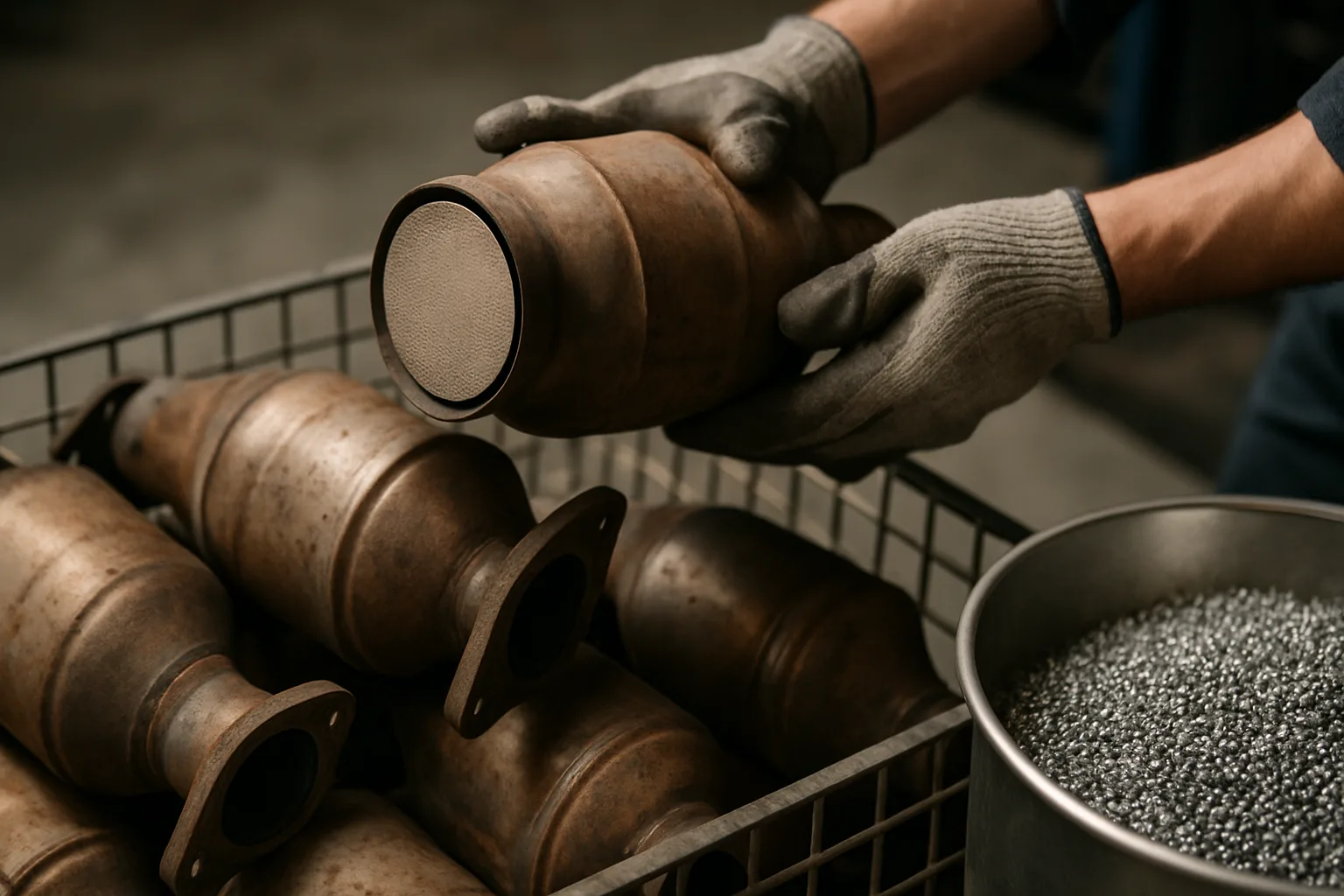
Catalytic converter theft cost U.S. vehicle owners and insurers billions of dollars in claims over the past several years — and the damage doesn't stop at the driveway. Every stolen converter that moves through a gray-market pipeline poisons the legitimate recycling market for honest scrap yards, fleet operators, and individual sellers trying to get a fair price. If you're focused on catalytic converter recycling Dearborn and you're playing by the rules, theft-driven market distortion is actively working against you. Here's what's really happening — and how transparent platforms are helping legitimate sellers fight back.
The Theft Problem Is Bigger Than Stolen Parts
On the surface, catalytic converter theft looks like a crime that only affects the vehicle owner. A Prius sits three inches lower in a parking lot, someone files an insurance claim, and life moves on. But the downstream effect on the legitimate recycling market is significant and underappreciated.
Stolen converters typically move fast — through informal channels, fly-by-night buyers, and gray-market processors who aren't asking questions. That velocity distorts the local price signal. When a buyer in the Dearborn area or anywhere in Michigan is processing large volumes of questionable material at suppressed prices to reduce exposure, the price benchmarks they quote to legitimate sellers get dragged down too. Honest sellers end up anchoring their price expectations to a market that's been contaminated by theft.
There's also a regulatory blowback effect. When theft spikes, state legislators respond with stricter documentation requirements, holding periods, and reporting mandates for all converter purchases — not just the sketchy ones. Legitimate recyclers bear the compliance burden of crimes they had no part in. That friction raises operating costs, and some of those costs get passed back to sellers through lower offers.
How Michigan's Regulatory Environment Affects Scrap Converter Prices in 2026
Michigan has tightened its scrap metal dealer regulations over the past several years, and 2026 enforcement reflects that. Dealers purchasing catalytic converters are now required to document seller identity, vehicle information, and in many cases, proof of ownership or removal authorization. These aren't optional guidelines — failure to comply creates real legal exposure for buyers.
For sellers in Dearborn and across Michigan, that means one thing: documentation is your leverage. Buyers who are serious about compliance want documented inventory. They're not just tolerating paperwork — they actually prefer it because it protects them. A fully documented converter with a clear chain of custody commands more buyer confidence than an undocumented unit with a vague story attached to it.
This is exactly where the gap between "catalytic converter buyers near me within 8.1 km" and a truly competitive offer becomes visible. A nearby buyer who's cutting corners on documentation isn't doing you any favors — they're paying you a price that reflects their risk exposure, not the actual used catalytic converter scrap value based on precious metal content. Proximity doesn't equal best price.
To understand how current precious metal markets are driving converter values right now, check current scrap converter prices before you make any decisions about where to sell.
What the Theft Market Does to Legitimate Seller Price Discovery
Here's the blunt version: when stolen converters flood a local market, price discovery breaks. The single-buyer model — calling one yard, accepting whatever number they give you — was already a weak strategy. In a theft-distorted market, it's even worse.
Think about what actually determines a converter's value:
- Platinum group metal (PGM) content — platinum, palladium, and rhodium concentrations vary by make, model, and year
- Current precious metal spot prices — which move daily and sometimes sharply
- Converter condition — melted substrates, damaged shells, and missing end caps all reduce recovery yield
- Accurate identification — serial numbers, OEM part numbers, and VIN-based lookups all help buyers price correctly
When a buyer is processing high volumes of stolen, undocumented units, they develop pricing habits that ignore documentation and identification. They quote flat, low-ball numbers because they've trained themselves not to ask detailed questions. When you walk in with a fully documented, properly identified converter, they apply the same blunt pricing logic — and you leave money on the table.
The answer isn't to find a different single buyer. The answer is to create competition. More buyers bidding on your documented inventory means the price reflects actual PGM value, not one buyer's risk-adjusted guess. Platforms like SMASH exist precisely for this reason — to put your inventory in front of vetted buyers who are competing on price, not colluding to keep it low.
If you want to see how competitive bidding changes the math, find the best scrap converter prices today and compare what you'd get in a single-buyer conversation versus a transparent auction format.
The Case for Documented Inventory — A Real Scenario
Consider a mid-sized auto dismantler operating out of the Dearborn area. They pull converters from end-of-life vehicles daily — sometimes dozens per week. For years, they called the same buyer, got a price, loaded a truck. No documentation beyond a basic receipt. Price never changed much. They assumed that was just "what converters pay."
Then two things happened simultaneously: Michigan tightened its scrap dealer documentation requirements, and their longtime buyer started asking for vehicle information they'd never tracked. The yard scrambled to retrofit documentation onto inventory they couldn't fully account for — and their buyer's offers dropped while they sorted it out.
The pivot was painful but instructive. They started using photo documentation on every pull. VIN lookups on every unit. Serial tracking through the inventory tool so every converter had a clean identity before it hit the sales channel. Once that documentation was in place, they had something they'd never had before: leverage. Multiple buyers could now bid confidently because the risk of purchasing non-compliant inventory was eliminated. The price they received moved up — not because the market changed, but because competition finally worked the way it's supposed to.
That's the SMASH model. Find the best price for your scrap on SMASH — vetted buyers, documented inventory, auction format. No subscription fees. SMASH only wins when you win.
How to Sell Catalytic Converters Online and Protect Yourself From Market Distortion
The rise of online converter sales has been one of the most important shifts in the scrap recycling space. When you sell catalytic converters online through a legitimate platform, you step outside the local price bubble entirely. You're no longer competing against theft-distorted local benchmarks — you're accessing a national pool of vetted buyers who price based on actual PGM content and spot markets.
Here's what the process looks like when it's done right:
- Identify your converters accurately. Use VIN lookup and serial number identification to confirm exactly what you have. Generic descriptions get generic prices.
- Document everything. Photos of the unit, photos of the vehicle it came from (if applicable), proof of ownership or authorization. This isn't just compliance — it's a pricing tool.
- Upload to a platform with vetted buyers. Not a Facebook group. Not a Craigslist listing. A platform where buyers have been screened and are competing seriously.
- Let competition work. Multiple bids on a well-documented load reveal the market. You see what buyers are actually willing to pay — not what one buyer hopes you'll accept.
- Get paid with a clear paper trail. Auto-invoicing, documented transactions, clean records. This protects you, your buyer, and your business reputation.
For sellers in sell catalytic converters Michigan markets — particularly in the Wayne County and greater Dearborn corridor where auto dismantling activity is concentrated — this approach is increasingly becoming the standard for serious operators. The yards still playing the single-buyer phone call game are leaving real money on the table.
To stay current on pricing trends and selling strategies, read scrap converter pricing guides that break down what actually drives converter value in today's market.
Winning Honestly in a Theft-Distorted Market
Catalytic converter theft isn't going away overnight. Gray-market channels will continue to operate until enforcement closes every gap — and that takes time. But legitimate sellers don't have to wait for perfect market conditions to get a fair price.
The tools exist right now: documented inventory, accurate identification, competitive auction formats, and transparent pricing based on real precious metal markets. The yards and operators who adopt these practices aren't just protecting themselves from regulatory scrutiny — they're actively building a competitive advantage in a market where most sellers still haven't figured out that documentation equals leverage.
Dearborn has some of the most experienced scrap operators in the country. The ones who will still be winning five years from now are the ones treating their converter inventory like the high-value commodity it actually is — not a commodity priced by whoever answers the phone first.
If you're ready to stop guessing and start competing, take the first step and find the best scrap converter prices — get a free quote at best-scrap-converter-prices.com. Your inventory is worth more than one buyer wants to admit.
Frequently Asked Questions
Q: How does catalytic converter theft affect prices for legitimate sellers in Dearborn?
Theft floods local markets with undocumented inventory, which trains some buyers to quote flat, low prices without considering actual PGM content. In Dearborn and across Michigan, this means legitimate sellers anchoring to suppressed local benchmarks often leave real money behind. Competitive online platforms help correct this by exposing your documented inventory to buyers who price on real market data.
Q: Do I need to prove ownership to sell catalytic converters in Michigan in 2026?
Yes. Michigan scrap dealer regulations now require documentation of seller identity and, in most cases, evidence of lawful possession of the converter. This applies to buyers statewide — not just in Dearborn. Having clean documentation protects you as a seller and actually improves the price you can command from compliant buyers.
Q: Is it worth selling catalytic converters online instead of using catalytic converter buyers near me?
Proximity alone doesn't equal best price. Local buyers working in theft-affected markets often quote conservatively. Selling online through a vetted platform like SMASH puts your documented inventory in front of multiple competing buyers, which can reveal significantly better pricing than a single local offer — especially for high-PGM units.
Q: What information do I need to get an accurate scrap converter price?
The more specific your identification, the better your price. Ideally, you want the converter's serial number or OEM part number, the vehicle's VIN if it came from an end-of-life vehicle, photos of the unit and shell condition, and the make, model, and year of the source vehicle. Accurate identification means buyers can price on actual PGM content rather than guessing low.
Q: How do I know if I'm getting the real market value for my used catalytic converter scrap value?
The only way to know is competition. A single buyer's quote tells you what one person is willing to pay — not what the market will actually bear. Platforms that put your inventory in front of multiple vetted buyers give you real price discovery. Tracking precious metal spot prices (platinum, palladium, rhodium) also helps you understand whether a quote reflects current market conditions.
Follow SMASH on LinkedIn for ongoing scrap metal market insights, pricing updates, and industry news that keeps you ahead of the market.