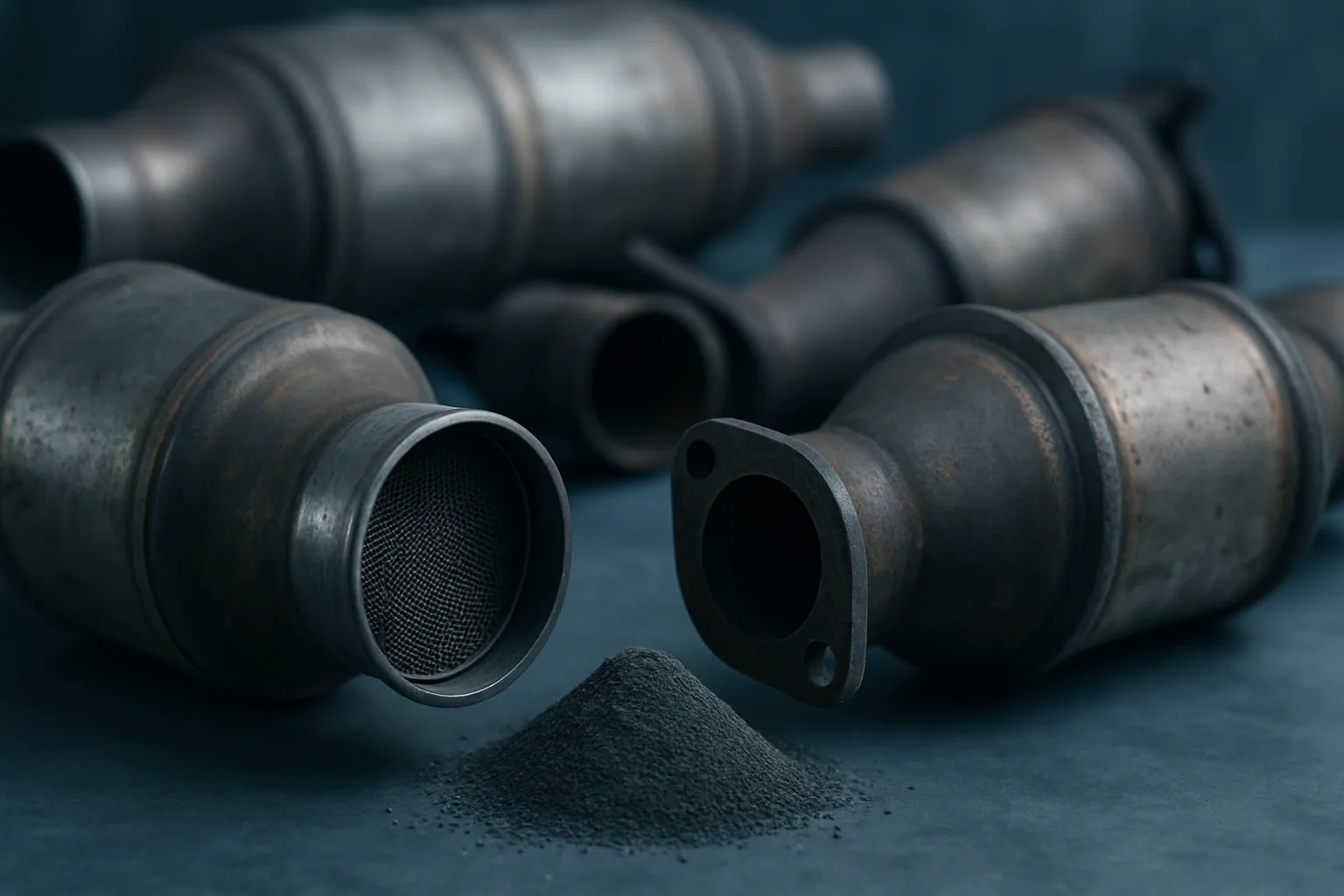
OEM vs. Aftermarket Catalytic Converters: Why the Scrap Value Gap Is Bigger Than You Think
Pull two catalytic converters off the same vehicle make and model. One is OEM. One is aftermarket. They look almost identical sitting on your workbench — but their scrap values can be separated by hundreds of dollars. If you're selling converters without understanding why, you're leaving real money on the table every single time.
The OEM catalytic converter value gap versus aftermarket units isn't random. It comes down to chemistry, loading rates, and the precious metals inside. Knowing the difference is one of the most practical things a converter seller can learn in 2026 — especially with platinum, palladium, and rhodium markets staying volatile heading into fall.
What Makes OEM Catalytic Converters Worth More at the Scrap Yard
OEM stands for Original Equipment Manufacturer. These are the converters installed at the factory — engineered to meet the vehicle's emissions specs and built to last the full service life of that vehicle. To do that job reliably, manufacturers load them with significantly higher precious metal content than a budget aftermarket replacement ever needs to carry.
The three metals that determine catalytic converter scrap value are platinum (Pt), palladium (Pd), and rhodium (Rh). OEM units from major automakers — think GM, Ford, Toyota, Honda — are typically loaded at rates that support real catalytic efficiency over 100,000+ miles of driving. Aftermarket converters, built primarily to pass an emissions test at a fraction of the cost, use lower precious metal loadings. They do the job well enough for street use. But when that converter hits the end of its life and lands at a scrap yard, the payout reflects what's actually inside — and the difference is significant.
- OEM converters — higher PGM (platinum group metal) loading, tighter tolerances, better washcoat distribution
- Aftermarket converters — lower PGM loading, designed for cost-efficiency rather than longevity or recovery value
- Value gap — can range from modest to several hundred dollars depending on the vehicle and metal markets
This isn't speculation. Recyclers and refiners who process thousands of converters a month can tell you within seconds whether something is OEM or aftermarket. The data is in the assay results.
How Recyclers in Toledo and Ohio Are Identifying Converter Types
Walk into any serious converter operation in Toledo and you'll find staff who can identify OEM versus aftermarket by visual cues alone — weld patterns, heat shields, stamped codes, and substrate color. But visual ID is just the first step. The real money is in accurate cataloguing.
Converters come with serial numbers, part numbers, and manufacturer stamps. Cross-referencing those against live pricing databases is how experienced sellers avoid getting lowballed. In Ohio, where a strong automotive history means a consistent flow of domestic OEM units from GM and Ford platforms, knowing what you have before you sell is a genuine competitive advantage.
The challenge for smaller yards and individual sellers is access to that data. Not everyone has a subscription to a pricing database or relationships with multiple buyers. That information gap is exactly where sellers lose money — not because the market is unfair, but because one buyer with no competition has no reason to offer you the full price. If you're looking for Toledo scrap metal services that take identification seriously, you want a buyer or platform that shows you the breakdown, not just a flat number per unit.
Catalytic Converter Prices Today — What's Driving the Market in 2026
Precious metal markets don't sit still, and catalytic converter prices today reflect that reality. Rhodium, which peaked at extraordinary levels earlier this decade, has stabilized but remains highly sensitive to supply shifts out of South Africa. Palladium continues to see demand pressure from hybrid vehicle platforms that retain combustion engines. Platinum has seen renewed interest from both automotive and industrial sectors.
The practical takeaway: the spread between a high-value OEM unit and a low-value aftermarket piece is not fixed. It moves with the underlying metal prices. A converter that paid well in early 2026 might pay differently by Q4 if rhodium ticks up or palladium softens. This is why locking yourself into a single buyer relationship — the old way of doing things — is a disadvantage. If your one buyer is working off stale pricing or skimming margin on the spread, you have no reference point.
Platforms that create real competition around your inventory give you a market signal, not a single opinion. That's the core difference between price discovery and price guessing. To check current scrap converter prices and understand what your OEM units are actually worth right now, you need access to real buyer competition — not one call, one number, take it or leave it.
Scrap Metal Inventory Management — The Step Most Sellers Skip
Here's a common scenario at yards across Ohio: a load of converters goes out the door priced by weight or by a rough visual sort. Some of those units are high-value OEM pieces from late-model domestic trucks. Others are cheap aftermarket units worth a fraction of the price. They all get averaged together, and the seller gets one blended rate.
The buyer knows exactly what's in that load. The seller doesn't — or didn't document it well enough to negotiate. That's not a market problem. That's a scrap metal inventory management problem, and it's fixable.
Good documentation before a sale means:
- Photographing each unit clearly, including stamps and serial numbers
- Cross-referencing part numbers against a converter pricing database
- Separating OEM units from aftermarket before quoting
- Tracking your inventory so you can identify patterns in what you're accumulating
When buyers can see exactly what they're bidding on — with photos, serial tracking, and accurate descriptions — they bid with more confidence. More confident buyers tend to bid higher. That's not a complicated concept, but it requires doing the documentation work upfront. SMASH builds inventory tools and photo documentation into the process precisely because documented loads consistently attract stronger offers than mystery boxes.
Why Selling Through a Competitive Auction Changes the Math
The traditional converter selling process looks like this: you call your guy, he tells you a number, you take it. Maybe you call a second yard for comparison. Maybe you don't. Either way, you're working with one or two data points and hoping you're not getting taken.
The SMASH scrap metal auction model flips that. Your documented inventory goes in front of multiple vetted buyers simultaneously. Those buyers compete. You see the bids. You make the call based on actual market response, not a single buyer's margin calculation.
For OEM converter inventory specifically, this matters enormously. The value spread between a commodity buyer who blends everything and a specialty converter buyer who wants specific OEM units can be substantial. You can't access that spread if you're only talking to one buyer. Competition can help reveal the market. More buyers means better price discovery. That's not a promise of a specific dollar amount — that's how markets work when they function properly.
Toledo yards moving regular converter volume have everything to gain from putting that inventory in front of a competitive field. Get competitive bids for your scrap metal and see what actual buyer competition looks like for your specific units — OEM and aftermarket alike.
How to Position Your Inventory Before You Sell
Whether you're an individual seller or running a yard in northwest Ohio, the preparation steps are the same. Do them before you sell, not after.
- Sort first. Separate OEM from aftermarket. Don't mix them in one lot if you can avoid it.
- Document everything. Serial numbers, photos from multiple angles, visible stamps or codes.
- Know your metals. Understand that platinum-heavy units (many domestic OEM converters) behave differently than palladium-heavy units (common in Japanese OEM vehicles).
- Watch the market. PGM prices shift. Selling into a rising rhodium market is different from selling when it's depressed.
- Use platforms that work for you. A platform with no subscription fee and a vetted buyer network means no upfront cost and real competition on your loads.
SMASH charges no subscription fee. You only pay when a deal closes — meaning SMASH only wins when you win. That structure matters when you're evaluating who to trust with your converter inventory. To find the best scrap converter prices today, start with the right platform and the right documentation. The rest follows. You can also read scrap converter pricing guides to sharpen your knowledge before your next sale.
If you're moving converters regularly out of Toledo or anywhere across Ohio, doing this right isn't complicated — it just requires not defaulting to the path of least resistance. The path of least resistance is usually the most expensive one.
Disclaimer: Catalytic converter scrap prices fluctuate daily based on platinum, palladium, and rhodium spot prices. Always check current rates before selling. The figures and ranges referenced in this article reflect general market context as of August 2026 and are not guaranteed pricing.
Frequently Asked Questions
Q: Why is OEM catalytic converter value so much higher than aftermarket?
OEM converters are loaded with higher concentrations of platinum, palladium, and rhodium because they need to maintain emissions performance for the full life of the vehicle. Aftermarket units are built for cost efficiency and use lower PGM loadings — which means less recoverable precious metal when the converter reaches the end of its life. The scrap value reflects what's actually inside, not what the converter looks like on the outside.
Q: How do I know if my catalytic converter is OEM or aftermarket?
Check for a stamped part number or serial code on the converter body. OEM units typically carry manufacturer-specific codes that can be cross-referenced against pricing databases. Aftermarket units often have generic identifiers or codes from replacement part suppliers. Visual cues like weld style, heat shield design, and substrate color can also help, though experienced recyclers and platforms with good inventory tools can confirm identification more reliably.
Q: What are catalytic converter prices today in Toledo, Ohio?
Converter prices in Toledo follow the same PGM spot markets as the rest of North America — platinum, palladium, and rhodium prices set the floor, and buyer competition determines how much of that value you actually capture. Prices change daily. To get accurate current pricing for your specific units, use a platform that shows real buyer bids rather than a single yard quote.
Q: Is it worth sorting OEM converters from aftermarket before selling?
Yes — almost always. Mixing high-value OEM units into a lot with low-value aftermarket pieces typically results in a blended rate that undervalues your best inventory. Separating and documenting OEM units individually gives buyers the information they need to bid accurately, and accurate buyers tend to bid more competitively on clearly identified, high-value units.
Q: How does SMASH help with selling scrap catalytic converters?
SMASH connects sellers with vetted buyers through a competitive auction format, which means your documented converter inventory goes in front of multiple buyers at once rather than one buyer at a time. The platform supports photo documentation and serial tracking to help buyers bid with confidence. There are no subscription fees — SMASH earns only when a transaction closes, so the incentive is aligned with getting you the strongest result the market can support.
Ready to stop guessing what your converters are worth? Find the best scrap converter prices — get a free quote at best-scrap-converter-prices.com.
Follow SMASH on LinkedIn for scrap metal market updates, converter pricing insights, and industry news that actually matters to yard operators and sellers across North America.