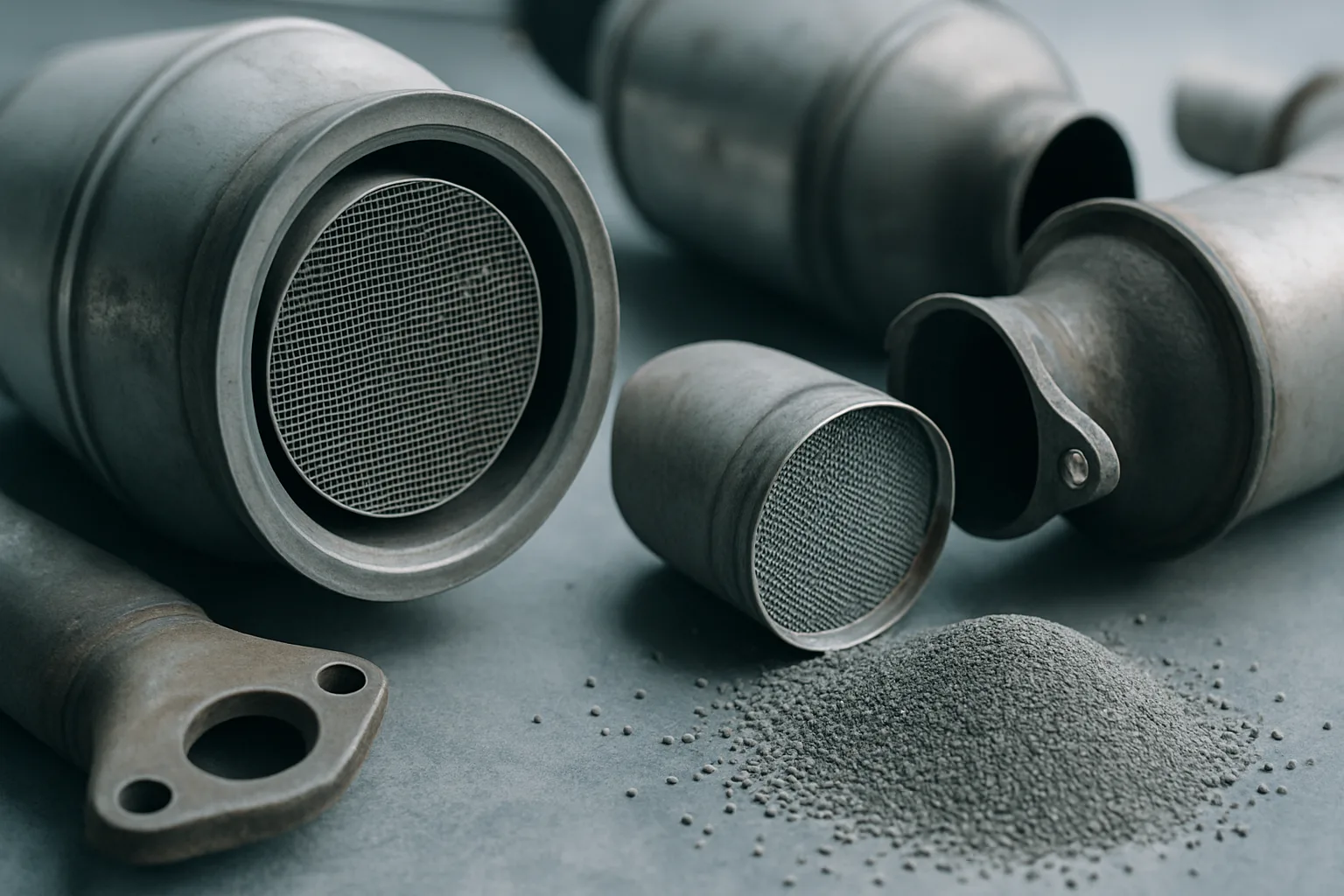
What's Actually Inside a Catalytic Converter — and Why It's Worth Real Money
Most people know catalytic converters are valuable. Far fewer understand why. It's not the steel housing or the ceramic substrate that drives the price. It's what's embedded inside that substrate — three precious metals that are rarer than gold and critical to industries far beyond scrap yards. If you want to understand catalytic converter prices today, you need to understand platinum, palladium, and rhodium first.
These three metals are part of the platinum group metals (PGMs). They exist in trace quantities inside every converter, measured in grams — sometimes fractions of a gram. But global demand for PGMs is intense, prices swing sharply, and that directly controls what a scrap converter is worth on any given day. The converter sitting in your shop is essentially a small PGM deposit.
Understanding how converter scrap value gets calculated puts you in a far better position when it's time to sell. Guessing or accepting the first number a buyer throws at you is how yards leave money on the table.
The Three Metals That Drive Catalytic Converter Prices Today
Every catalytic converter uses some combination of platinum, palladium, and rhodium. The exact blend depends on the vehicle manufacturer, the engine type, the model year, and whether the vehicle runs gasoline or diesel. Each metal plays a specific chemical role in the emissions reduction process — they're not interchangeable, and the market prices them independently.
Here's what you need to know about each one:
- Platinum (Pt): Historically the most recognized PGM, platinum is used heavily in diesel converters. It handles oxidation reactions that neutralize carbon monoxide and unburned hydrocarbons. Platinum prices tend to be more stable than palladium or rhodium, but they still shift with industrial demand, mining output from South Africa, and broader commodity market sentiment.
- Palladium (Pd): Palladium dominates gasoline engine converters. Over the past decade, it surged dramatically in price as stricter emissions standards drove automaker demand through the roof. Palladium is primarily mined in Russia and South Africa, which makes its price sensitive to geopolitical and supply chain disruptions.
- Rhodium (Rh): The smallest quantity but often the highest per-gram value of the three. Rhodium reduces nitrogen oxide emissions — a critical function under modern emissions standards. It's extraordinarily rare, and its price is notoriously volatile. Rhodium can move hundreds of dollars per troy ounce in a single month.
The relative weight of each metal inside a specific converter, combined with the current spot price for each PGM, is what ultimately drives the converter's scrap value. There's no flat number — it's a calculation.
How Converter Scrap Value Is Actually Calculated
Legitimate converter buyers aren't guessing. They're working from assay data — laboratory analysis that shows exactly how many grams of platinum, palladium, and rhodium a specific converter type yields after processing. Over time, that assay data builds into large databases organized by serial number, VIN, or converter part number.
Here's the basic formula behind every converter price:
- Identify the converter — by serial number, part number, or OEM identification. This maps to existing assay records.
- Pull current PGM spot prices — platinum, palladium, and rhodium each have live market prices updated throughout the trading day.
- Calculate the gross value — multiply PGM content (in troy ounces) by their respective spot prices.
- Apply a return percentage — processors don't pay 100% of assay value. They factor in refining costs, logistics, and their margin. The return percentage a buyer offers is often where the real negotiation happens.
What this means for sellers: two buyers looking at the exact same converter on the exact same day might offer meaningfully different prices — not because one is cheating, but because their assay data, their refining costs, or their return percentage assumptions differ. That gap is real money. More competitive bidding environments help surface the actual market rate. Platforms like SMASH Scrap — where verified buyers bid on your metal exist precisely to create that competition instead of leaving it to a single phone call.
Why Converter Prices Fluctuate — Even Day to Day
If you've been selling converters for any length of time, you've seen prices move without any obvious explanation. A load worth one number on Monday might be worth a different number on Friday. This isn't yard operators being arbitrary — it's the PGM market doing what commodity markets do.
Several factors drive short-term price movement:
- Spot price shifts: PGMs trade on international markets. A single large mining disruption, a currency swing, or a shift in industrial demand forecasts can move prices quickly.
- Refinery backlogs: When processors are backed up, return timelines extend — and some buyers factor that carry cost into what they'll pay today.
- Automotive production data: New vehicle output affects long-term PGM demand projections. Weak auto production numbers can soften palladium demand sentiment.
- EV transition pace: As electric vehicles displace internal combustion engines over the long term, the demand trajectory for converter PGMs is a legitimate market conversation. In 2026, that transition is real but gradual — ICE vehicles still dominate the roads, and converter scrap volume remains strong.
- Currency fluctuations: PGMs are priced in USD globally. Currency swings between the dollar and the South African rand or Russian ruble — two major PGM-producing nations — can affect supply-side economics.
The practical takeaway: timing matters, documentation matters, and getting multiple buyers engaged matters. Check current scrap converter prices before you commit to a sale — the market you sold into six months ago may look different today.
Why Indianapolis Sellers Need Competitive Bidding — Not One Buyer
In Indianapolis and across Indiana, scrap yards and auto recyclers move significant converter volume. The region's mix of older domestic vehicles, fleet operations, and commercial trucking means a wide variety of converter types flow through local yards — diesel units, high-value domestic cats, and mid-tier imports alike.
The problem isn't finding a buyer. There are buyers. The problem is that a single buyer, reached by a single phone call, has no incentive to offer you their best number. They'll offer what they think you'll accept. Without competitive pressure, you have no way of knowing whether that number reflects the actual market or just reflects what that one buyer wants to pay.
That's the core argument for auction-style selling. When multiple vetted buyers compete for your load, the price discovery process actually works. SMASH runs exactly this kind of format — documented inventory, serial tracking, vetted buyer pool, competitive bids. If you're handling Indianapolis scrap metal services at any real volume, the difference between one bid and four bids on the same load compounds quickly over a year.
For sellers in Indianapolis and the broader Indiana market, find the best scrap converter prices today by putting your inventory in front of buyers who are actively competing — not just waiting for your call.
Documentation: The Hidden Variable in Converter Scrap Value
Experienced buyers pay more for well-documented loads. This isn't arbitrary — it's risk management on their end, and it's leverage on yours.
When a buyer receives a load with clear serial numbers, accurate part identification, and photo documentation, they can price it with confidence against known assay data. When a load arrives with missing serials, damaged units, or ambiguous identification, buyers build uncertainty into their offer — and uncertainty costs the seller.
Strong documentation practices include:
- Photo every unit — both the converter body and the serial/part number clearly visible.
- Record serial numbers at intake, not at sale time.
- Separate converter types — don't mix diesel and gasoline units, or high-value domestics with lower-value imports, in a way that obscures the load composition.
- Note any physical damage — crushed, foiled, or bead-blasted converters have lower recoverable PGM content and buyers price accordingly.
Platforms like SMASH build inventory documentation tools directly into the selling process. Buyers on the platform see what they're bidding on. That confidence reflects in the offers. Read scrap converter pricing guides to go deeper on how documentation affects your bottom line.
Disclaimer: Catalytic converter prices fluctuate daily based on live PGM spot prices and market conditions. Always verify current rates before finalizing any transaction.
Frequently Asked Questions
Q: What precious metals are inside a catalytic converter?
Every catalytic converter contains some combination of platinum, palladium, and rhodium — known collectively as platinum group metals (PGMs). The exact mix and quantity depend on the vehicle make, model, engine type, and year. These PGMs are what give converters their scrap value, not the steel or ceramic components.
Q: Why do catalytic converter prices change so often?
Because converter scrap value is directly tied to live PGM spot prices, which trade on international commodity markets and move daily. Palladium, platinum, and rhodium all respond to mining output, industrial demand, currency movements, and geopolitical factors. A converter worth a certain amount today may be worth more or less by the end of the week.
Q: How do I get the best catalytic converter price in Indianapolis?
The most reliable way to get a strong price is to have documented inventory and put it in front of multiple buyers who are actively competing for it. Single-buyer transactions rarely surface the true market rate. In Indianapolis and across Indiana, sellers who use auction-style platforms or get multiple bids consistently fare better than those relying on a single buyer relationship.
Q: Does a damaged catalytic converter have scrap value?
Yes, but less than an intact unit. Physical damage — crushing, foiling, or bead-blasting — can reduce the recoverable PGM content, and buyers factor that into their offers. Always disclose damage and document it with photos so buyers can price accurately rather than assuming the worst.
Q: What is a catalytic converter auction and how does it work?
A catalytic converter auction is a competitive bidding format where multiple vetted buyers submit offers on a documented converter inventory. Rather than accepting the first number one buyer quotes over the phone, the seller receives competing bids and can accept the strongest offer. SMASH facilitates exactly this process — documented inventory, verified buyers, competitive pricing.
---If you're selling converters in Indianapolis, across Indiana, or anywhere in the U.S., the math is simple: better information and more competition produce better outcomes. Document your inventory, know what's inside your converters, and put those loads in front of buyers who have to earn the sale. That's how you stop leaving money on the table. When you're ready, find the best scrap converter prices today and get a free quote at best-scrap-converter-prices.com.
Stay current on PGM markets, scrap pricing trends, and converter industry news by following SMASH on LinkedIn — practical updates for people who actually work in scrap.
```