From Honeycomb to Hard Cash: How Assaying and Smelting Determine Your Converter's True Value
Most converter sellers never think about what happens after they hand over a load. They get a number, take it or leave it, and move on. But if you don't understand how that number gets calculated, you're negotiating blind — and in Miami's competitive scrap market, that's money left on the table.
The science behind scrap catalytic converter prices Miami sellers chase every day comes down to two processes: assaying and smelting. These aren't abstract lab concepts. They're the direct pipeline from your converter's ceramic substrate to your final payout. Understanding them changes how you evaluate offers and who you trust to buy your cats.
Whether you're moving a handful of units from a local shop or selling full pallets, find the best scrap converter prices today by knowing exactly what drives the number behind every bid.
What's Actually Inside a Catalytic Converter — and Why It Matters
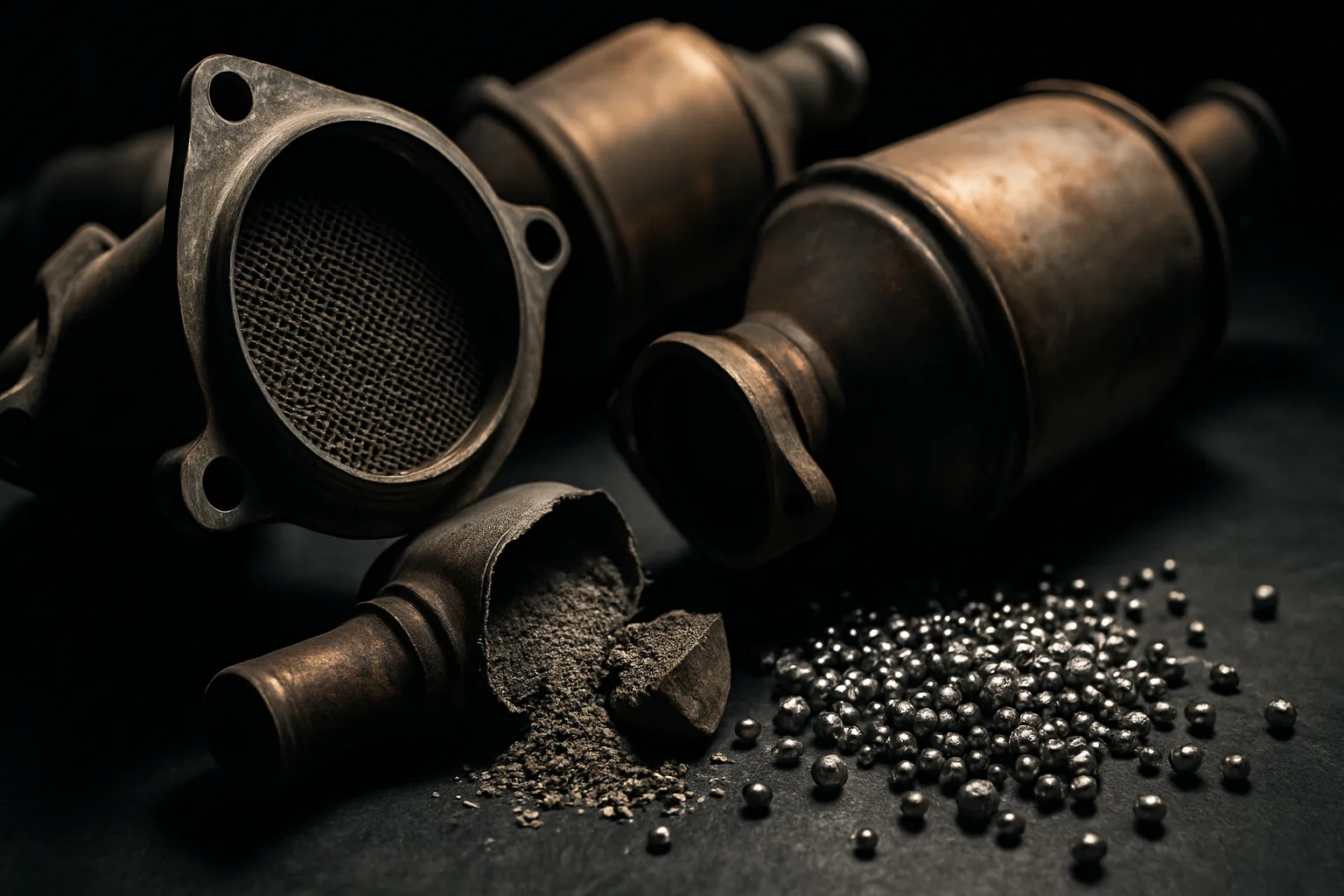
A catalytic converter looks simple from the outside. Cut one open and you'll find a ceramic or metallic honeycomb substrate coated with a wash of platinum group metals (PGMs): platinum (Pt), palladium (Pd), and rhodium (Rh). These three metals do the actual work of converting exhaust emissions into less harmful gases.
Their concentration varies widely by vehicle type, engine size, model year, and manufacturer. A late-model truck converter from a major domestic brand might carry several grams of combined PGMs. A small economy import might carry a fraction of that. The outer shell tells you almost nothing. The substrate chemistry tells you everything.
This is why experienced catalytic converter buyers Florida-wide don't price cats by weight alone. They price by PGM content — and that content only becomes verifiable through proper assaying.
- Platinum: Used primarily in diesel converters. Prices fluctuate with industrial demand and auto sector output.
- Palladium: Dominant in gasoline converters. Has seen extreme price swings over the last decade due to supply constraints from Russia and South Africa.
- Rhodium: The rarest and most volatile of the three. Even tiny quantities significantly impact converter scrap value.
How Assaying Works: Turning Substrate Into a Price-Per-Unit Number
Assaying is the analytical process that determines how much of each PGM sits inside a specific converter or batch of converters. It's a multi-step process, and understanding it reveals why accurate assay results take time — and why rushing the process costs sellers money.
Here's how a professional assay typically unfolds:
- Decanning: The outer steel shell is cut away, and the ceramic or metallic substrate is removed. The substrate is the part that holds the PGMs. The shell itself has minimal scrap value and is usually processed separately as ferrous material.
- Crushing and milling: The substrate is crushed into a fine, homogeneous powder. This is critical — PGM distribution across the honeycomb isn't perfectly uniform, so a representative sample requires thorough mixing of the entire unit.
- Sampling: A statistically accurate sample is pulled from the milled powder. Typical sample sizes are small — often just a few grams — but they must represent the entire batch accurately.
- Digestion: The sample is dissolved in acid (typically aqua regia, a mixture of nitric and hydrochloric acid). This breaks down the material and puts the metals into solution.
- Analysis: The solution is analyzed using techniques like Inductively Coupled Plasma Optical Emission Spectrometry (ICP-OES) or X-ray fluorescence (XRF). These methods quantify the exact concentration of platinum, palladium, and rhodium in the sample.
- Settlement calculation: The assay results are applied against current spot prices for each PGM, minus processing and refining fees, to produce a final settlement value per unit or per troy ounce of recovered metal.
The entire process can take days to weeks depending on the facility, batch size, and whether the buyer uses in-house processing or sends material to a third-party smelter. Sellers who sell catalytic converter online through transparent platforms can track where their material sits in this pipeline — rather than waiting on a phone call that may never come.
Smelting: Where the Metal Gets Recovered and the Real Value Is Confirmed
Assaying tells you what's in the converter. Smelting is the process that actually extracts it. These two steps are related but distinct — and both matter when evaluating your used catalytic converter scrap value.
After assaying, milled converter material is fed into a high-temperature smelting furnace. At temperatures exceeding 1,400°C, the ceramic substrate breaks down. The PGMs, which have extremely high melting points, are collected into a metallic collector (often iron or copper) that sinks to the bottom of the molten bath. The slag — the waste material from the ceramic — floats to the top and is removed.
What remains is a PGM-rich alloy called a "sponge" or "matte," depending on the process used. This material then undergoes further refining through chemical and electrochemical processes to separate pure platinum, palladium, and rhodium from each other and from the collector metal.
The final refined metals are assayed again at this stage to confirm purity before settlement. This is why some buyers offer "toll refining" arrangements where sellers retain ownership of their material through the entire smelting and refining process, settling based on actual recovered values rather than upfront estimates.
For high-volume sellers in Miami and across Florida, understanding the difference between an upfront price-per-unit offer and a toll refining arrangement can be the difference between a fair deal and a significant underpayment.
Why Assay Accuracy Directly Impacts Scrap Catalytic Converter Prices Miami Sellers Receive
Here's the practical reality: not all buyers use the same assay methods, and not all assay results are shared transparently with sellers. Some buyers run internal assays and apply undisclosed margins before quoting. Others use third-party labs but don't share the raw data with the seller.
This opacity is one of the biggest sources of price disparity in the converter market. A Miami seller quoting three different buyers on the same load may receive three meaningfully different numbers — not because the converters changed, but because each buyer's assay process, overhead, and margin structure is different.
Transparent buyers will show you:
- The assay results per unit or per lot
- The PGM spot prices used in the calculation
- Their refining fees and deductions
- The return percentage (what percentage of recovered PGM value you receive)
If a buyer can't or won't show you these numbers, you're accepting a black-box offer. Read scrap converter pricing guides to understand what a fair settlement structure looks like before you commit to any buyer.
Platforms like SMASH are built around this transparency problem. Rather than accepting one buyer's undisclosed margin, you can compare scrap metal bids from verified buyers who compete openly for your load — giving you a clearer picture of what your cats are actually worth in the current market.
How to Use This Knowledge to Get Better Converter Prices in Miami
Understanding assaying and smelting isn't just academic. It gives you specific, practical leverage when negotiating with buyers or evaluating online platforms.
Ask about assay method. Fire assay (FA) and ICP are both legitimate but have different precision profiles for PGMs. A buyer using XRF screening alone — without wet chemistry confirmation — is giving you a preliminary estimate, not a final settlement number.
Understand return rates. Most processors don't pay 100% of recovered PGM value. Return rates typically range widely depending on the buyer, batch size, and whether you're selling spot or toll refining. Negotiating return rate is as important as negotiating price per unit.
Document your inventory. Photo documentation, serial tracking, and accurate unit counts protect you if there's a dispute over assay results or unit counts. SMASH's inventory tools make this easy, especially for larger loads coming out of Miami's active auto recycling yards.
Watch PGM spot prices. Palladium and rhodium are notoriously volatile. A load quoted today may settle very differently if processing takes three weeks and markets move. Understand whether your buyer is locking in spot at time of receipt or at time of settlement — it matters.
For sellers looking to move converters from Miami-area shops or yards, taking advantage of local Miami scrap metal services that connect you with vetted buyers can eliminate a lot of this guesswork.
SMASH brings competitive bidding to this process. Instead of one buyer setting your price based on their internal assay and margin, multiple verified buyers see your load and compete. More competition means better price discovery. Check current scrap converter prices and see how your material compares before you accept any offer.
The converter market in Miami and across Florida is active, and buyers know what they're doing. The sellers who get the best returns are the ones who know what they're doing too. If you're ready to stop guessing and start getting real numbers on your cats, now's the time to put your load in front of buyers who compete for it.
Disclaimer: Catalytic converter scrap value fluctuates daily based on platinum, palladium, and rhodium spot prices. Always verify current rates before finalizing any sale.
Frequently Asked Questions
Q: How long does catalytic converter assaying take before I get paid?
It depends on the buyer and facility. Basic XRF screening can happen same-day, but it's a preliminary estimate. Full wet chemistry assay (ICP or fire assay) through smelting and refining typically takes one to four weeks. Ask your buyer upfront whether they pay on an advance or wait for final settlement.
Q: Why do cat converter prices in Miami vary so much between buyers?
Different buyers use different assay methods, apply different return rates, and carry different overhead structures. Margin assumptions baked into upfront offers vary significantly. Getting multiple bids — ideally from a platform that brings buyers into direct competition — is the most reliable way to identify the best offer for your specific load.
Q: Does it matter if my catalytic converters are damaged or partially melted?
Yes. Damaged substrates, melted or cracked ceramics, and missing or loose material all reduce the recoverable PGM content. Buyers will factor this into their offer, and some may reject heavily damaged units. Document condition with photos before shipping — it protects you if a buyer disputes the assay result.
Q: Can I sell catalytic converters online from Miami without dropping them off in person?
Yes. Many platforms, including SMASH, support remote selling with photo documentation, VIN lookup, serial tracking, and freight coordination. You pack and ship the load; buyers bid based on your documented inventory. It's a growing option for Florida sellers who want access to buyers beyond their immediate area.
Q: What is a "return rate" and how does it affect my final payout on scrap converters?
The return rate is the percentage of total recovered PGM value that the refiner or processor pays back to the seller after deducting their fees. If the assay shows $500 worth of recoverable metals and the buyer's return rate is 80%, your settlement is $400. Negotiating return rate — not just price per unit — is critical for maximizing your used catalytic converter scrap value.
Ready to stop taking one buyer's word for what your cats are worth? Find the best scrap converter prices — get a free quote at best-scrap-converter-prices.com and put real competition behind your next load.
Follow SMASH on LinkedIn for ongoing industry updates, PGM market insights, and practical guides for converter sellers across North America.
```