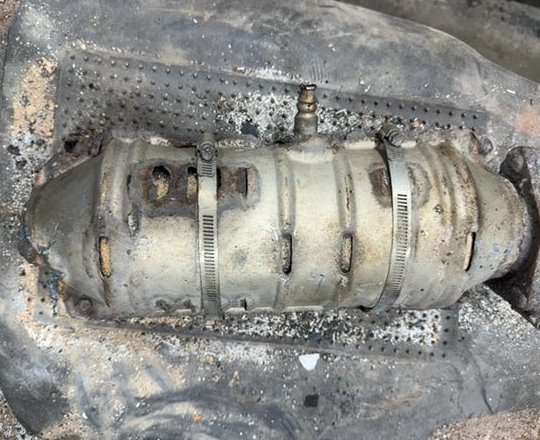
Precious-Metal Benchmarks vs. a Real Offer: What Actually Matters When You Sell a Catalytic Converter
You found a precious-metal spot price online. You found a calculator that spits out a number. Now you have an actual offer for your identified converter. Which number should you trust — and why do they rarely match?
That gap is the question worth answering before you decide anything.
What Precious-Metal Benchmarks Actually Measure
Platinum, palladium, and rhodium trade on commodity markets. Those prices move daily — sometimes sharply. Benchmarks reflect the value of refined, pure metal, not the value of your converter sitting on a shelf.
Between your converter and refined metal, there are real costs:
- Assay and sampling — the actual precious-metal content has to be measured, not assumed.
- Processing and smelting — refining costs money regardless of the spot price.
- Recovery rates — not every gram in the substrate gets recovered. Recovery varies by converter condition, age, and substrate type.
- Buyer margin — whoever buys your converter takes on price risk. That risk gets priced in.
A spot-price calculator skips all of this. It may show you a theoretical ceiling, not a realistic offer. That doesn't mean offers are arbitrary — it means the gap has real causes.
What an Identified Converter Offer Actually Reflects
When a buyer quotes a price on a specific converter — say, a unit with a known vehicle application, a readable serial number, and documented condition — that quote is grounded in something more useful than a benchmark:
- Known precious-metal loading — identifiable converters have published or historical loading data by vehicle make, model, and year.
- Current demand from downstream buyers — not just spot prices, but what processors are actively paying for that substrate type right now.
- Condition assessment — a converter with intact substrate and verifiable origin is worth more to a buyer than one of unknown condition.
An offer on an identified, documented converter reflects current market demand, not a theoretical calculation. That's the number closer to what actually changes hands.
A Hypothetical Comparison — Clearly Labeled as Such
The following is a hypothetical scenario for illustration only. It does not represent an actual transaction, customer, or outcome. No real offer, price, or result is implied.
Suppose someone in Summit County has a detached converter from a vehicle they owned. They find a precious-metal benchmark suggesting a rough value based on platinum and palladium spot prices. They also submit the converter details — VIN, photos, serial number — to a purchase eligibility review and receive a specific offer.
In this hypothetical, the offer is lower than the raw benchmark. That gap might reflect processing costs, recovery assumptions, and current buyer demand for that specific substrate. Or the offer might be closer to the benchmark than expected, because that particular converter has high-demand loading and the buyer is actively sourcing it.
The hypothetical point: neither number is "wrong." They measure different things. The benchmark measures refined metal. The offer measures what a real buyer will pay for that converter, today, as-is.
The decision question isn't "which number is higher." It's "which number reflects what I'll actually receive?"
What You Can't Determine from a Calculator Alone
No online calculator can tell you:
- What your specific converter's substrate condition is
- Whether the substrate has been damaged, washed, or contaminated
- What downstream buyers are paying for that unit type this week
- Whether your converter qualifies for a purchase review under current acceptance criteria
Calculators are a starting point for curiosity, not a substitute for a real eligibility review. If you want to check current scrap converter prices against an actual offer, you need a buyer who can assess the specific unit — not a formula built on generic assumptions.
Selling a Catalytic Converter in Ohio: What to Bring to the Process
Ohio has documentation requirements tied to converter sales. Requirements can change, and this is not legal guidance — confirm current requirements directly with SMASH when you submit your details. Generally, being prepared with the following puts you in the strongest position for a purchase eligibility review:
- Proof of vehicle ownership (title or registration matching the converter's source vehicle)
- A readable serial number or OEM part number on the converter
- Clear photos of the converter, including both ends and any visible markings
- Your name and contact information
An unknown vehicle make is a different situation from an unclear ownership history. If you know the vehicle but not the exact make or year, say so when you submit — don't guess. SMASH will tell you what additional information is needed.
How Documentation Affects What a Buyer Can Offer
Documented, identified converters are easier for buyers to price confidently. When a buyer can match your serial number to known loading data, they don't have to discount for uncertainty. That matters in the offer you receive.
Keep the converter intact. Don't attempt to open, cut, or remove the substrate. A damaged substrate affects both value and eligibility. Submit it as-is, with photos, and let the review process work from there.
If you're in northeast Ohio and want to understand your options, Akron scrap metal services through SMASH start with a straightforward eligibility review — not a promise, just a process.
To find the best scrap converter prices today, the benchmark is a reference point. The offer is the real number. Submit your converter details and find out where yours lands.
For more context on how converter values are calculated and what affects offers, read scrap converter pricing guides before you decide. And for additional converter information from SMASH directly, visit SMASH converter information.
Ready to move forward? Submit your converter details to SMASH for a purchase eligibility review at best-scrap-converter-prices.com. No subscription. No runaround. A straight review of what you have.
Frequently Asked Questions
Q: How much is my catalytic converter worth in Akron, Ohio?
There's no universal answer — converter value depends on the specific unit, its precious-metal loading, current market demand, and condition. Online calculators use benchmark metals prices, which don't reflect actual offer prices after processing costs and recovery rates. Submit your converter details for an eligibility review to get a number grounded in your actual unit, not a generic formula.
Q: Can I sell a single catalytic converter online if I'm in Ohio?
Lawful owners — including someone with a single detached converter — can submit details for a purchase eligibility review. Ohio has documentation requirements for converter sales; confirm current requirements with SMASH when you submit. This is a review process, not an automatic offer or guaranteed purchase.
Q: What documentation do I need for catalytic converter recycling in Akron?
Generally, proof of vehicle ownership, a readable serial or part number, and clear photos of the converter are the starting point. Requirements can vary and may change — treat this as preparation guidance, not legal advice, and confirm exactly what's needed when you submit your details to SMASH.
Q: Why is the offer I received lower than the precious-metal calculator showed?
Benchmarks measure the price of refined, pure metal — not what a buyer pays for a raw converter. Processing costs, assay, recovery rates, and buyer margin all sit between the spot price and the offer you receive. A specific offer on an identified converter reflects actual market demand for that unit today, which is a more accurate signal than a theoretical ceiling.
Q: Do I need to remove or cut open the converter before selling it?
No. Keep the converter intact. Cutting or opening the converter can damage the substrate, reduce value, and affect purchase eligibility. Submit photos and details as-is and let the review process determine next steps.