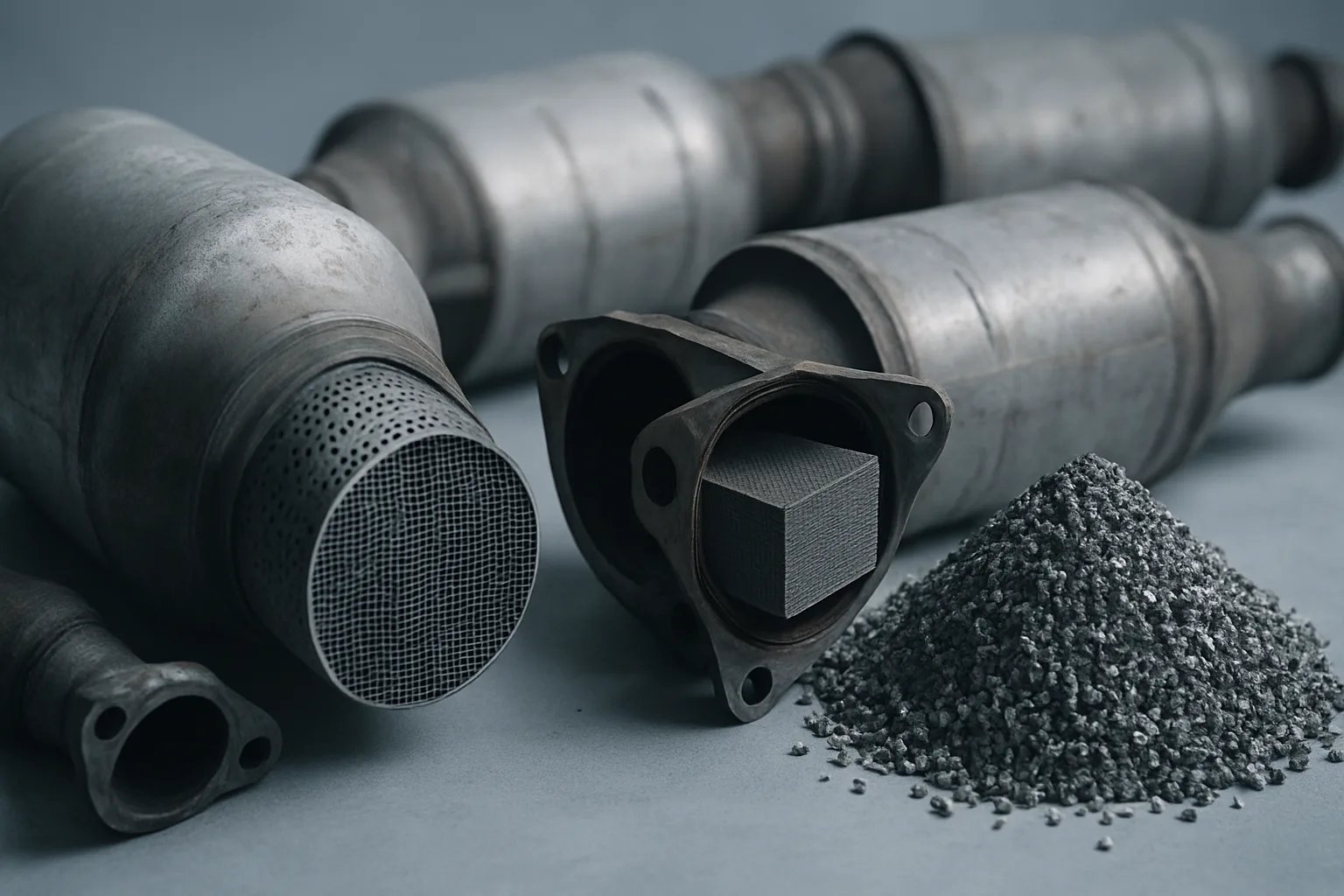
Why Two Identical-Looking Converters Can Have Wildly Different Scrap Values
Pull two catalytic converters off the shelf at any scrap yard in Atlanta and they might look almost identical. Same size. Same shape. Same dirty exterior. But one could be worth $40 and the other could fetch $400 or more. That gap isn't random — it comes down to grading, and most sellers never learn how it works until they've already left money on the table.
If you're trying to get the best catalytic converter price Atlanta has to offer, understanding how converters are graded and priced is the single most important thing you can do before you walk into a yard or submit a load for auction. This week's market recap breaks it all down — grading tiers, what drives pricing week to week, and how to use that knowledge to your advantage.
How Catalytic Converter Grading Actually Works
Every converter gets assigned a grade based on the concentration of platinum group metals (PGMs) inside the ceramic substrate — primarily platinum, palladium, and rhodium. Those three metals are what give a converter its scrap value. The shell, the casing, the heat shield? Largely irrelevant. What matters is what's inside and how much of it.
Grading systems vary by buyer, but most follow a general structure:
- High-grade converters: Found on luxury vehicles, larger engines, or newer model vehicles. Higher PGM loading. These are the units buyers compete hardest for.
- Mid-grade converters: The majority of the market. Standard domestic and import passenger vehicles. Solid scrap value, consistent demand.
- Low-grade converters: Older units, small displacement engines, or converters that have been heat-damaged or physically compromised. Lower PGM content, lower payouts.
- Foreign/import grades: Many buyers break this down further — domestic Ford/GM/Chrysler grades versus Japanese or European import grades, which often carry different PGM ratios.
- Aftermarket converters: These are the ones that catch sellers off guard. Aftermarket units contain significantly less PGM content than OEM converters. Expect substantially lower offers — often just a few dollars for the steel value alone.
The grade a buyer assigns determines your payout. If a buyer grades your converter lower than it actually is — intentionally or through sloppy identification — you lose money. That's why having access to accurate grading data and multiple competing buyers is critical.
Rhodium, Palladium, and Why Scrap Metal Prices Today Matter Every Week
Converter scrap value doesn't exist in a vacuum. It moves with the precious metals market, and right now in August 2026, that market continues to show meaningful volatility. Rhodium in particular has always been the wildcard — it's the rarest of the three primary PGMs and its price swings can dramatically shift the value of high-grade converters almost overnight.
Here's the reality of how PGM pricing affects your converter value:
- Rhodium price today has an outsized impact on high-grade converter payouts because even a small amount of rhodium in a converter can represent a significant portion of its total value.
- Palladium drives the majority of mid-grade converter value. It's the most common PGM in gasoline engine converters, and it's still commanding strong market attention.
- Platinum matters more in diesel converters and certain European vehicle platforms. As diesel fleet recycling continues in 2026, platinum-loaded units are worth tracking carefully.
The practical takeaway: scrap metal prices today are a live input to your converter's value. A converter you hold for two weeks might be worth more or less depending on where PGMs settle. Timing matters. So does knowing which metal is dominant in your specific load — and that's where proper grading becomes a financial decision, not just a sorting task.
For up-to-date pricing benchmarks, check current scrap converter prices before you make any moves on your inventory this week.
The Pricing Tiers Most Sellers Never See — and How to Access Them
Here's the uncomfortable truth about the scrap converter market: there are effectively multiple pricing tiers operating simultaneously, and most individual sellers only access the lowest one. A small yard selling a few units locally gets one price. A consolidator moving volume gets another. A direct-to-refinery relationship gets something else entirely.
The gap between the street-level price and what a converter is actually worth to a downstream buyer can be significant. That spread exists because of information asymmetry — buyers know more about PGM content than most sellers do, and they price accordingly.
This is exactly the problem that platforms like the SMASH scrap metal auction marketplace are built to solve. Instead of calling one buyer and accepting their number, you put your documented inventory in front of multiple vetted buyers simultaneously. Competition happens. Price discovery happens. The spread between what you'd accept from a single cold call and what the market will actually pay becomes visible — and that visibility almost always benefits the seller.
For yards in Atlanta and across Georgia dealing in regular converter volume, the difference between a single-buyer relationship and a competitive auction format can be meaningful, especially on high-grade or rare OEM units where buyers have more room to move on price.
How to Document Your Converters to Get Accurate Grade Assessments
You can't get a fair grade on a converter that a buyer can't properly identify. Sloppy documentation is one of the most common reasons sellers end up with low offers — not because their units aren't valuable, but because the buyer couldn't confirm the grade and defaulted to a conservative number.
If you're submitting converters for auction or requesting quotes, here's what documentation should include:
- Serial number or part number: The most reliable way to identify a converter. It's stamped on the unit itself. Photograph it clearly — blurry serial photos kill deals.
- VIN of the source vehicle (where available): Especially useful for confirming OEM status and matching to the correct grade database entry. SMASH's inventory tool includes VIN lookup functionality for exactly this reason.
- Clear photos of the converter: Both ends, the body, and any identifying marks. Buyers need to visually confirm condition — cracks, hollow substrates, and physical damage all affect grade assignment.
- Quantity and condition notes: Are the substrates intact? Has the unit been torched or cut? Full, uncompromised converters grade higher.
- Make, model, and year of source vehicle: Useful context when serial numbers are worn or missing.
Yards using Atlanta scrap metal services that are connected to auction-based platforms consistently report that thorough documentation leads to more competitive bids. More information means buyers can bid with confidence — and confident buyers bid higher.
Want a deeper dive into documentation best practices? Read scrap converter pricing guides for step-by-step walkthroughs.
Market Recap: What Atlanta Converter Sellers Should Watch This Week
As of this week in August 2026, the converter market in Georgia and across the Southeast is active. Fleet recycling, dealer trade-in volume, and continued infrastructure work are keeping converter supply moving through yards. Here's what's shaping the pricing environment right now:
- PGM spot prices remain volatile. Rhodium continues to create pricing swings at the high end of the market. If you're holding high-grade units, watch the daily spot before committing to a sale.
- Aftermarket converter volume is increasing. As older vehicles cycle out and are replaced with units that already had OEM converters swapped, the proportion of aftermarket units in the scrap stream is rising. Know what you have before you price it.
- Buyer competition is healthy. Multiple refiners and consolidators are actively sourcing in the Southeast. That's good news for sellers who know how to reach them — and bad news for sellers relying on a single local buyer who knows there's no competition.
- Documentation requirements are tightening. Regulatory environment in 2026 continues to push for better chain-of-custody documentation on converter transactions. Yards with clean records and photo documentation move faster and face fewer delays at the buyer level.
The bottom line this week: if you're in Atlanta and you're selling converters without knowing your grades and without accessing multiple buyers, you're likely leaving value behind. The market is there. The buyers are competing. The question is whether you're positioned to capture that competition or just taking whatever the first call offers.
Start where the data is. Find the best scrap converter prices today and see how your current load stacks up against real market benchmarks. If you're ready to put your inventory in front of vetted buyers through a competitive auction format, SMASH makes that process straightforward — no subscription fees, no guesswork, no single-buyer ceiling on your price.
Frequently Asked Questions
Q: How do I know what grade my catalytic converter is before I sell it?
The most reliable method is identifying the serial number stamped on the converter body and cross-referencing it with a converter database. The make, model, and year of the source vehicle also help narrow down the grade. Platforms like SMASH use documented inventory tools — including VIN lookup and serial tracking — to help sellers and buyers confirm grades before transactions are finalized.
Q: Why does the rhodium price today affect what I get for my converter?
Rhodium is one of three platinum group metals found inside a catalytic converter's ceramic substrate, and it's the rarest and most price-volatile of the three. Even a small rhodium loading in a high-grade converter can represent a significant percentage of its total value. When rhodium spot prices move, the payout on high-grade units moves with it — sometimes substantially within a single week.
Q: What's the difference between an OEM and aftermarket catalytic converter in terms of scrap value?
OEM (original equipment manufacturer) converters are built to meet vehicle emissions specs and contain meaningful PGM loading. Aftermarket converters are designed to be affordable replacements and contain significantly less PGM content — sometimes close to none. This is one of the most common surprises sellers encounter. Always confirm whether your units are OEM before pricing your load or accepting a quote.
Q: Is it worth selling catalytic converters through an auction platform versus a local yard in Atlanta?
It depends on your volume and how informed you are about your grades. For individual units, a well-documented quote through a transparent pricing tool can still reveal whether your local yard is offering fair market value. For loads of ten or more units, an auction format that puts your inventory in front of multiple competing vetted buyers typically produces better price discovery than a single local offer. The more buyers competing, the more accurately the price reflects actual market value.
Q: How do scrap metal prices today impact catalytic converter payouts week to week?
Converter payouts are directly tied to live PGM spot prices — platinum, palladium, and rhodium. These metals trade daily on global commodity markets, so the payout you receive on a Tuesday can differ from what you'd receive the following Monday. Checking current market benchmarks before selling — rather than assuming last week's price holds — is one of the simplest ways to protect your margins on every load.
Follow SMASH on LinkedIn for weekly scrap metal market updates, converter pricing insights, and industry news across North America.