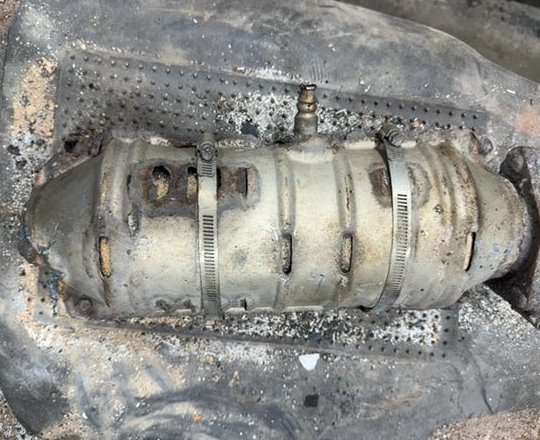
From Exhaust System to Precious Metal: What Really Happens to a Catalytic Converter After You Pull It
Most people know catalytic converters contain valuable metals. Fewer understand what actually happens between the moment you pull one off a vehicle and the moment those metals get recovered and re-enter the market. That gap in knowledge costs sellers real money — because if you don't understand the lifecycle, you can't position yourself to sell catalytic converters online at the right time, to the right buyer, with the right documentation.
This week's roundup breaks down the full journey — from vehicle removal all the way through precious metal refining — and shows you where the value lives, where it leaks, and how platforms like SMASH are changing who captures it.
Stage One: Removal and Identification — Where Most Sellers Leave Money Behind
It starts at the vehicle. Whether you're a recycling yard in Bakersfield processing end-of-life vehicles or a shop pulling converters off fleet returns, the first step is physical removal. That part is straightforward. The identification step is where things get complicated — and where pricing diverges fast.
Catalytic converters are not uniform. A unit from a 2019 Toyota Prius contains a very different precious metal loading than one from a 2016 Ford F-150. The substrate composition — the ceramic or metallic honeycomb inside the shell — varies by manufacturer, engine size, emissions generation, and regional market. Some units carry platinum. Some carry palladium. Many carry a blend of all three platinum group metals (PGMs): platinum, palladium, and rhodium.
Proper identification means knowing which unit you have before you price it. Tools like VIN lookup and serial number tracking — both available through SMASH's inventory system — help yards assign accurate values to each converter rather than guessing based on visual inspection alone. A misidentified unit often gets sold cheap. The buyer knows what it is. The seller didn't.
- OEM converters — Original factory units, typically higher PGM content
- Aftermarket converters — Replacement units, usually lower precious metal loading
- Direct-fit vs. universal fit — Affects both scrap value and recovery yield
- High-value units — Certain Toyota, Honda, and domestic truck converters command significant premiums
Yards in California — including high-volume operations in Bakersfield — process thousands of units monthly. Without a systematic identification process, pricing becomes guesswork. Guesswork benefits the buyer, not the seller.
Stage Two: Accumulation and Inventory — The Overlooked Step That Shapes Your Price
Once converters are pulled and identified, most yards accumulate inventory before selling. This is a deliberate strategy. Selling one converter at a time limits your leverage. Selling a documented load of sorted, photographed, and catalogued units puts you in a completely different negotiating position.
Scrap metal inventory management is not glamorous, but it's one of the highest-ROI practices a yard can adopt. When buyers can see exactly what they're bidding on — photos, serial numbers, unit counts, estimated substrate weights — they bid with more confidence. More confidence means higher bids. That's not theory. That's basic buyer psychology applied to a commodity market.
Photo documentation matters more than most sellers realize. A blurry photo of a pile of converters tells a buyer nothing. A clean photo showing each unit, its serial or part number, and its condition tells a buyer everything they need to submit a competitive bid. The difference in price discovery between a documented load and an undocumented one can be significant.
If you want to find the best scrap converter prices today, the work starts before you post the load — it starts the moment the converter comes off the vehicle.
Stage Three: Pricing and Market Timing — Understanding What Drives Converter Scrap Value
Here's where the market gets real. Catalytic converter scrap prices are directly tied to the spot prices of the PGMs inside them. When platinum price today moves, converter values move with it. Same with palladium and rhodium — historically the highest-value metal in the mix, though rhodium prices have shown extreme volatility over the past several years.
As of November 2026, PGM markets remain sensitive to several converging factors:
- EV adoption rates — Slower-than-projected EV uptake in North America has sustained demand for ICE vehicle converters longer than some analysts predicted
- Mining supply constraints — South African PGM production continues to face infrastructure and labor challenges
- Recycled metal supply — End-of-life vehicle volumes in California and across the U.S. are increasing as older fleet inventory ages out
- Currency and trade dynamics — PGM pricing is USD-denominated globally, which affects import/export flows of scrap converter material
For sellers trying to time the market: watch the metals, not the calendar. The catalytic converter scrap yard price you're quoted on a Monday can look very different by Friday if palladium spikes or rhodium corrects. Platforms that connect you to multiple vetted buyers help you capture market rates in real time rather than accepting a single buyer's offer that may already be discounting for their own margin.
One note for context: searches around catalytic converter scrap price nz reflect the same underlying PGM dynamics — platinum, palladium, and rhodium trade globally. Whether you're in Bakersfield or Auckland, the metals drive the price. The difference is local supply, buyer competition, and your documentation quality.
Want to check current scrap converter prices before you sell? Make that a habit, not an afterthought.
Stage Four: Selling — Why Single-Buyer Transactions Underperform
This is the stage where most yards leave the most money on the table. The old model: call your one buyer, get a number, take it or negotiate slightly, move on. That model worked when information asymmetry heavily favored buyers. Buyers knew the PGM prices. Sellers often didn't — or didn't have the tools to verify what they were hearing.
The competitive auction model changes that dynamic entirely. When multiple vetted buyers compete for your load, the market sets the price — not one buyer's margin target. That's not a sales pitch. That's how price discovery works in every functional commodity market.
SMASH operates on exactly this principle. You list your documented load — photos, serial numbers, unit count, condition notes. Verified buyers bid. You see competing offers. You make an informed decision. The auto-invoicing and paperwork tools handle the back end. You're not chasing BOLs and packing lists manually.
For yards in Bakersfield and across California, this matters especially. California's recycling ecosystem is dense — high vehicle volume, strong buyer interest, active regulatory environment. That's a market where competitive pricing should be accessible. It often isn't, because sellers aren't using competitive platforms.
Ready to stop guessing? Compare scrap metal bids from verified buyers and see what your load is actually worth in a competitive market.
Stage Five: Refining and Precious Metal Recovery — The Final Destination
After the sale, converters move to a processor. The substrate is separated from the steel shell, crushed or milled into a fine powder called "spent catalyst" or "converter powder," and then sent to a smelter or refinery for PGM recovery. This is a multi-step metallurgical process that typically takes weeks, not days.
The refining yield — meaning how much platinum, palladium, and rhodium actually comes out — depends on the assay of the material going in. This is why documentation at the front end of the lifecycle matters so much. Refiners sample and assay incoming material. If a buyer has purchased a load based on inaccurate identification, the refinery reconciliation can create disputes downstream.
For sellers, the takeaway is this: your converter's journey doesn't end when you get paid. The metals go on to be used in new catalysts, electronics, medical equipment, and industrial applications. The recycled PGM market is a genuine circular economy — and it functions better when every step of the chain, starting with your identification and documentation, is accurate.
To go deeper on how pricing works at each stage of this lifecycle, read scrap converter pricing guides that break down the market by metal type, unit category, and regional demand.
What This Means for Your Operation Right Now
The lifecycle of a catalytic converter is longer and more complex than most sellers account for. But understanding it gives you a real edge. You know which units to prioritize. You know why documentation affects your price. You know why a single-buyer call is structurally designed to underperform.
If you're running a yard in Bakersfield, California, or anywhere else in the U.S. with converter inventory sitting unpriced, the market isn't waiting. PGM prices move. Buyer demand shifts. The best time to get competitive bids on a documented load is when the market is active — and right now, end-of-life vehicle volume is high and buyer appetite is strong.
No subscription fees. No guessing. Just documented inventory, competitive buyers, and transparent pricing. That's the SMASH model — and it's built for yards that are serious about recovery, not just throughput.
If you're ready to stop leaving money in the exhaust pipe, find the best scrap converter prices and get a free quote at best-scrap-converter-prices.com. Your next load deserves more than one buyer's number.
Disclaimer: Catalytic converter scrap prices fluctuate daily based on platinum, palladium, and rhodium spot markets. All pricing references in this article are for informational context only. Always check current rates before selling.
Frequently Asked Questions
Q: How do I sell catalytic converters online safely and get a fair price?
Use a platform that connects you to multiple vetted buyers and requires documented inventory — photos, serial numbers, unit counts. Single-buyer transactions limit your price discovery. Competitive auction platforms like SMASH give verified buyers the information they need to submit confident, competitive bids on your load.
Q: What determines the catalytic converter scrap yard price I'm quoted?
The primary drivers are the spot prices of platinum, palladium, and rhodium — the precious metals inside the substrate. Secondary factors include unit identification accuracy, substrate condition, load size, and how many buyers are competing for your material. A documented, sorted load consistently attracts stronger offers than an unsorted pile.
Q: Where can I sell catalytic converters in Bakersfield, California?
Local scrap yards in Bakersfield will buy converters, but local pricing reflects a single buyer's margin. To access broader market pricing, list your inventory through an online platform that reaches verified buyers across North America. You're not limited to whoever is closest — you're limited to however many buyers you give access to your load.
Q: How does platinum price today affect what I get for my converters?
Directly. PGM spot prices are the foundation of converter scrap value. When platinum or palladium prices rise, converter prices typically follow — though there's always a lag as buyers and processors adjust. Tracking daily metal prices before you sell helps you time your listing and validate the offers you receive.
Q: Does scrap metal inventory management really affect my sale price?
Yes — significantly. Buyers price in uncertainty. An undocumented load with no photos and no unit identification gives buyers reason to discount their offer as protection against unknown risk. A fully documented load with serial numbers, photos, and sorted categories removes that uncertainty. Buyers bid higher when they know what they're getting.
Follow SMASH on LinkedIn for weekly scrap metal market updates, PGM pricing context, and insights for recycling yards across North America.
```