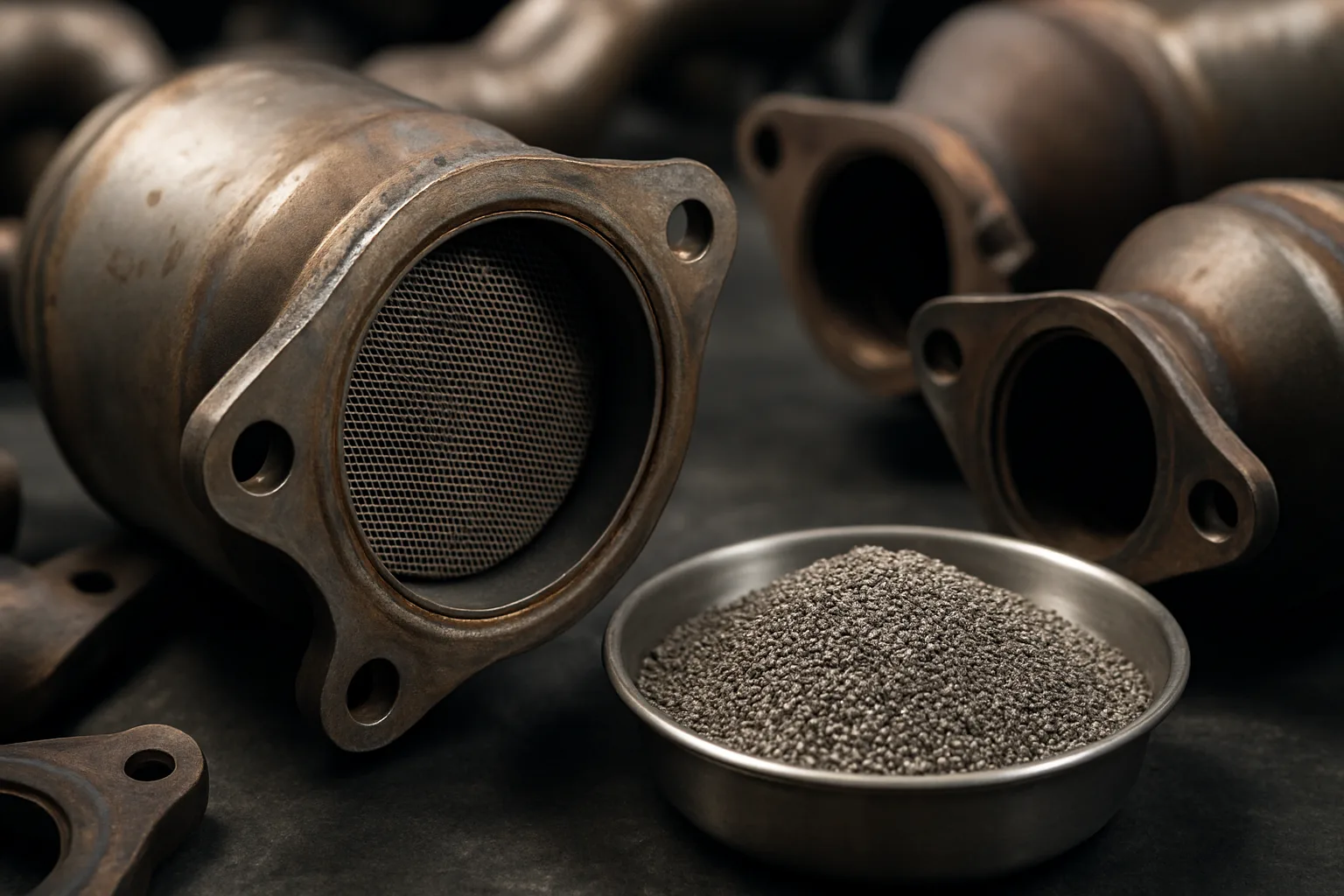
From Exhaust System to Element Recovery: The Catalytic Converter Lifecycle
Most scrap yards treat a catalytic converter like any other piece of metal — weigh it, guess a price, move on. But inside that ceramic honeycomb sits palladium, platinum, and rhodium. The palladium price today alone can swing the value of a single cat by tens of dollars in either direction. If you don't understand where your converter has been — and what's inside it — you're leaving money on the table every single time.
This week's roundup breaks down the full lifecycle of a catalytic converter: from the moment it bolts onto a vehicle to the moment those precious metals get refined and re-enter the market. Understanding that journey is how serious sellers in Kansas City and across Missouri stop guessing and start pricing with confidence.
Stage One: Manufacturing and Vehicle Installation
Every catalytic converter starts as a washcoat — a thin ceramic layer applied to a metal or ceramic substrate (the honeycomb you see when a cat is cut open). Precious group metals (PGMs) — primarily palladium, platinum, and rhodium — get suspended in that washcoat at precise concentrations. The converter then gets welded into the exhaust system and bolted to the vehicle.
The PGM loading varies significantly by make, model, engine type, and model year. A late-model domestic truck converter might carry very different metal concentrations than a foreign luxury vehicle cat from the same year. That's not a guess — it's engineering. OEM specifications determine exactly how much palladium or platinum a given converter needs to meet emissions standards. This is why converter scrap value is never one-size-fits-all.
- Palladium: Primary metal in gasoline engine converters. Oxidizes hydrocarbons and carbon monoxide.
- Platinum: More common in diesel converters. High temperature tolerance.
- Rhodium: Reduces nitrogen oxides. Used in smaller quantities but historically the highest-value PGM per troy ounce.
Stage Two: Active Life, Heat Cycles, and Degradation
A catalytic converter doesn't just sit there. Every cold start, every heat cycle, every mile of combustion gases passing through that substrate changes the converter's internal chemistry. Over time, the washcoat degrades. Substrate cracking from thermal stress, contamination from oil or coolant leaks, and physical damage from road debris all reduce a converter's efficiency — and ultimately determine when it comes out of the vehicle.
High-mileage converters often have reduced PGM concentrations compared to fresh units, because some metal migrates or becomes inaccessible during the refining process. This is not always visible on the outside. A converter that looks fine externally might be cracked internally, with the precious metal substrate partially destroyed. That's exactly why buyer-side assay data matters, and why the catalytic converter scrap price near me you see quoted for one unit may differ substantially from the next.
Physical condition factors that affect scrap converter prices:
- Intact vs. rattling/empty substrate (aftermarket or previously gutted cats)
- Evidence of overheating (blue-gray discoloration, warped shell)
- Leaded or contaminated substrate
- DPFs (Diesel Particulate Filters) versus standard three-way catalysts
- Foil-type versus ceramic substrate
Stage Three: Removal, Yard Intake, and Inventory — Where Kansas City Sellers Often Lose
Here's where most money gets left behind. A vehicle comes off the road. The converter gets cut, tossed in a bin, and eventually sold — often to a single buyer who calls with a number you can't verify. No documentation. No serial reference. No competitive pricing. Just a gut-check offer that you either take or don't.
Yards handling scrap catalytic converter prices in Kansas City face the same challenge that yards face anywhere: the moment a converter leaves your facility, you lose negotiating leverage. But before it leaves, you have an opportunity to capture information that changes your position entirely. Serial numbers, OEM part numbers, photos, and condition notes turn a mystery load into a documented asset. That's not extra work — that's inventory management that pays off.
Platforms like the SMASH scrap metal auction marketplace are built specifically for this stage. Instead of calling one buyer, you document your load and let verified buyers compete. That's price discovery — not guessing. And for converters, where the spread between a lowball offer and a competitive bid can be significant, it makes a real difference. If you're moving volume out of Kansas City or anywhere in Missouri, that difference compounds fast.
Good scrap metal inventory management at this stage means:
- Photographing each converter before it goes in the bin
- Recording serial or OEM part numbers where visible
- Separating by type (foil, ceramic, DPF, aftermarket)
- Logging condition flags (rattling substrate, heat damage, contamination)
- Grouping into clean loads that buyers can accurately assess
Want to see how this works in practice? Read scrap converter pricing guides that walk through exactly how documentation affects what buyers are willing to pay.
Stage Four: Sale, Transport, and the Role of Palladium Price Today
Once your load is documented and ready to move, the market takes over. And right now, the market is driven almost entirely by live PGM spot prices. The palladium price today directly affects what refiners will pay processors, which flows downstream to what buyers will bid on your load. When palladium runs high, converters from gasoline vehicles get more attention. When rhodium pulls back, diesel-heavy loads feel the pressure.
This is why timing matters — and why selling into a competitive auction format beats a single-buyer negotiation. One buyer quotes you based on their margin target for that day. Multiple vetted buyers, bidding against each other, reflect the actual market. That's the difference between a price you accept and a price the market actually supports.
Transport and documentation at this stage also matters for compliance. A clean bill of lading (BOL), proper packing lists, and verified buyer credentials protect you if questions arise later. Converters are a high-theft commodity. Staying above board isn't just good ethics — it's good business in Kansas City scrap metal services and markets across Missouri.
Not sure where you stand right now? Check current scrap converter prices before your next load moves.
Stage Five: Processing, Refining, and PGM Recovery
After your load sells and ships, it heads to a processor or directly to a refiner. This is where the catalytic converter scrap metal actually becomes a commodity again. The refining process — typically smelting or hydrometallurgical processing — breaks down the substrate and isolates the PGMs. Assay reports from this stage confirm exactly how much palladium, platinum, and rhodium came out of the load.
Most sellers never see this data. That's part of why the single-buyer model persists — buyers can quote vague numbers because sellers have no visibility into the back end. Transparent platforms and documented inventory change this equation. When buyers know a seller has accurate serial data and condition records, they bid differently. They bid more accurately. And accurate bids, in a competitive environment, tend to be higher bids.
The recovered PGMs re-enter the commodities market — sometimes within weeks of your load shipping. The palladium that came out of a Kansas City yard's load could end up in a new converter manufactured somewhere across North America. That's the full cycle, and it moves faster than most sellers realize.
How to Position Yourself for Better Converter Scrap Value in 2026
The converter market in 2026 rewards sellers who show up prepared. PGM prices are live and volatile. Buyer competition is real. Documentation is the difference between a guess and a defensible price. Whether you're selling ten cats or ten thousand, the fundamentals don't change.
Start with what you can control: your inventory process. Get the data before the load leaves. Know your types, know your condition grades, separate your DPFs from your standard cats. Then sell into a format where buyers compete — not one where a single buyer makes a take-it-or-leave-it call.
SMASH is built for exactly this. No subscription. No guesswork. Vetted buyers, auction format, auto-invoicing, and photo documentation built into the workflow. If you're moving converter loads out of Missouri and you're still calling one buyer, you owe it to your margin to try a different approach. Find the best scrap converter prices today and see what competitive bids actually look like on your inventory.
Disclaimer: Catalytic converter scrap prices fluctuate daily based on live PGM spot markets. Always verify current rates before selling. The data above reflects general market context as of August 2026.
Frequently Asked Questions
Q: How does the palladium price today affect what I get for my scrap catalytic converters?
Palladium is the primary precious metal in most gasoline engine catalytic converters. When the palladium spot price rises, processors pay more for PGM-rich loads, which flows downstream to higher bids from converter buyers. Checking the palladium price today before you sell gives you a real-time baseline to evaluate any offer you receive.
Q: What are scrap catalytic converter prices like in Kansas City compared to the national market?
Converter prices in Kansas City generally track national PGM spot prices — the same palladium, platinum, and rhodium benchmarks that drive the entire market. Local variation typically comes from buyer competition, not geography. Using an auction-based platform with multiple vetted buyers gives Kansas City sellers access to competitive bids rather than local single-buyer pricing.
Q: Does the condition of my converter affect its scrap price?
Yes — significantly. A converter with an intact ceramic substrate and verifiable serial number will attract higher bids than one with a rattling or damaged interior. Aftermarket or previously gutted converters carry almost no PGM value. Documenting condition with photos and notes before you sell helps buyers bid accurately and with confidence.
Q: What's the difference between a ceramic and foil-type catalytic converter for scrap purposes?
Ceramic substrate converters are the most common type from passenger vehicles and generally contain the highest concentrations of palladium and platinum. Foil-type converters (common in European vehicles) have a metallic substrate and are processed differently. Both have scrap value, but they're typically graded and priced separately, so mixing them in a single undifferentiated load can cost you money.
Q: How do I find a reliable scrap converter buyer near me in Missouri?
The most reliable way to find a competitive buyer in Missouri is to sell into a platform where multiple vetted buyers compete for your load rather than relying on a single contact who controls your price. Document your inventory, know your types, and use platforms like SMASH that bring buyer competition to you — rather than requiring you to cold-call your way to a fair number.
---Ready to stop guessing and start selling smarter? Find the best scrap converter prices at best-scrap-converter-prices.com and get a free quote on your next load. For ongoing market insights, scrap metal auction updates, and converter pricing trends, follow SMASH on LinkedIn.
```