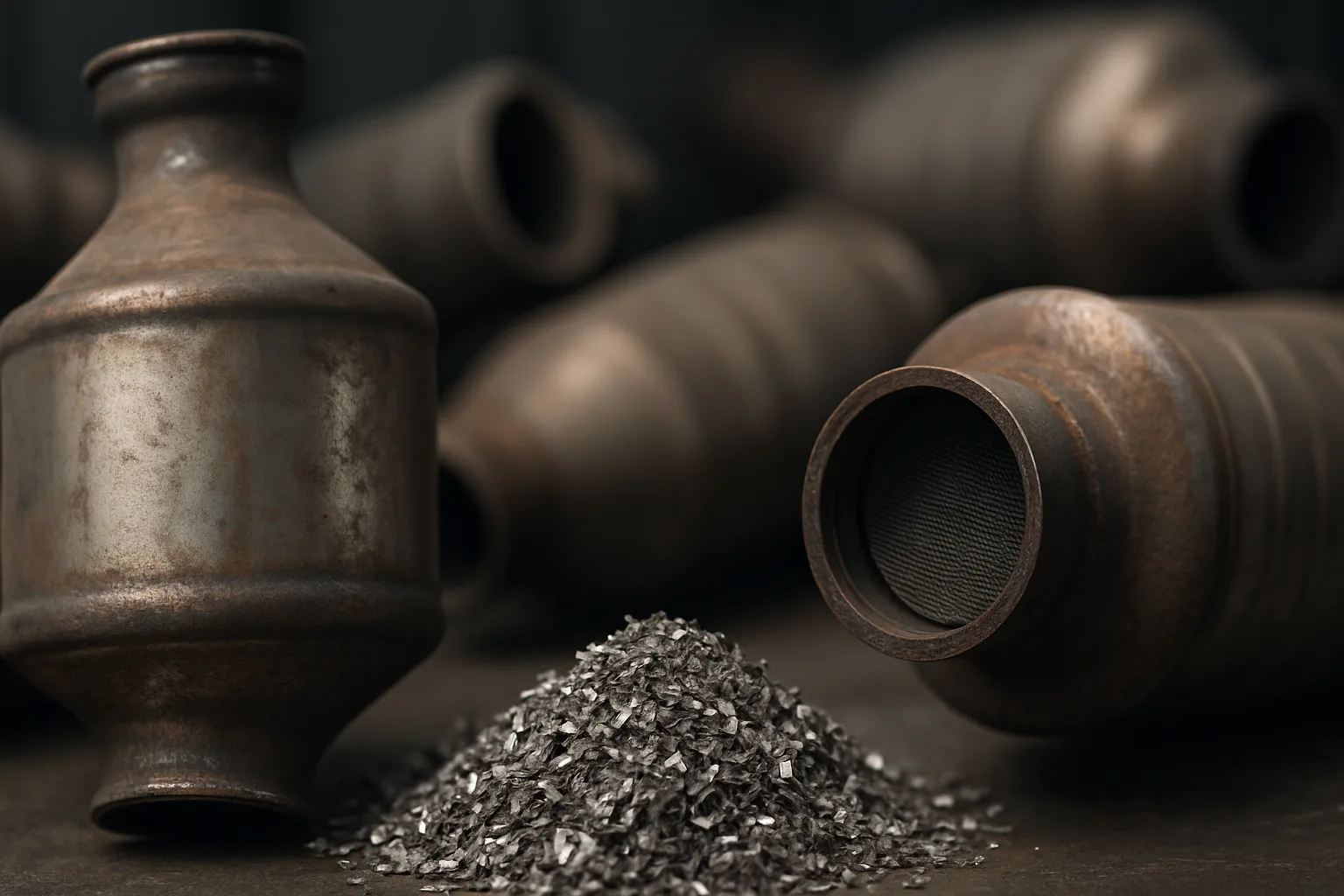
Most sellers have no idea what actually happens to a catalytic converter after it leaves their hands — and that gap in knowledge costs them money. If you're trying to get the best cat converter prices Pittsburgh buyers will pay, understanding how assaying and smelting work gives you real leverage. You stop guessing. You start asking better questions.
This isn't a chemistry lecture. It's a practical breakdown of the process that determines your converter's scrap value — from the moment it comes off the vehicle to the moment precious metals hit the market.
Platforms like get competitive bids for your scrap metal are built on this exact transparency. When you understand what drives converter prices, you understand why competition between buyers matters so much.
Why the Assay Process Drives Catalytic Converter Scrap Value
Every catalytic converter contains a ceramic or metalite substrate coated with platinum group metals — platinum (Pt), palladium (Pd), and rhodium (Rh). These three metals are what recyclers actually want. The steel shell, the mat material, the oxygen sensors — those are secondary. The PGMs are the payout.
The problem is you can't see PGMs. You can't weigh them on a yard scale. They have to be assayed — chemically analyzed — to determine exactly how much is present and in what ratio. That number, combined with live spot prices for each metal, determines your converter's true scrap value. Everything else is an estimate.
Here's why this matters to sellers in Pittsburgh and across Pennsylvania: buyers who don't do proper assaying are guessing. Some guess conservatively to protect their margin. That conservative guess comes out of your pocket. When you find the best scrap converter prices today, you're looking for buyers who price based on actual PGM content — not gut feel.
The Step-by-Step Process: From Your Yard to the Smelter
Understanding the pipeline helps you spot where value gets created — and where it can get lost. Here's how a converter typically moves through the recycling chain:
- Depanning (Decanning): The steel shell is cut or crushed to extract the ceramic substrate inside. Some yards do this on-site. Others sell whole units. Depanned material is more accurately assessed because buyers can see and weigh the substrate directly.
- Sorting and Identification: Converters are sorted by type — OEM vs. aftermarket, domestic vs. foreign, by vehicle manufacturer and engine family. VIN lookup tools and serial tracking help identify specific units. Different converters have wildly different PGM loads. A late-model foreign catalytic converter can carry significantly more palladium than a generic aftermarket unit.
- Sampling for Assay: Once sorted into lots, a representative sample is drawn. This is critical. A poor sample equals a bad assay equals a bad price. Reputable processors use rigorous sampling protocols — the entire lot gets ground into a homogeneous powder, then a precise sample is pulled for analysis.
- Assaying: The sample gets analyzed using fire assay (the industry gold standard) or ICP (inductively coupled plasma) methods. Fire assay involves high-temperature fusion to separate PGMs from the base material. ICP uses plasma to ionize the sample and measure elemental concentrations. Both methods produce a certified result — grams per unit, or grams per ton — of Pt, Pd, and Rh.
- Settlement Calculation: The assay result gets multiplied by the spot price for each metal on that settlement date. Deduct processing fees, and what's left is your net return. Transparency at this stage — seeing the actual assay numbers — is what separates trustworthy buyers from the ones you should avoid.
- Smelting and Refining: The bulk material goes to a primary smelter. High-temperature furnaces separate base metals from PGMs. The resulting concentrate goes through further chemical refining to produce pure platinum, palladium, and rhodium — ready for resale on the commodity market.
Each step in this chain affects your final payout. The further you are from the assay result, the more you're leaving to trust — or to chance.
Platinum Group Metals and How Scrap Metal Prices Today Affect Your Check
Palladium, platinum, and rhodium trade on commodity markets every day. Scrap metal prices today for these metals can shift dramatically week to week — sometimes day to day. Rhodium in particular has a history of extreme volatility. A load worth one number on Monday can be worth something very different by Friday.
This is why settlement timing matters. When you sell a load of converters, your contract should specify:
- Which metal prices apply (spot on assay date, average over a window, etc.)
- What deductions apply (processing, refining, sampling fees)
- How quickly you receive the assay results
- Whether you have any right to dispute the assay
Sellers in Pittsburgh who run volume — multiple loads per month — know this. The difference between a favorable and unfavorable settlement structure can be worth thousands of dollars annually. Don't sign a deal you don't understand. Read scrap converter pricing guides to get familiar with how these terms work before you negotiate.
For context, European processors have long been ahead on assaying transparency — something noted in academic and industry literature on recycling the platinum group metals a European perspective. North American yards are catching up, driven by sellers who demand better documentation. That's a shift worth knowing about.
What Good Documentation Does for Your Converter Scrap Value
Photo documentation, serial tracking, and detailed inventory records aren't just paperwork. They directly support your converter scrap value by giving buyers more confidence in what they're bidding on.
Think about it from the buyer's side. A lot of converters with clear photos, identified units, weight data, and VIN-verified OEM parts carries less risk than a mystery pallet of mixed units with no documentation. Less buyer risk means a stronger bid. That's not theory — that's how markets work.
Platforms like SMASH use inventory tools, VIN lookup, and photo documentation to make this process systematic. When you build a well-documented lot, you're not just being organized — you're removing the buyer's excuse to discount. Check current scrap converter prices on your documented units and you'll see the difference a clean record makes.
For Pittsburgh scrap metal services, this kind of documentation also matters for compliance — Pennsylvania has strengthened secondary metals dealer reporting requirements, and thorough records protect you on that front too.
Why Competition Between Buyers Changes Everything for Cat Converter Prices in Pittsburgh
Here's the old way: one buyer, one phone call, one number — take it or leave it. If that buyer's assay is conservative, or their settlement terms are unfavorable, you have no leverage. You don't even know what you're missing.
The new way puts multiple vetted buyers against each other in a competitive format. When buyers know they're competing, they price tighter. They can't pad their margins as easily because another buyer is right behind them with a better number. More buyers means better price discovery. That's not a pitch — that's economics.
This is exactly how SMASH is built. Vetted buyers, auction format, transparent process, no subscription fees. We only win when you win. For a yard in Pittsburgh running regular converter loads, that structure makes a measurable difference over time.
The catalytic converter recycling near me search gets you a list of options. But options alone don't tell you who's pricing based on real assay data versus who's guessing and protecting their spread. Competition reveals that faster than any conversation will.
How to Use This Knowledge Before Your Next Sale
You don't need a chemistry degree to sell smarter. You need a few habits:
- Identify your units before you sell. OEM converters from late-model vehicles carry higher PGM loads. Know what you have. Use VIN lookup tools where available.
- Document your loads. Photos, weights, unit counts. A packing list that buyers can actually use to build a confident bid.
- Ask about assay transparency. Before you commit to a buyer, ask how they assay, when they settle, and whether you see the actual numbers. A buyer who hedges on this question is telling you something.
- Watch the metals market. You don't need to trade futures. But knowing whether palladium is trending up or down this week is relevant when you're deciding whether to hold a load or move it.
- Put your load in front of more than one buyer. Every time you sell to a single buyer without competition, you're accepting their number as the market. It might not be.
Pittsburgh yards have access to multiple regional buyers and national processors. Pennsylvania's industrial history means there's real infrastructure here for converter recycling. Use that. Don't default to the first call you make.
If you want to stop leaving money in the assayer's pocket, start with better information and more buyers. The process that determines your converter's value is systematic — and now you understand it. Put that understanding to work.
Ready to see what your load is actually worth? Find the best scrap converter prices — get a free quote at best-scrap-converter-prices.com. Bring your documentation, know your units, and let buyers compete for your business.
Disclaimer: Catalytic converter prices fluctuate daily based on platinum, palladium, and rhodium spot markets. Always verify current rates before finalizing any sale.
Frequently Asked Questions
Q: How do I get the best cat converter prices in Pittsburgh?
Get multiple bids from vetted buyers and document your load thoroughly — photos, weights, and identified units. Buyers compete harder when they can clearly see what they're bidding on. Platforms like SMASH put your load in front of multiple buyers simultaneously, which supports better price discovery than a single phone call ever will.
Q: What metals are actually inside a catalytic converter?
The valuable metals are platinum (Pt), palladium (Pd), and rhodium (Rh) — collectively called platinum group metals or PGMs. These are embedded in the ceramic or metalite substrate inside the steel shell. Their concentrations vary significantly by vehicle make, model year, and whether the converter is OEM or aftermarket.
Q: Why do catalytic converter prices change so often?
Because palladium, platinum, and rhodium trade on commodity markets, and those markets move daily. Rhodium in particular has historically been one of the most volatile traded metals. Scrap converter prices follow those spot prices, so a load's value on Monday can differ from its value on Friday. Watching the market before you sell is worth the effort.
Q: Is it worth depanning (decanning) converters before selling?
It depends on your volume and equipment. Depanned material allows buyers and assayers to directly weigh and sample the substrate, which can lead to more accurate pricing. However, whole-unit sales are faster and require less equipment. If you're running consistent volume, depanning can improve your net return — but discuss it with your buyer before you change your process.
Q: How do I find a reputable catalytic converter recycling buyer near me in Pennsylvania?
Look for buyers who are transparent about their assay process, provide written settlement documentation, and have verifiable references. Avoid buyers who give you a flat rate with no explanation of how they arrived at it. For Pittsburgh sellers, working through a platform that vets its buyers — and forces competition — is a reliable way to avoid getting undercut by a buyer with no accountability.
Stay current on scrap metal market movements and converter pricing trends — follow SMASH on LinkedIn for industry updates and insights that actually matter to yards and sellers.
```