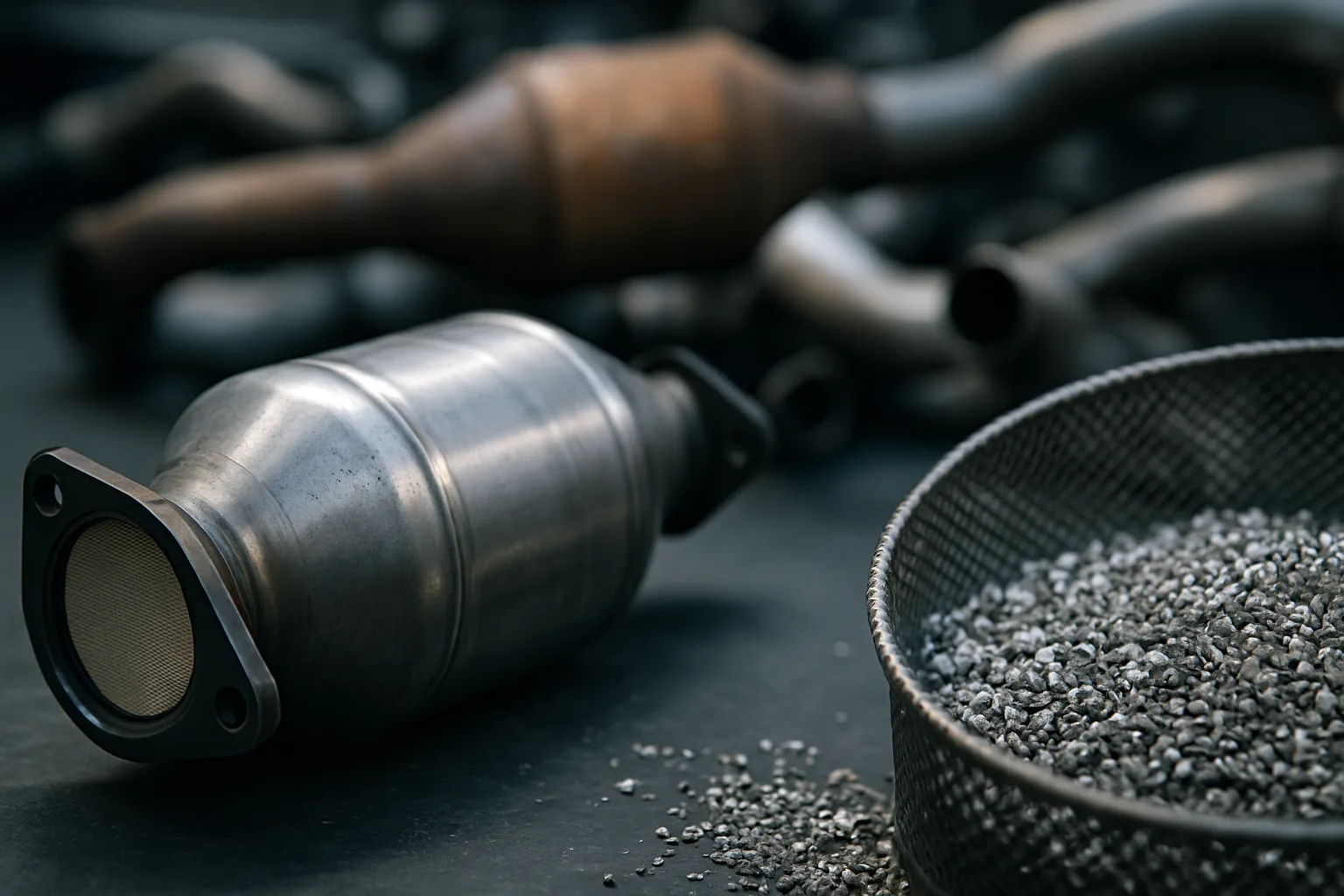
Why Rhodium, Palladium, and Platinum Determine What Your Converter Is Actually Worth
Most converter sellers think the yard sets the price. They don't. Three metals you've probably never traded directly — rhodium, palladium, and platinum — drive nearly every dollar a buyer offers you for your scrap converter. If you're chasing the best catalytic converter price Nashville has to offer and you don't understand those markets, you're negotiating blind.
This isn't abstract finance. It's the difference between leaving $40 on the table per unit or walking away knowing you got a fair shake. Let's break down exactly how global precious metal markets flow downstream into the price your local Tennessee buyer quotes you today.
The Three Metals Inside Every Converter — and Why Their Prices Swing Hard
Catalytic converters use platinum group metals (PGMs) to convert toxic exhaust gases into less harmful emissions. The three primary PGMs are platinum (Pt), palladium (Pd), and rhodium (Rh). Each has a different concentration depending on the vehicle make, engine type, and model year — and each trades on global commodity markets around the clock.
Here's what makes PGM pricing volatile:
- Rhodium is the rarest of the three. It's produced almost exclusively as a byproduct of platinum and palladium mining, primarily in South Africa and Russia. When supply hiccups — a mine strike, a geopolitical disruption, a refinery outage — rhodium price today can spike sharply. It's historically the most price-volatile PGM, sometimes swinging hundreds of dollars in a single week.
- Palladium is the workhorse metal for gasoline converters. Demand is tied directly to global auto production. When automakers ramp up or when emissions regulations tighten in major markets, palladium demand follows.
- Platinum dominates diesel converter applications. It trades more like a hybrid of gold and an industrial metal — influenced by both financial markets and real industrial demand.
None of these metals trade locally. They trade in London, Zurich, and New York. That means a supply disruption in South Africa affects what a scrap yard in Nashville pays you within days — sometimes hours. Check current scrap converter prices before you call a buyer, not after.
How Global Market Signals Flow Down to Your Local Scrap Converter Price
The path from a London Metal Exchange quote to your converter check involves several layers. Understanding each one helps you time your sales better and identify when a buyer is padding their margin at your expense.
- Spot prices move first. PGM spot prices update continuously during trading hours. Refiners and large processors watch these in real time.
- Assay and processing margins adjust. Refiners set their buy prices based on expected recovery rates from converter material plus their margin. When spot prices rise, refiner bids typically follow — though not always immediately.
- Middlemen and yards reprice their offers. Scrap yards buying converters price off refiner bids minus their own handling margin. When rhodium or palladium surges, competitive yards update their price lists quickly. Less competitive ones lag — and that lag costs sellers money.
- You get a quote. If you're calling one yard, you're getting one data point in a market that has dozens. That single quote may or may not reflect today's actual scrap metal prices today.
The takeaway: the further you are from live market data, the more margin someone else captures. Platforms like the SMASH scrap metal auction marketplace exist precisely to compress that gap — putting verified buyers in competition so the price you see is closer to what the market actually says your converter is worth.
What Makes Nashville Converters Different — and Why It Matters for Pricing
Tennessee is a significant auto state. Nashville sits in a region with active dealer networks, fleet operators, and independent repair shops generating steady converter volume. That volume matters because buyers in competitive markets move faster and price sharper when they know supply is consistent.
But "competitive market" doesn't mean every buyer in Nashville plays it straight. Some buyers rely on sellers not knowing scrap metal prices today. They quote flat rates that don't move when PGM prices do. That's how they protect their margins — and how your margins shrink. If you're selling Nashville scrap metal services and not benchmarking against live market data, you may be leaving real money behind.
The good news: Nashville converters — particularly from domestic trucks, SUVs, and performance vehicles common in the region — often carry higher PGM loadings than compact or economy units. A loaded domestic truck cat can contain significantly more palladium than a foreign compact. Knowing your specific unit type puts you in a stronger position before you ever make a call.
Rhodium Price Today: The Wildcard That Can Double or Halve Your Quote Overnight
If you want to understand why your converter quote from six months ago doesn't match today's offer, start with rhodium. Of the three PGMs, rhodium carries the most extreme price swings — and the smallest supply base. It's produced in meaningful quantities in only a handful of locations globally, which makes it acutely sensitive to supply-side shocks.
When rhodium spikes, converters that are heavy in rhodium content — typically certain domestic performance applications and some foreign models — can see their scrap value jump dramatically. When it crashes, the same units drop just as hard. This isn't speculation. It's the basic mechanics of a thinly traded commodity market.
What this means practically for converter sellers in Tennessee:
- Don't sit on inventory if rhodium is trending down. The market won't save you.
- If you have a mix of units, identify which ones are rhodium-heavy before you sell. A buyer who separates and values by unit type will typically pay more than one who quotes you a flat-rate average.
- Use a how much is my catalytic converter worth calculator as a starting benchmark — but understand it's only as accurate as the PGM prices it pulls. Stale data means stale estimates.
The best time to find the best scrap converter prices today is when you're armed with current PGM data, not guessing off memory or last month's quote.
Why a Competitive Auction Model Beats the Single-Buyer Phone Call
Here's the structural problem with how most converter sellers operate: you call one buyer, get one number, and decide. That's not price discovery. That's a coin flip dressed up as a transaction.
A single buyer has every incentive to quote below market. They're not competing with anyone in that moment. You don't know if their number is fair. And if you don't read scrap converter pricing guides or track PGM markets, you have no reference point to push back.
SMASH flips that structure. Instead of one buyer with no accountability to market price, you get vetted buyers competing against each other in an auction format. Competition is what creates real price discovery. More buyers bidding on your load means the winning price reflects the actual market — not the margin one buyer decided to protect today.
For sellers moving volume in Tennessee — whether you're a yard clearing out accumulated inventory or a shop moving a few cats a week — the difference between one buyer and a competitive field of buyers can add up fast. SMASH doesn't charge subscription fees. The model works because we only win when you do.
It's also worth noting: if you've ever looked at a catalytic converter price list in India or other international benchmarks out of curiosity, you'll see that PGM-based pricing is fundamentally global. The same London spot price that moves a buyer in Nashville moves buyers everywhere. What differs is the competition layer on top of it — and that's exactly what a proper auction creates.
How to Time Your Converter Sale Around Precious Metal Markets
You don't need to be a commodities trader to sell smarter. A few simple habits will help you stop leaving money on the table.
- Check PGM spot prices before you call any buyer. Rhodium, palladium, and platinum prices are publicly available. A quick look tells you whether the market is up, down, or flat that day.
- Track trends over 2–4 weeks, not just the day. If palladium has been climbing for three weeks and you have inventory, you might be better served selling into the run rather than waiting for a peak you can't predict.
- Identify your units before you sell. Domestic vs. foreign, truck vs. passenger car, pre-OBD2 vs. modern — these all carry different PGM profiles. A buyer who can see unit detail will price more accurately.
- Use photo documentation. Platforms like SMASH use photo documentation and serial tracking so buyers can bid accurately. Better information to buyers equals more confident bids — which can mean better prices for you.
- Don't hold inventory waiting for a market top. Timing a commodity market perfectly is near-impossible. Sell when prices are reasonable and competition is active, not when you've guessed the peak.
Nashville sellers who treat converter scrap like any other commodity — bought and sold based on live market signals — consistently do better than those who rely on relationships with a single buyer and hope for fair treatment.
If you're ready to stop guessing and start selling with real price discovery behind you, best-scrap-converter-prices.com connects you with the tools and buyers to make that happen. Get a free quote and see what your converters are actually worth in today's market.
Disclaimer: Catalytic converter scrap prices fluctuate daily based on precious metal spot markets. All pricing referenced in this article is general and informational. Check current rates before selling.
Frequently Asked Questions
Q: How do rhodium and palladium prices affect what I get paid for scrap converters in Nashville?
PGM spot prices — especially rhodium and palladium — are the primary driver of converter scrap value. When these metals rise on global markets, buyers should pay more for your units because their refinery recovery value is higher. If your Nashville buyer's price hasn't moved in weeks despite market swings, that's a signal to get a second opinion.
Q: How do I find the best catalytic converter price in Nashville?
The best approach is to get multiple competing offers rather than relying on a single buyer. Check current PGM spot prices first so you have a baseline, then use a platform like SMASH to let vetted buyers compete for your inventory. More competition typically produces pricing that's closer to actual market value.
Q: Is a catalytic converter worth calculator accurate?
A converter worth calculator is a useful starting point, but its accuracy depends entirely on how current its PGM price data is. Calculators using stale prices will produce misleading estimates. Always cross-reference any estimate against live rhodium, palladium, and platinum spot prices before you sell.
Q: Does it matter what kind of vehicle the converter came from?
Yes — significantly. Domestic trucks and SUVs common throughout Tennessee tend to carry higher PGM loadings than compact foreign vehicles. The make, model, engine size, and model year all influence how much platinum, palladium, and rhodium the converter contains. Identifying your specific units before selling helps buyers price accurately and typically improves your offer.
Q: Why does my converter quote change from week to week even when nothing else has changed?
Global precious metal markets move continuously. A converter that was quoted at one price last week may be worth more or less this week based entirely on PGM spot price movement — not on anything you did differently. This is why checking scrap metal prices today before every sale is a practical habit, not just a suggestion.
Follow SMASH on LinkedIn for ongoing scrap metal market updates, PGM price insights, and industry news that helps you sell smarter.