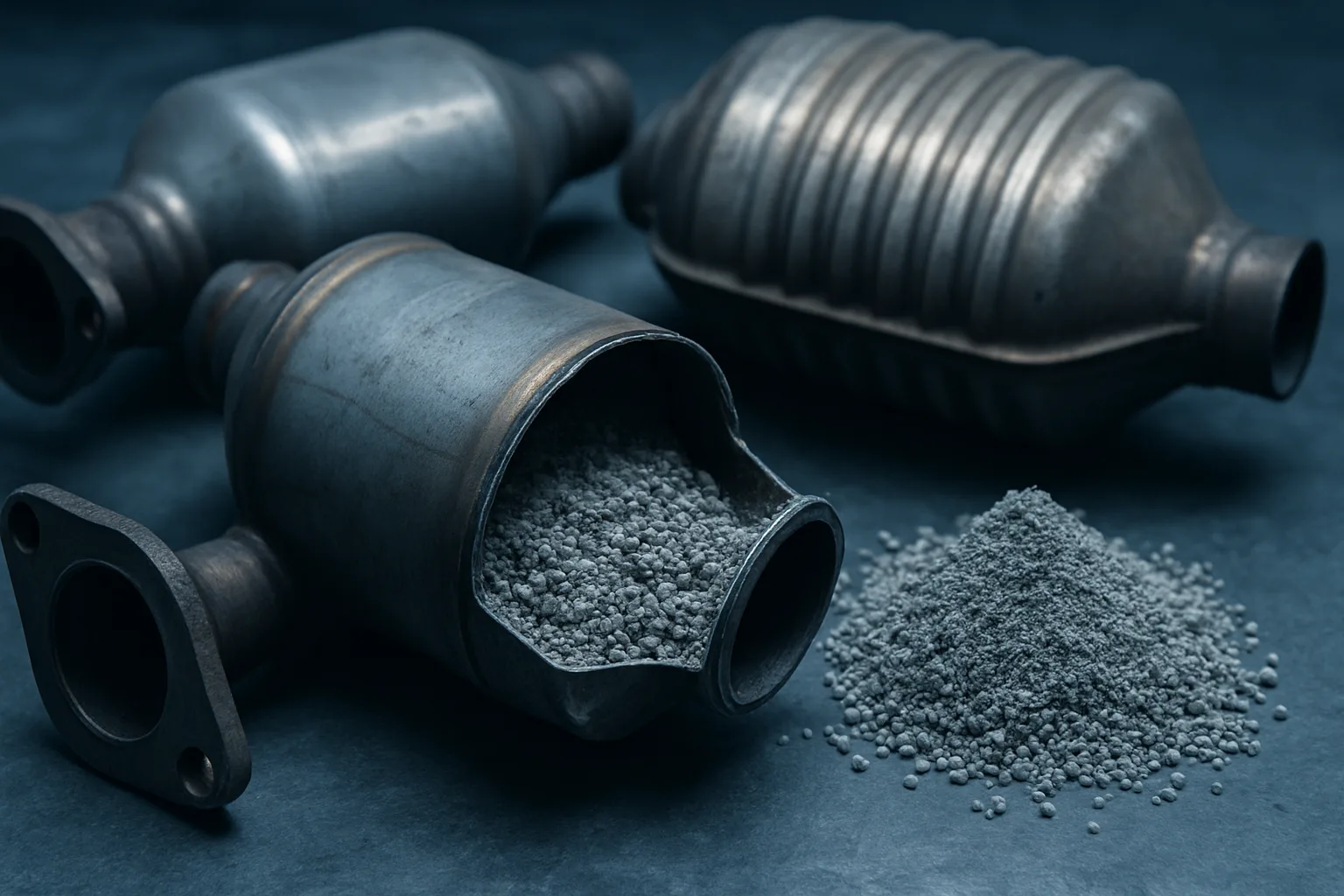
Your OEM catalytic converter could be worth three to five times more than the aftermarket unit bolted onto the car next to it — and most sellers have no idea why. That gap isn't random. It comes down to chemistry, loading rates, and substrate quality. If you're trying to get the best catalytic converter scrap value for your inventory, understanding what's inside the unit matters more than anything else.
This week's market recap breaks down the OEM vs. aftermarket divide, what's driving precious metal valuations heading into fall 2026, and how sellers in Newark and across New Jersey can stop leaving money on the table.
What's Actually Inside an OEM Converter — and Why It Pays More
Original equipment manufacturer converters are built to meet strict emissions standards set by the vehicle's manufacturer. That means higher loading rates of platinum group metals (PGMs) — palladium, platinum, and rhodium — applied to a dense ceramic or metallic substrate. The chemistry is precise. The substrate surface area is engineered for maximum catalytic efficiency and long service life.
Aftermarket converters are built to pass emissions tests at a lower price point. They work — but they use less PGM loading to keep manufacturing costs down. A domestic OEM unit from a full-size truck might carry three to four grams of palladium or more. An aftermarket replacement for the same application might carry a fraction of that. Less metal in means less money out when it hits the refinery.
- OEM converters: Higher PGM loading, denser substrates, longer service life, premium scrap value
- Aftermarket converters: Lower PGM loading, thinner substrates, shorter service life, lower scrap value
- Foreign domestic OEM (FD/OEM): Units from foreign-made vehicles assembled domestically — values vary widely by make and model
- High-value OEM targets: Diesel units, pre-emission-change domestic trucks, and hybrid system converters often carry the highest PGM concentrations
This is exactly why a recycling yard or private seller in Newark can't quote a flat price per unit and call it a day. The spread between a high-value OEM diesel cat and a thin aftermarket replacement can be hundreds of dollars per unit. Knowing what you have before you sell is the difference between a fair deal and a bad one.
Palladium Price Today — Weekly Market Context for August 23, 2026
PGM markets moved with some volatility through the back half of summer 2026. Palladium — the metal that drives value in most gasoline-engine catalytic converters — has remained sensitive to EV adoption trends, automotive production shifts, and ongoing supply dynamics from primary mining regions. Rhodium, once the most volatile of the three, has continued its correction from historic highs seen in earlier years, though it still commands a premium.
Platinum has gained relative ground as hydrogen fuel cell development accelerates and some automakers shift catalyst formulations. None of these moves happen in isolation. When you're selling a load of converters, the daily spot price for each of the three metals directly affects what a refinery will pay — and what a buyer is willing to bid. That's why the catalytic converter scrap value on a load quoted last Tuesday might look different this Sunday.
Key market factors worth watching right now:
- Palladium remains the dominant value driver in most gasoline OEM units
- Rhodium premiums are tighter than they were in 2023–2024 but still meaningful on high-density OEM loads
- Platinum's role in hybrid and diesel converters is creating renewed interest from buyers
- Currency movement affects cross-border transactions — important for yards near Newark's port infrastructure
Disclaimer: PGM prices fluctuate daily. Always check current scrap converter prices before committing to a sale. The figures above reflect general market context, not specific spot prices.
Why Aftermarket Converters Still Have Real Value — Just Different Value
Dismissing aftermarket converters entirely is a mistake. They still contain recoverable PGMs — just in lower concentrations. A yard processing high volume can accumulate significant weight in aftermarket units, and the aggregate value adds up. The key is accurate identification so you're not blending high-value OEM units into a mixed load that gets priced at the lower average.
Sorting matters. Commingling OEM and aftermarket units in the same lot without documentation almost always means the buyer prices the load conservatively — protecting themselves against the unknown. When you separate by type, document by VIN or serial number, and photograph each unit, you give buyers the confidence to price aggressively. That's not just best practice. That's how you protect your margin on every load you move.
Platforms like SMASH Scrap — where verified buyers bid on your metal are built specifically for this. Serial tracking, photo documentation, and vetted buyer competition mean your sorted, documented load goes in front of multiple buyers simultaneously — not just the one guy who returns your calls. Competition can help reveal the market. That's the whole idea.
Selling Catalytic Converters in Newark — What Local Sellers Need to Know
Newark sits at the center of one of the densest automotive recycling corridors in the eastern United States. The port, the density of auto dismantlers, and proximity to major metro demand make Newark scrap metal services a competitive space. That's good news for sellers — in theory. In practice, local competition doesn't automatically mean you're getting the best price. It means there are a lot of buyers in the market, and not all of them price the same way.
New Jersey sellers dealing in higher-volume loads should be especially focused on documentation and sorting. The state has seen increased regulatory attention on converter transactions in recent years — tracking requirements, seller ID protocols, and record-keeping are part of the landscape. Staying ahead of compliance isn't just about avoiding fines. It's about being the kind of seller that premium buyers want to work with. Buyers who price well tend to pay a premium for sellers who have their paperwork clean.
If you're processing a mix of OEM and aftermarket units out of Newark, here's a practical framework:
- Sort by type first: OEM, aftermarket, and high-value FD/OEM should never sit in the same bucket
- Use VIN lookup where possible: Verify the vehicle application to confirm OEM status
- Document with photos: Serial numbers, substrate condition, foil vs. ceramic — all of it helps
- Get multiple quotes: One buyer is a guess. Three buyers is a market. Five buyers is competition
- Time your sale: PGM spot prices move. Selling into strength matters
To find the best scrap converter prices today, you need more than a single contact in your phone. You need access to a verified buyer pool who knows what they're looking at.
The Old Way vs. The SMASH Way — How Converter Sales Have Changed
Five years ago, selling a load of cats meant calling your regular buyer, taking a price, and moving on. No second opinion. No documentation standard. No real benchmark to know if you left money behind. That system worked fine for buyers. Sellers just had to trust the process.
That model is broken now. PGM volatility, sorting complexity, and the shift toward documented, traceable converter transactions have changed what the sale actually requires. Sellers who still rely on a single-buyer phone-call model are operating blind in a market that's gotten significantly more sophisticated.
SMASH approaches this differently. Vetted buyers. Auction format. Inventory tools with photo documentation, VIN lookup, and serial tracking built in. Auto-invoicing so the paperwork doesn't pile up. No subscription fees — we only win when the seller wins. That's the structure. More buyers means better price discovery. Documented inventory gives buyers more confidence to price aggressively. If you haven't explored what a competitive bid process looks like for your converter loads, it's worth understanding what you might be missing.
Whether you're running a full dismantling operation in New Jersey or consolidating a smaller load from a repair shop network, the path to better converter scrap value runs through documentation and competition — not loyalty to one buyer who prices conservatively by default.
How to Maximize Catalytic Converter Scrap Value Before Your Next Sale
The best converter price isn't just about finding the right buyer. It's about arriving at the transaction with the right load. Preparation compounds. Sellers who consistently document, sort, and present clean lots attract buyers who are willing to price them fairly — and those buyers come back. That cycle builds real long-term value into your operation.
Here's what high-performing converter sellers do differently:
- They treat converters as a PGM commodity, not just scrap — because that's what they are
- They track market conditions and time larger loads strategically
- They invest in sorting and documentation upfront to eliminate buyer risk at pricing time
- They use platforms that create competition, not platforms that capture a single quote
- They know their high-value units by sight and never let them get blended into a mixed load
If you want to read scrap converter pricing guides that go deeper into specific vehicle applications, substrate types, and regional market trends, there's a full resource library available to help you benchmark your loads against what the market is actually paying.
The bottom line: OEM and aftermarket converters are not interchangeable commodities. Treating them like they are will cost you real money. Sort your loads, document your units, and put them in front of multiple vetted buyers. That's the model that produces consistent results. If you're ready to see what competitive bidding looks like for your next load, get a free quote at best-scrap-converter-prices.com — and find out where your inventory actually stands in today's market.
Frequently Asked Questions
Q: Why is the catalytic converter scrap value so much higher on OEM units than aftermarket replacements?
OEM converters are built with higher concentrations of platinum group metals — palladium, platinum, and rhodium — to meet strict factory emissions standards over the vehicle's full service life. Aftermarket units use lower PGM loading to reduce manufacturing costs. When the converter reaches the refinery, less metal in means a lower payout per unit.
Q: How does palladium price today affect what I get paid for my converters?
Palladium is the primary value driver in most gasoline-engine catalytic converters. The daily spot price directly influences what refineries pay buyers and what buyers will bid for loads. Even small swings in palladium spot pricing can shift the per-unit value on a larger load by a meaningful amount. Always check current market rates before finalizing a sale.
Q: Is it worth sorting OEM and aftermarket converters before selling in Newark?
Absolutely. Commingled loads get priced conservatively because buyers have to protect against the unknown. Sellers in Newark who sort by type and document with photos and serial numbers consistently attract better bids. The extra time upfront pays off at pricing time — and it keeps you compliant with New Jersey's transaction record-keeping requirements.
Q: Can I sell catalytic converters online and still get a competitive price?
Yes — and for most sellers, selling catalytic converters online through a platform with verified buyers and an auction format produces better results than a single-buyer phone quote. Documentation tools, VIN lookup, and buyer competition mean your load gets priced based on what it actually contains, not what a single buyer is willing to offer sight unseen.
Q: How do I know if my converter is OEM or aftermarket?
OEM converters are typically marked with the vehicle manufacturer's branding or a supplier code that ties back to the original vehicle application. Aftermarket units often carry a generic brand name and a universal or application-specific part number. VIN lookup tools can help confirm the original converter fitment for the vehicle. When in doubt, serial tracking and photo documentation will help buyers accurately assess and price what you have.
Stay current on PGM markets and converter pricing trends by following SMASH on LinkedIn — regular updates on scrap metal market insights and industry news for recyclers across North America.
```