The rhodium price today can swing hundreds of dollars in a single week — and most converter sellers have no idea that's what's driving the offer they just got from their local buyer. If you've ever walked away from a sale feeling like you left money on the table, you probably did. Understanding what actually sets converter scrap value isn't complicated, but nobody in the yard bothers to explain it. Let's fix that.
This isn't a chemistry lecture. It's a practical breakdown of how three precious metals — platinum, palladium, and rhodium — determine what your catalytic converter is worth on any given day, and what you can do with that knowledge to get a better price.
---The Three Metals That Set Your Catalytic Converter Price
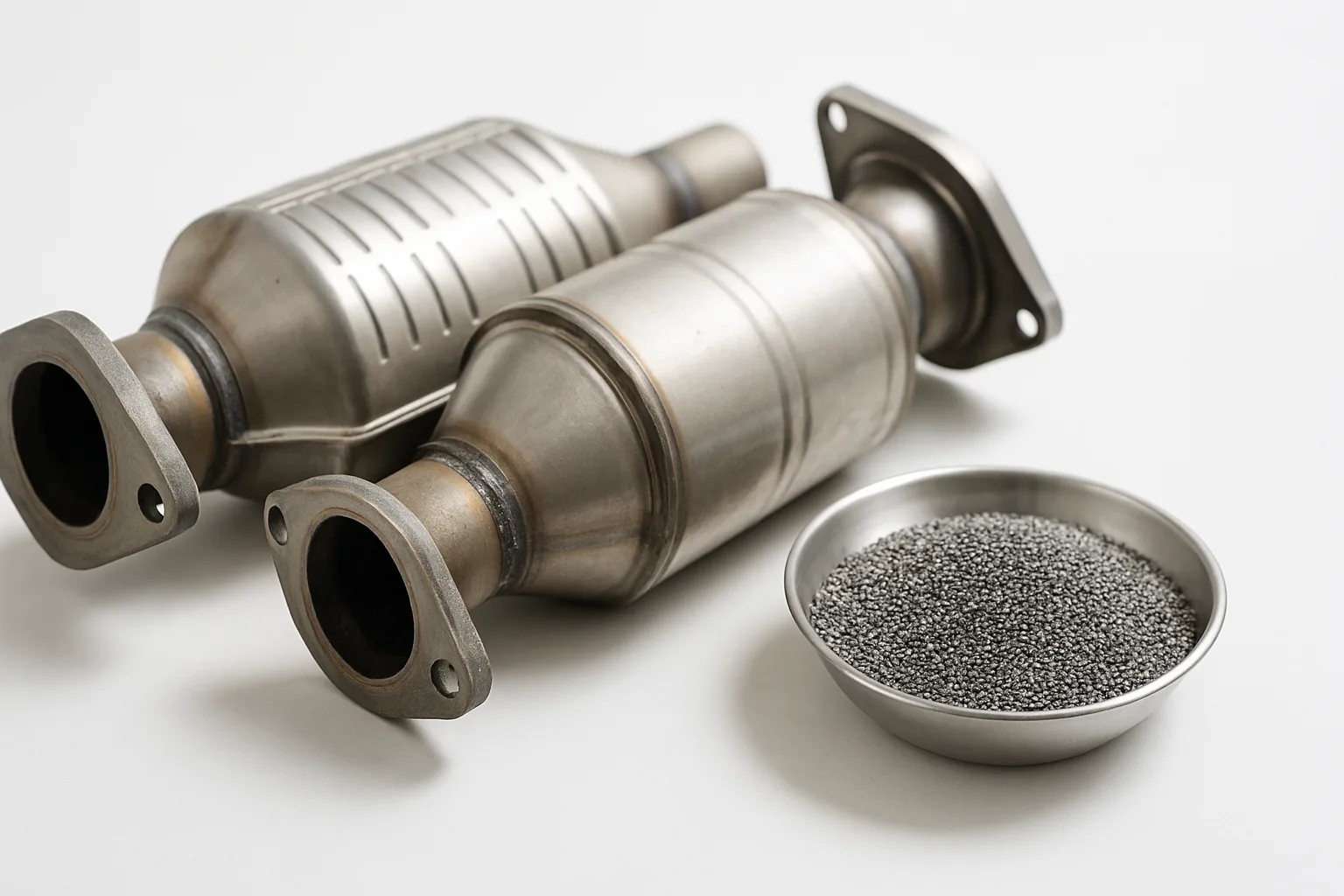
Every catalytic converter contains a ceramic or metalite substrate coated with a precise blend of platinum group metals (PGMs). These aren't trace amounts — they're the entire reason converters have scrap value in the first place. The three metals that matter are platinum (Pt), palladium (Pd), and rhodium (Rh), and each one trades independently on global commodity markets.
Here's why that matters to you as a seller:
- Platinum is typically used in diesel converters and some older gasoline units. It trades at a fraction of rhodium's price but adds meaningful value to high-load commercial vehicle cats.
- Palladium is the dominant metal in most modern gasoline catalytic converters. It peaked dramatically in the early 2020s and remains highly volatile. Small shifts in palladium pricing move the value of a full truckload significantly.
- Rhodium is the wild card. The rhodium price today can be many times higher per troy ounce than gold. Even tiny rhodium loadings — measured in fractions of a gram — translate into serious dollar value on high-grade OEM converters.
When a buyer quotes your converter, they're calculating an estimated return based on the current spot prices of all three metals, minus processing costs, refining fees, and their margin. The question is whether their math and yours are even close to aligned — and without market data, you're negotiating blind.
---Why the Rhodium Price Today Changes Everything
Rhodium is one of the rarest elements on earth. Nearly 80% of global supply comes from South Africa, and annual production is measured in tens of thousands of troy ounces — not millions. That supply constraint, combined with surging demand from automotive emissions regulations, makes rhodium pricing extraordinarily sensitive to any disruption.
This extreme sensitivity is why sellers checking converter scrap value on Monday can be looking at a meaningfully different number by Friday. A strike at a major South African mine, a shift in emissions policy in the EU or China, or a surge in autocatalyst demand can spike rhodium pricing with little warning. Conversely, an economic slowdown that cuts new vehicle production drops demand for PGMs and pulls prices lower.
The practical takeaway: timing matters. Selling a load of high-grade OEM converters when rhodium is at a peak versus a trough can represent a significant difference in your payout. Most single-buyer setups — one phone call, one offer, take it or leave it — give you no leverage to act on that timing. That's the structural problem that platforms like SMASH help solve by letting you compare scrap metal bids from verified buyers rather than accepting whatever one buyer tells you the market is doing today.
---OEM Catalytic Converter Value vs. Aftermarket: Why It's Not the Same
Not all converters are created equal, and this is where a lot of sellers lose money through misidentification. An OEM catalytic converter — factory-installed by the vehicle manufacturer — carries significantly higher PGM loadings than an aftermarket replacement unit. The difference in OEM catalytic converter value versus an aftermarket cat can be dramatic, sometimes three to five times higher per unit depending on the vehicle.
Why do OEM units carry more precious metal? Because manufacturers engineer them to meet strict emissions standards across the full lifespan of a vehicle. Aftermarket converters are built to pass inspection at a lower cost, which means lighter PGM loadings and lower scrap value. If your buyer isn't distinguishing between OEM and aftermarket in their quote, that's a problem.
High-value OEM converters typically come from:
- Full-size trucks and SUVs (especially domestic brands)
- Luxury and performance vehicles
- Older pre-emission-standard vehicles where loadings were less precisely engineered and often heavier
- Heavy-duty commercial vehicles with large diesel converters
Serial number tracking and VIN lookup tools can identify converter grades before you sell. Documented inventory — with photos, serial numbers, and vehicle source data — gives buyers more confidence in their bids and can support stronger offers. This is exactly the kind of documentation workflow that platforms built to find the best scrap converter prices today are designed to support.
---How Sellers in Virginia Beach Are Getting Smarter About Converter Pricing
Virginia Beach has a dense concentration of dealerships, fleet operators, and repair shops — all generating a steady flow of used and scrap converters. The challenge has always been the same: local buyers quote what the local market supports, not necessarily what a competitive national market would pay. For sellers moving volume, that gap adds up fast.
Sellers across Virginia are increasingly approaching converter sales the way sophisticated scrap yards approach ferrous and non-ferrous loads: with documentation, market timing, and multiple buyers in play at once. The old model — call your one guy, get a number, load the truck — worked when nobody had better options. That's changed.
In Virginia Beach specifically, sellers dealing with coastal fleet operators (marine equipment, delivery vehicles, government contracts) have access to a consistent stream of converter material from high-mileage commercial units. Those loads, properly graded and documented, can attract competitive bids from buyers well outside the local Virginia market. Getting those bids requires access to a buyer network that isn't limited by geography. That's where SMASH's network of verified scrap metal buyers changes the equation — competition doesn't care what zip code you're in.
If you're in Virginia Beach and you've been selling converters through a single relationship without benchmarking that price against the market, it's worth asking the question: how would you know if you're leaving money behind? Scrap converter pricing guides can give you a baseline, but live competition reveals the actual market.
---The Documentation Advantage: How to Sell Catalytic Converters Online
Selling scrap metal online — especially converters — used to feel like a leap of faith. Who are these buyers? How do you know they'll pay? What happens if the grade disputes your inventory? Those are legitimate concerns, and the answer isn't to ignore them. It's to document everything before the sale, not after.
When you sell scrap metal online through an auction or bid platform, the buyers you're reaching are evaluating your material based on what you show them. A load with clear photos, serial numbers matched to converter databases, vehicle source information, and accurate grade descriptions attracts more confident buyers. More confident buyers bid more aggressively. That's how price discovery actually works.
Here's what a well-documented converter load should include:
- Photos — exterior condition, end caps, substrate visibility where possible
- Serial numbers — matched against known grade databases to verify OEM status
- Vehicle source data — year, make, model, VIN where available
- Count and weight — accurate unit count and total weight by category
- Grade breakdown — separated by type (domestic, foreign, foil, DPF) so buyers aren't pricing for the worst unit in the lot
This level of prep takes time on the front end. It saves arguments, chargebacks, and low-ball adjustments on the back end. And it positions you as a seller that serious buyers want to work with repeatedly. If you're ready to check current scrap converter prices and see how your documented inventory stacks up, start with the market data before you start the conversation with a buyer.
---What to Expect When You List Converters Through SMASH
SMASH runs a B2B auction format for scrap converters and other non-ferrous material. Vetted buyers compete on your load. You see the bids. You decide whether to accept. No subscription fees — SMASH only wins when you do.
The process is straightforward for sellers who've done the documentation work. You upload your inventory — photos, serial numbers, grades, weights — and the platform pushes your listing to a network of qualified buyers. The auction format means buyers aren't guessing what the other guy is paying. They're bidding competitively, which is exactly the environment where catalytic converter recycling prices tend to reflect actual market value rather than one buyer's preferred margin.
For sellers in Virginia Beach and across Virginia who are moving volume — whether from a yard, a fleet operation, or a dealer network — the SMASH model removes the ceiling that a single-buyer relationship puts on your return. Competition reveals the market. Documentation supports the bid. Transparency closes the deal.
You've done the hard work of sourcing, sorting, and grading your converters. Getting the best price for that work shouldn't depend on who you happen to call first. If you're serious about converter scrap value, SMASH is worth understanding before your next load moves.
Ready to stop guessing? Find the best scrap converter prices — get a free quote at best-scrap-converter-prices.com and see what a competitive market actually looks like for your material.
---Precious metal prices fluctuate daily based on global commodity markets. All converter values referenced in this article are illustrative. Always verify current platinum, palladium, and rhodium spot prices before completing any sale.
---Frequently Asked Questions
Q: What is the rhodium price today and how does it affect my converter's value?
The rhodium price today changes daily based on global commodity trading. Even small amounts of rhodium in a high-grade OEM converter can account for a significant portion of its total scrap value. Check current spot prices before any sale — a difference of several hundred dollars per troy ounce in rhodium pricing can meaningfully change what your load is worth.
Q: How do I know if my catalytic converter is OEM or aftermarket?
OEM converters typically have manufacturer serial numbers stamped on the body that can be matched to known converter databases. Aftermarket units are often lighter, have simpler end caps, and may carry third-party brand markings. Many platforms and recyclers use serial number lookup tools to confirm OEM catalytic converter value before pricing a load.
Q: Can I sell catalytic converters in Virginia Beach without going through a local buyer?
Yes. Online scrap platforms like SMASH connect sellers in Virginia Beach and across Virginia with vetted buyers across North America. You're not limited to local pricing. Well-documented loads can attract competitive bids from buyers who specialize in converter material regardless of your location.
Q: What's the difference between catalytic converter recycling prices near me versus national market rates?
Local catalytic converter recycling prices near me reflect what a single regional buyer is willing to pay, minus their margin. National market rates reflect what multiple competitive buyers will bid when they're competing for the same load. The gap between the two depends on your market, your volume, and how well-documented your inventory is.
Q: Does SMASH charge a subscription fee to list converters for auction?
No. SMASH operates on a no-subscription model — there are no upfront fees to list your material. The platform earns when you earn, which aligns the incentive to get you the strongest possible bids from vetted buyers.
---Follow SMASH on LinkedIn for scrap metal market updates, PGM pricing insights, and converter industry news — straight from people who actually work in the yard.